Following months of strategic alignment across the Ethereum Foundation and the wider Ethereum ecosystem, the Protocol cluster has officially published its comprehensive long-term roadmap and core priorities. The announcement outlines the foundational principles governing its work through December 2029, detailing the precise requirements for upcoming network upgrades as the mainnet prepares for the post-Glamsterdam era and enters the Hegotá scoping season.
The comprehensive planning process leading to this announcement involved roughly 60 dedicated researchers and engineers. Utilizing an extensive framework that included 62 proposed Ethereum Improvement Proposals (EIPs), multiple Glamsterdam retrospectives, 16 contribution templates, and numerous cluster-wide working sessions, the core contributors established a shared set of priorities. These objectives focus heavily on a critical path designed to secure Ethereum’s layer-1 infrastructure against future technological threats while maintaining network stability and performance.
The North Star: Achieving Quantum Resistance
The overarching priority for the Ethereum Foundation Protocol cluster is ensuring that Ethereum’s layer-1 infrastructure achieves quantum resistance across all three fundamental layers—execution, consensus, and data—by December 2029. This aggressive timeline deliberately aligns with migration targets independently established by major technology corporations, including Google, Cloudflare, and Microsoft.
While estimates for the arrival of a cryptographically relevant quantum computer, often referred to as Q-day, vary widely and may occur much later or not at all, the Protocol cluster has chosen a proactive approach. Rather than waiting for absolute certainty regarding a timeline that remains outside human control, the team has implemented a self-imposed, non-negotiable deadline. This aggressive planning assumption treats the December 2029 target as a firm commitment, which will be reassessed with the guidance of outside cryptographic experts in January 2027 to account for ongoing advancements in quantum computing.
Shipping post-quantum readiness early serves as a strategic safeguard, signaling the network’s intent to remain secure and operational for decades and centuries to come. Although Ethereum’s development philosophy traditionally maintains a healthy skepticism toward all-in bets, the impossibility of scheduling Q-day has necessitated this definitive timeline.
The Plan: Cadences and Milestones Toward 2029
Client teams are projected to begin implementing the Hegotá upgrade in late Q4 2026. Under the preliminary framework established by the July Strawmap, achieving full post-quantum readiness resides at L, positioned five hard forks after Glamsterdam. Releasing Glamsterdam in December 2026 and reaching L by December 2029 demands an average cadence of approximately 7.2 months per fork, leaving a narrow margin for error if any single upgrade experiences delays.
To mitigate scheduling risks, subsequent updates to the roadmap introduced a minimum viable post-quantum (MV-PQ) layer-1 milestone at J. Under this contingency framework, the post-quantum public-key registry is slated for the I fork, while a post-quantum heartbeat on the consensus layer, leanDA data sampling, and leanSPHINCS execution transactions arrive at J*. Achieving this milestone via a 12-month cadence from Glamsterdam protects the network’s operational continuity through Q-day, even if full economic finality features require additional time to mature.
The MV-PQ milestone is designed as a temporary safeguard that preserves network operations under reduced guarantees while researchers finalize the complete post-quantum design, including post-quantum attestations necessary for economic finality. Because fork ordering after J remains flexible, the research cluster is actively planning Hegotá, I, and J* as an integrated delivery sequence, with final sequencing contingent upon ongoing research maturity and client implementation capacity. Meeting these rigorous timelines requires unprecedented parallel delivery, overlapping fork development, and close coordination across client teams, grant recipients, academic institutions, and the global developer community.
Five Multi-Fork Research Arcs
To manage both near-term upgrade delivery and long-horizon architectural goals, the Protocol cluster organizes its engineering efforts around five distinct multi-fork research arcs: fast finality, post-quantum cryptography, privacy, state management, and the zero-knowledge Ethereum Virtual Machine (zkEVM).
The fast finality arc aims to reduce Ethereum’s transaction finality duration from minutes down to a matter of seconds. Current architectural proposals decouple block production from the finality process, restructuring the consensus layer around an available chain supported by a dedicated finality gadget. Specifications and early prototypes are already underway, with decoupled consensus serving as a leading candidate for inclusion in the I* fork.
The post-quantum arc spans the consensus, data, and execution layers to fulfill the December 2029 readiness commitment. Cryptographic agility is prioritized on the execution layer through native account abstraction, allowing signature schemes to be updated without requiring a hard fork for every individual algorithm. Conversely, consensus layer cryptography utilizes a more conservative approach, requiring thorough battle-testing and hardening prior to rollout rather than piecemeal updates.
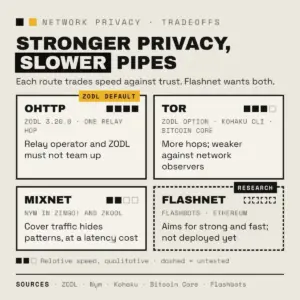
The privacy arc focuses on establishing privacy as a core protocol guarantee, enabling users to hold balances and interact with applications without exposing financial histories or relying on trusted intermediaries. Initial work begins during the Hegotá cycle to deliver native, trustless, and censorship-resistant private transactions on layer-1, with subsequent milestones addressing post-quantum privacy at scale and encrypted mempools.
The state arc addresses state growth and access constraints to prevent them from becoming bottlenecks for the network. Key initiatives include migrating to an improved trie structure, managing sustainable state growth, and enabling decentralized access to historical and current state data, with primary implementation work scheduled for I* and subsequent upgrades.
Finally, the zkEVM arc transitions execution proofs from optional features to mandatory protocol validation, ultimately allowing validators to verify succinct zero-knowledge proofs rather than re-executing every block. While mandatory proofs are tentatively slated for the K* fork, potential reordering options are under review to optimize the deployment of post-quantum consensus features. Regardless of the exact sequence, the push toward layer-1 zero-knowledge verification accelerates formal verification tooling and cryptographic components that benefit the entire research roadmap.
Setting Priorities and Managing the Maturity Pipeline
The foundational mandate guiding the Protocol cluster remains focused on concentrating efforts where only the protocol layer can act, fulfilling the core requirements that preserve Ethereum’s foundational properties. Following the completion of Glamsterdam, the priority framework has shifted to elevate post-quantum readiness and integrate formal verification as a cross-cutting tooling layer supporting all active research arcs.
Ideas enter the mainnet pipeline through a rigorous maturity progression, advancing from initial research and EIP drafting through prototyping, devnets, and progressive signal evaluations among core developers. Each stage requires empirical evidence and risk reduction before subsequent commitments are authorized.
Hegotá as the First Test of Execution
Hegotá represents a crucial test for the protocol cluster’s new scoping methodology. The upgrade’s primary headliners on the consensus and execution layers are Fork-choice enforced Inclusion Lists (FOCIL) and Frame Transactions, respectively, which must be implemented and tested concurrently. Consensus-layer additions beyond FOCIL are strictly limited to ensure that client developers and researchers remain fully available to specify and prototype decoupled consensus for subsequent upgrades.
Hegotá addresses core protocol guarantees across censorship resistance, privacy, and security. FOCIL improves transaction inclusion guarantees by requiring validators to enforce specific inclusion constraints on builder blocks, complemented by profiles that extend these protections to future transaction types. Privacy improvements include keyed nonces to enhance user anonymity and recent on-chain state references that integrate private transactions into inclusion constraints.
Security enhancements are anchored by Frame Transactions, which introduce programmable validation, execution, and gas payment at the protocol level. This framework provides a native migration path away from vulnerable secp256k1 keys, supports signature aggregation, and accommodates new signature schemes without individual hard forks. Additional security measures include transaction assertions via state diff opcodes, code reuse instructions for delegated accounts, and gas floors for adversarial block construction.
The Protocol cluster has released its detailed Hegotá tier list and companion opinion post, providing comprehensive grades and rationales for every candidate EIP. To engage directly with the community regarding these priorities and upgrade plans, the team has scheduled a Reddit AMA on r/ethereum, with public questions collected via community submission forms.
 Ethereum & Smart Contracts
 Ethereum & Smart Contracts
 Ethereum & Smart Contracts