Hyperliquid’s ecosystem has officially entered a new phase with the launch of Elysium, the network’s very first Layer 2 chain. Developed by the Kinetiq team, Elysium is engineered to provide the throughput that the main Hyperliquid architecture deliberately lacks. By filling this infrastructure gap, Kinetiq is betting that a substantial amount of demand for high-speed blockspace has remained untapped within the broader Hyperliquid ecosystem.
While day-one metrics provided immediate evidence of robust user interest, whether Elysium can successfully translate this initial flurry of activity into durable, long-term demand remains a critical question for builders, traders, and investors alike. Understanding the launch requires examining the structural makeup of the network, what is currently live on the chain, and the strategic hurdles it must clear to establish a lasting presence in the competitive decentralized finance landscape.
Why Hyperliquid Needs Another Chain
To understand why Elysium was built, it is necessary to look at how Hyperliquid is architected. The main network effectively operates across two primary layers. The first is HyperCore, a specialized engine that handles the high-performance order books where nearly all spot and derivatives trading takes place. The second is the underutilized HyperEVM, an environment designed to handle smart contracts for applications such as lending markets and decentralized exchanges.
These two layers share consensus mechanisms. Because HyperCore is the most vital component of the entire Hyperliquid stack, the throughput capacity of HyperEVM is intentionally capped. This safeguard ensures that heavy smart contract activity, congestion, or inefficient applications on the EVM can never slow down the core order books. While this design brilliantly protects the core exchange from external network stress, it simultaneously limits the scaling potential of the EVM environment.
High-frequency applications—such as memecoin launchpads, active automated market makers, and automated trading bots—require substantial room to operate efficiently. Given the continued success and prioritization of HyperCore, it was likely going to be a considerable amount of time before the core development team shifted its focus toward expanding the capacity of the EVM layer.
This bottleneck created the opening for Elysium. Designed to target an impressive 300 million gas per second, Elysium boasts roughly 100 times the capacity of HyperEVM. In theory, this provides the broader ecosystem with an execution environment fast enough to support demanding decentralized finance applications, memecoins, and other high-speed onchain activities that HyperEVM simply cannot support. At the same time, the chain settles back to HyperEVM and utilizes the HYPE token for its gas fees, maintaining a structural tie to the native ecosystem.
What’s Live at Launch
That dramatic increase in capacity has already drawn a substantive lineup of protocols to the network. The roster includes several prominent applications that previously passed on deploying to HyperEVM because the operational constraints outweighed the potential benefits.
On the decentralized finance front, Aero, Nest, and Uniswap stand out as the primary protocols live from day one. Meanwhile, the memecoin sector is represented by Ascend, fomo, and Pump.fun, giving traders dedicated launchpads and portals to discover, launch, and trade new tokens at high speeds.
Traders arrived almost immediately following the network’s deployment. In a social media post published just a few hours after launch, Kinetiq co-founder Omnia reported that Elysium had already processed nearly 10 million transactions. During this initial surge, blocks were landing every 50 to 90 milliseconds, placing immense pressure on the underlying infrastructure. Infrastructure provider Conduit was even forced to briefly rate-limit traffic during the first five minutes of operation to maintain stability under the sudden load.
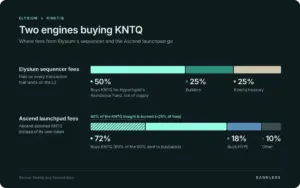
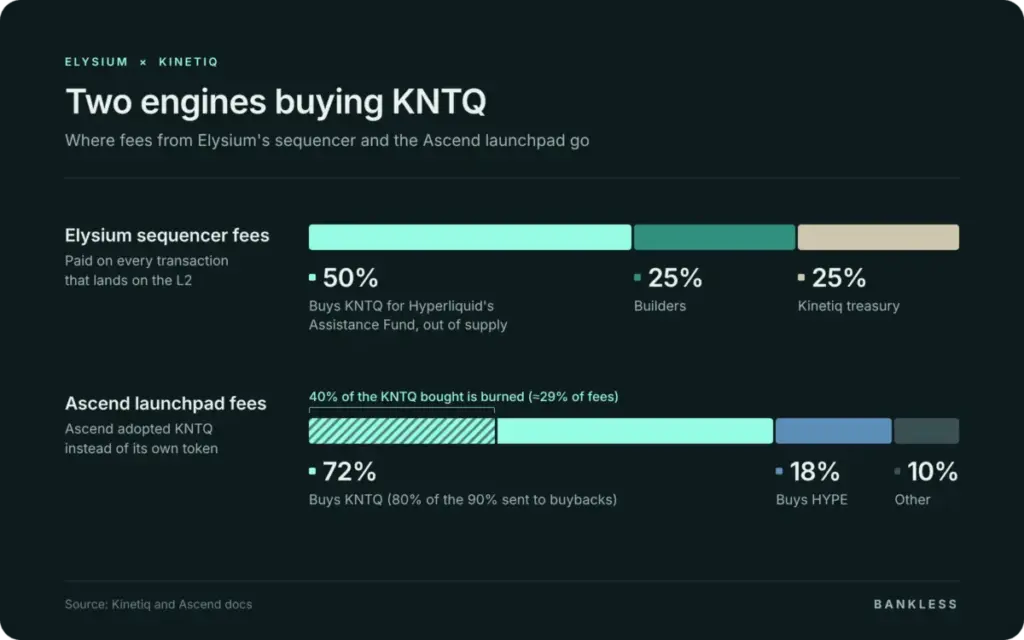
This heavy user activity also creates direct economic value for the Kinetiq ecosystem and its native token, KNTQ. Half of all sequencer fees generated on Elysium are allocated toward purchasing KNTQ tokens on the open market and sending them to Hyperliquid’s Assistance Fund, which permanently removes them from the circulating supply. Additionally, a quarter of these sequencer fees are directed to builders, while the remainder flows into the Kinetiq treasury.
Among the launch applications, the Ascend launchpad plays a particularly vital role for KNTQ because it introduces a secondary source of organic buy pressure. Rather than deploying a distinct token of its own, the launchpad adopted KNTQ. According to its project documentation, Ascend directs 90 percent of its protocol fees into token buybacks, splitting those funds 80-20 between KNTQ and HYPE. Of the KNTQ purchased through this mechanism, 40 percent is permanently allocated to token burns.
In practice, this means that active memecoin trading on Elysium generates both sequencer fees and additional KNTQ purchases funded directly by launchpad revenue.
However, the most significant expansion of Elysium’s functional capabilities is still on the horizon. An upcoming protocol upgrade expected in about four weeks will allow Elysium-hosted applications to read and write directly to HyperCore’s order books. This upcoming integration will open entirely new avenues for decentralized applications to interact natively with Hyperliquid’s core trading infrastructure.
This staggered rollout strategy may ultimately work to the network’s advantage. It gives Elysium time to find its operational footing amid a challenging broader market before another major catalyst arrives to expand what builders can accomplish, which in turn could attract a fresh wave of protocols and liquidity.
The Bull Case
Beyond the initial burst of speculative activity, the primary bull case for Elysium rests on its ability to attract trading volume and liquidity that Hyperliquid would have otherwise missed entirely.
Proponents of this view argue that launching an independent layer does not drain value from the core network. Because HyperEVM fees currently account for less than one percent of Hyperliquid’s total revenue, the HYPE token loses virtually nothing even if Elysium were to absorb all of that transactional volume. Furthermore, additional USDC capital brought into the broader ecosystem through Elysium could potentially expand the reserves that generate revenue for AQAv2—the program Hyperliquid activated in August that automatically channels 90 percent of the yield on its USDC reserves into HYPE buybacks.
The much larger opportunity, according to market observers, lies in capturing trading flow from networks like Solana, which frequently handles 25 to 50 times the spot trading volume of Hyperliquid’s onchain layers. Part of this volume discrepancy exists because HyperEVM has historically been too fast for professional market makers who require ultra-low latency. By establishing a high-performance chain running adjacent to HyperCore, the ecosystem can finally host these professional market participants, with the resulting hedging activity ultimately landing back on Hyperliquid.
There is also a clear opening to attract some of Solana’s more speculative retail activity. Sentiment within the broader crypto market frequently turns hostile toward Solana’s memecoin manufacturing ecosystem due to rapid boom-and-bust cycles.
If those cyclical shifts in sentiment persist, Elysium can successfully position itself as an execution venue that is both exceptionally fast and structurally more positive-sum. On networks where value frequently drains into speculative launches that collapse within minutes, participants often walk away empty-handed. On Elysium, even speculative trading activity generates tangible fees that fund KNTQ buybacks and reward the developers building applications on the network.
What It Still Needs
Attracting an initial wave of speculative traffic is one challenge, but converting that attention into a durable, self-sustaining source of activity will be the ultimate trial for the network.
Market participants readily concede that a short-lived memecoin season can temporarily spike network fees before abruptly fading away. This dynamic is especially important to monitor given KNTQ’s substantial future supply schedule. Starting on November 27, roughly 310 million contributor and investor tokens are scheduled to begin vesting over a two-year period, resulting in monthly token releases equivalent to approximately four percent of the current circulating supply.
Offsetting that incoming token supply will require far more than a transient rush of speculative memecoin trading. Elysium must successfully transition the attention it has captured into lasting, fundamental decentralized finance activity. This necessity highlights why its lineup of established protocols and the forthcoming HyperCore integration are so strategically vital.
Achieving this transition presents its own distinct hurdles. HyperCore already natively supports a rapidly expanding array of financial activities, including lending, borrowing, and high-performance trading. Elysium must clearly demonstrate that its additional blockspace capacity and smart contract flexibility can enable applications that meaningfully expand what users can accomplish with Hyperliquid’s assets and liquidity, rather than merely replicating existing services that are already handled efficiently elsewhere.
Moreover, developers must navigate these challenges within an increasingly hostile digital environment defined by the growing capabilities of automated, AI-assisted exploits and hacks.
Ultimately, day-one metrics strongly suggest that the underlying demand for high-performance blockspace that Kinetiq bet on is very real. However, Elysium’s long-term viability and success will depend entirely on its ability to transform early speculative interest into a secure, useful, and enduring decentralized finance ecosystem capable of generating the sustained transactional activity required to support its tokenomics.
 Tokenomics & Digital Assets
 Tokenomics & Digital Assets
 Tokenomics & Digital Assets