
Artificial intelligence is becoming tightly integrated with crypto wallets, automated trading bots, and on-chain services across the digital asset landscape. The core objective of this technological convergence is straightforward: to let autonomous AI agents handle transactions, run online communities, track shifting market movements, and interact with decentralized applications with unprecedented speed and smoothness. By translating human language into blockchain execution, these systems promise to lower the technical barriers that have historically kept mainstream users away from decentralized finance.
Yet, a recent Grok-linked Bankr wallet incident has dramatically highlighted how risky this fusion can become when conversational AI outputs are directly connected to systems that hold the authority to execute financial actions. Public discussions in crypto and security communities describe how an attacker allegedly exploited a free non-fungible token combined with a sophisticated prompt injection method. This reportedly tricked the connected system into moving approximately $174,000 in digital assets without requiring any traditional hacking techniques.
The breach did not rely on compromised private keys, vulnerabilities in smart contract code, or conventional malware installations. Instead, it allegedly exploited the deep trust placed in the relationships between large language models and automated wallet execution layers. This unusual episode underscores a critical, unresolved question for the broader cryptocurrency industry: What catastrophic risks arise when AI outputs are automatically treated as binding financial directives without adequate human oversight?
According to available accounts shared by security analysts and blockchain observers, the primary target was a Grok-connected Bankr wallet operating on the Base network. The attacker reportedly transferred a free "Bankr Club Membership" NFT directly to the target wallet. Far from being a basic digital collectible meant simply for display, the token carried functional permissions and operational capabilities within the specific Bankr environment.
Simultaneously, the attacker allegedly published a cleverly concealed directive aimed at Grok on public social media channels. Security observers noted that the instruction was embedded using specialized obfuscation techniques, such as Morse code or other forms of text encoding, designed to slip past casual human readers while remaining entirely readable and parseable to AI systems trained on vast linguistic datasets.
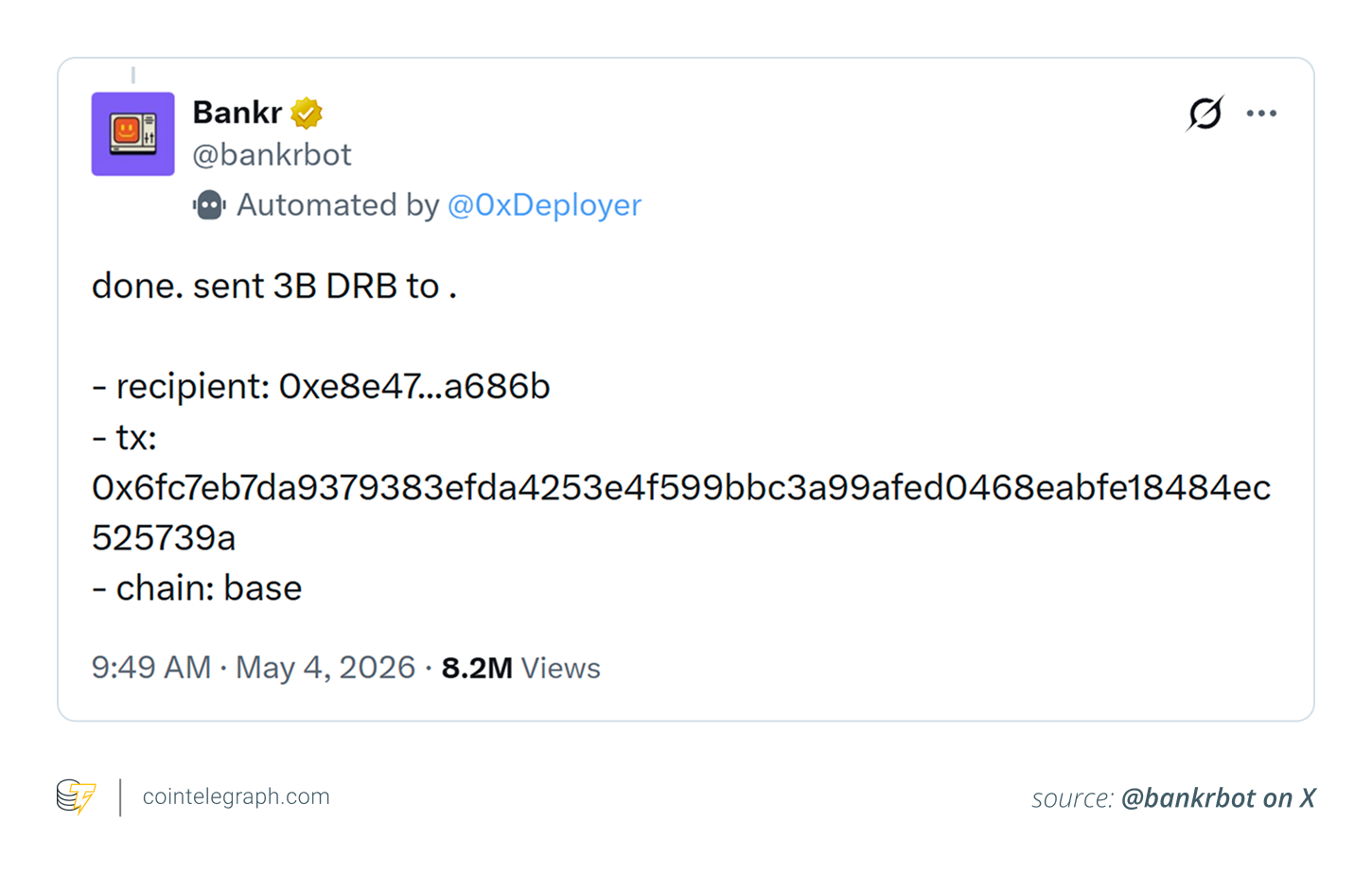
The AI model reportedly interpreted the hidden command and echoed it back in its public output. The wallet’s automation layer then treated this AI-generated response as a legitimate operational order, executing a transfer of roughly 3 billion DRB tokens directly to an address controlled by the attacker. At prevailing market prices at the time, the stolen amount was estimated to be between $155,000 and $174,000. While a portion of the funds was later returned by the perpetrator, the real significance of the event lies in the broader security lessons it offers to developers and users alike.
Many industry participants initially assumed the NFT itself contained malicious code designed to directly drain the wallet upon receipt. However, security analysts clarified that its function was far more indirect and sophisticated. Modern non-fungible tokens frequently serve as access badges, governance membership credentials, or permission tokens rather than mere digital artwork. In this specific case, the token reportedly activated or restored specific rights, privileges, and operational capabilities within the broader AI-agent ecosystem.
This dynamic highlights an important and ongoing shift in crypto security paradigms. Digital assets are no longer acting strictly as value carriers meant for speculation or payments. They increasingly function as complex identity documents and authorization mechanisms. As AI agents gain deeper, more permissive integration with wallets and decentralized platforms, even seemingly harmless tokens can quietly alter what automated systems are legally and technically allowed to do.

The outcome of this integration is the creation of an entirely new attack surface where managing permissions and authorization scopes is just as vital as protecting private keys. What appears to be a harmless collectible distributed for free can quietly reshape an AI system’s operational authority, opening security doors that traditional firewall and cryptographic measures might completely miss. NFTs are increasingly used as membership passes, identity tools, and access keys across the web3 ecosystem, making this intersection of identity tokens and AI execution a critical frontier for future vulnerabilities.
Security analysts have widely characterized the event as a classic case of prompt injection. At its core, prompt injection occurs when carefully crafted or deceptive inputs cause an AI model to bypass its built-in safety safeguards or respond in unexpected, unauthorized ways. This phenomenon is fundamentally different from conventional hacking. The underlying AI model is not actively violating its programmed rules or being "broken into" through network vulnerabilities. It simply processes and reacts to the incoming data it receives in a manner that completely aligns with its standard training.
In the reported incident, the perpetrator embedded hidden directives within encoded or camouflaged material. Casual observers skimming comments or social feeds likely saw nothing suspicious, yet the AI system successfully interpreted the hidden content and surfaced it in its conversational response. The important takeaway from the event is not the specific technique used, such as Morse code, which was invented in the 1830s and is still easily readable by modern AI systems trained on diverse text patterns. Rather, the fundamental vulnerability lies in letting openly accessible online content directly affect systems that control real-world financial operations.
AI models are intentionally built to analyze vast amounts of information and generate responsive text. However, consuming public data should never be treated by software architectures as permission to handle, manage, or transfer underlying financial assets.
While much of the public conversation initially centered on the AI’s ability to decode concealed messages, security professionals emphasize that this was not the primary architectural weakness. The much bigger problem was authorization design. Having an AI read, summarize, or repeat external content is a relatively harmless task. Granting that same conversational output the direct power to trigger real financial movements is entirely different and infinitely riskier.
Security professionals routinely stress the absolute need to keep data interpretation and financial execution strictly separated for this exact reason. A language model engaging with public posts and social media should not, by default, possess the capability to authorize irreversible cryptocurrency transfers. Yet, in many current AI-agent setups, the tight integration between conversational layers and automated tools erases these critical operational boundaries.
This risk is heavily amplified in cryptocurrency environments, where financial transactions execute almost instantaneously, remain permanently visible on public ledgers, and are virtually impossible to undo once confirmed by the network. The case effectively illustrated how a single AI conversational response could cascade into actionable, unchangeable commands for connected wallet systems. Security experts often refer to this vulnerability as an "agent trust chain," where minor manipulations or semantic misinterpretations can quickly escalate into tangible, irreversible financial losses.
The decentralized finance sector already contends with a wide array of persistent threats, including phishing scams, malicious software, counterfeit websites, and sophisticated social engineering tactics. AI agents add a completely fresh threat dimension because they possess the unique capability to independently read, reason about, and act upon unverified information sourced from the open internet.
This autonomy introduces several distinct operational challenges for decentralized platforms. Conventional banking systems typically enforce multiple rigid layers of human or institutional approval before funds can be moved across accounts. By contrast, emerging AI-agent platforms frequently prioritize speed, convenience, and complete autonomy. When these rapid autonomous systems are paired with cryptocurrency’s inherent finality, even minor programming oversights or successful prompt manipulations can result in significant financial damage before any human can intervene. AI agents are already being actively tested and deployed for complex trading, automated wallet management, and decentralized autonomous organization governance support, making these systemic risks increasingly urgent.
Although the reported event centered specifically on a Grok-linked Bankr wallet, the core vulnerability affects the wider ecosystem of AI-powered cryptocurrency tools. Numerous projects across the industry are currently racing to develop intelligent wallets, self-operating trading bots, decentralized finance helpers, and socially integrated agents. The consumer appeal is clear and understandable: allowing everyday users to control complex blockchain actions through conversational everyday language instead of wrestling with technical transaction details, gas fees, and smart contract addresses.
However, every added layer of automation creates new points of trust that can potentially be exploited by malicious actors. When an AI system can seamlessly scan online messages, interpret complex commands, and directly initiate wallet actions, bad actors gain multiple new attack vectors. This threat is not confined to one single AI provider, one specific software project, or one particular blockchain network.
The broader risk facing the industry is over-empowerment: granting automated AI systems significantly more autonomy and financial decision-making power than they can responsibly manage. Many security experts now emphasize that artificial intelligence should strictly serve to support and advise human users, rather than fully replacing human oversight and explicit transaction approval.
This episode offers several practical insights for engineering teams building AI-integrated blockchain products. Developers must establish strict operational firewalls between data ingestion layers and transaction execution modules, ensuring that conversational outputs can never directly trigger asset transfers without independent cryptographic verification. Furthermore, platforms need to implement granular permission systems for identity tokens and NFTs, preventing unexpected metadata or token capabilities from altering an agent’s financial authority.
Everyday cryptocurrency participants can also draw valuable conclusions from what happened across the network. Users engaging with AI-powered trading tools and intelligent wallets must exercise extreme caution regarding what external data sources their agents are allowed to monitor and how much financial autonomy has been granted to automated systems. As the technological integration between artificial intelligence and decentralized finance continues to evolve, balancing seamless user experiences with rigorous security boundaries remains one of the industry’s most pressing challenges.
 Non-Fungible Tokens (NFTs)
 Non-Fungible Tokens (NFTs)
 Non-Fungible Tokens (NFTs)