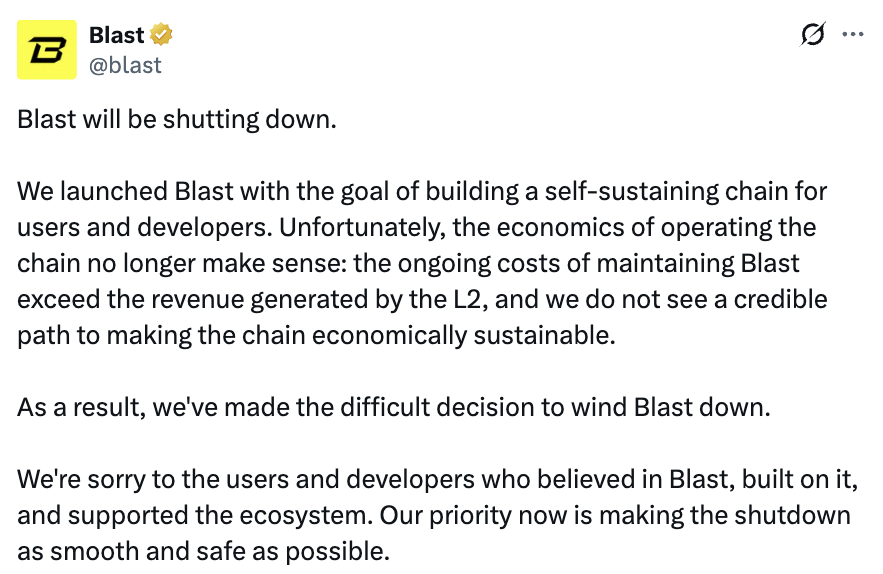
The Ethereum Layer-2 network Blast is officially shutting down its operations after operating costs outstripped the revenue generated by the blockchain network. In an official announcement shared on X on Friday, the Blast team revealed that there is no longer a "credible path" to achieving economic sustainability for the network. Consequently, the platform has urged all users to withdraw their digital assets back to the Ethereum mainnet as the infrastructure winds down its operations.
Reflecting on the unexpected closure, the project team expressed deep regret while addressing their community of supporters and developers. They noted that when Blast was initially conceptualized and brought to market, the primary ambition was to establish a robust, self-sustaining blockchain ecosystem tailored for both users and developers. Unfortunately, the shifting economic realities of running a Layer-2 chain have rendered the business model unviable, forcing the team to make the difficult decision to sunset the network entirely.
As part of the wind-down process, Blast is actively reducing its standard withdrawal delay to a much shorter 24-hour window. However, the platform cautioned that withdrawals will be temporarily unavailable while the network safely unwinds its underlying Lido assets—a complex technical process that is anticipated to take approximately one week to complete.
Users have been provided with a strict deadline of October 26 to execute their withdrawals smoothly through the standard Blast web interface. Following this date, user assets will technically remain accessible on the chain, but retrieving them will require interacting directly and manually with the underlying Blast bridge contracts deployed on the Ethereum mainnet. To assist users with this technical transition, Blast management has promised to publish comprehensive instructions detailing how to interact directly with the bridge contracts ahead of the October 26 cutoff date, while strongly encouraging everyone to move their capital back to the Ethereum mainnet well before the deadline arrives.
Blast Emerged From Blur’s NFT Boom
The origins of Blast trace back to the explosive growth of the non-fungible token (NFT) sector and the success of Blur, a prominent professional-grade NFT marketplace. Blast was founded by Tieshun "Pacman" Roquerre, the visionary developer behind Blur. Blur officially launched in October 2022 with a strategic focus on catering to high-volume, professional NFT traders by offering lucrative token incentives and advanced trading tools. By the end of 2022, Blur had successfully disrupted the market hierarchy by surpassing the then-leading marketplace, OpenSea, in total trading volume. Blur further cemented its dominance throughout early 2023, largely propelled by its aggressive token airdrop campaigns and trader reward structures.
Riding the wave of this momentum, Roquerre unveiled the concept for Blast in November 2023. The Layer-2 network was pitched with an innovative value proposition: offering native yield on deposited Ether and stablecoins, alongside a gamified points program tied to an eagerly anticipated token airdrop. This clever viral marketing and incentive strategy proved wildly successful, attracting an astonishing influx of more than $2 billion in total deposits before the network’s mainnet even officially launched to the public in February 2024.
However, despite its explosive initial adoption and billions in locked capital, Blast’s meteoric growth proved exceptionally difficult to maintain over the long term. The network quickly encountered severe headwinds amid a broader, prolonged market downturn within the broader NFT sector and shifting decentralized finance (DeFi) yields. According to comprehensive data tracked by DeFiLlama, Blast’s DeFi total value locked has suffered a catastrophic decline, falling by more than 98% from its all-time high of roughly $2.2 billion recorded in June 2024.
The broader ecosystem surrounding the founders has faced similar contraction. Blur, the flagship NFT marketplace that spawned the Blast ecosystem, has undergone a parallel downturn. At its peak in early 2024, Blur’s total value locked surged past the $200 million mark. In the wake of shifting market conditions and declining trading volumes across the digital collectibles landscape, Blur’s total value locked has since plummeted, currently standing at approximately $27 million.
 Non-Fungible Tokens (NFTs)
 Non-Fungible Tokens (NFTs)
 Non-Fungible Tokens (NFTs)