
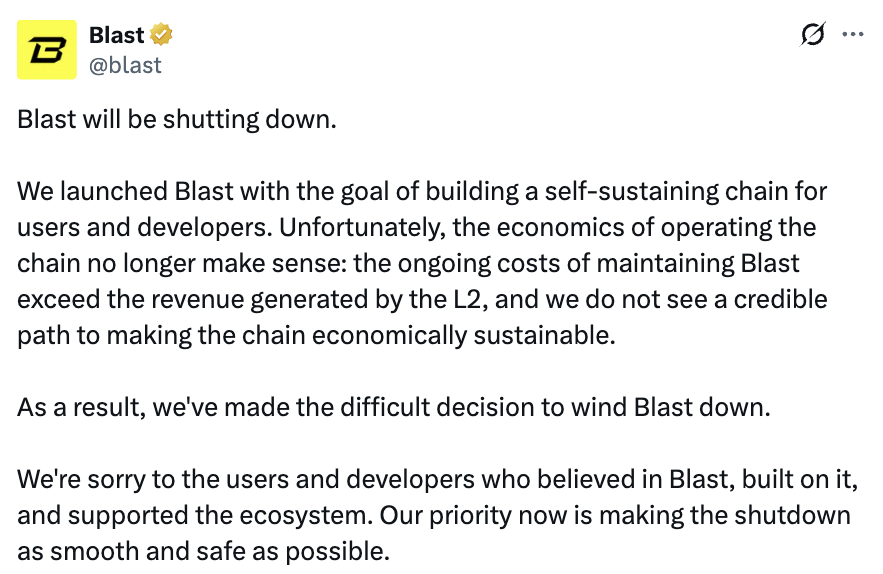
Ethereum layer-2 network Blast is officially shutting down its operations after discovering that the ongoing operating costs required to maintain the chain have severely exceeded the actual revenue generated. In an official announcement shared on Friday through a post on the social media platform X, the Blast team revealed that they currently see no "credible path" toward making the network economically sustainable over the long term. Consequently, the protocol has urged all users to withdraw their digital assets back to the Ethereum mainnet as the network begins its systematic wind-down process.
"We launched Blast with the goal of building a self-sustaining chain for users and developers," the team stated in their public address. "Unfortunately, the economics of operating the chain no longer make sense."
As part of the shutdown procedure, Blast has announced that it will reduce its standard withdrawal delay period to just 24 hours. However, withdrawals will be temporarily unavailable for a brief period while the network unwinds its underlying Lido assets, a technical process that the team estimates will take approximately one week to fully complete.
Users have been provided with a definitive deadline of Oct. 26 to execute their withdrawals seamlessly through Blast’s official user interface. After this date passes, user assets will technically remain accessible on the chain, but retrieving them will require users to interact directly with the underlying Blast bridge contracts deployed on the Ethereum mainnet. To assist with this transition, Blast has promised to publish detailed instructions ahead of the Oct. 26 cutoff, reiterating its strong recommendation for participants to move their funds back to the Ethereum mainnet well before the deadline arrives.
Blast Emerged From Blur’s NFT Boom
The origins of Blast trace back to the rapid rise of Blur, the prominent non-fungible token marketplace founded by Tieshun “Pacman” Roquerre. Blur originally launched in October 2022 with a strategic focus on catering to professional and high-frequency NFT traders by leveraging aggressive token incentives and airdrop promises. This calculated approach allowed Blur to fiercely challenge established market leaders such as OpenSea. By the end of 2022, Blur had successfully surpassed OpenSea in total trading volume, extending its dominance further into early 2023 through continuous token distributions and trader reward structures.
Riding the wave of this early success, Roquerre unveiled the concept for Blast in November 2023. The layer-2 scaling network was heavily marketed around innovative features, including native yield generation capabilities for Ether (ETH) and stablecoins, alongside a gamified points program designed to tease an anticipated future token airdrop. This clever marketing and incentive strategy proved extraordinarily effective at capturing the attention of the broader decentralized finance community, helping the network attract more than $2 billion in total deposits even before its official mainnet went live in February 2024.
Despite the initial wave of enthusiasm and massive capital inflows, maintaining Blast’s rapid growth trajectory ultimately proved difficult as the broader cryptocurrency market experienced a prolonged and severe downturn in the non-fungible token sector. The network’s decentralized finance total value locked has declined steadily from its impressive peak of roughly $2.2 billion recorded in June 2024. According to tracking data from DeFiLlama, the network’s TVL has fallen by more than 98% since that high-water mark, reflecting a steep erosion of user engagement and liquidity over the subsequent months.
Blur, the sister project that initially fueled Blast’s meteoric rise, has faced a strikingly similar downward trajectory. The total value locked on the Blur marketplace platform, which climbed above $200 million during its early-2024 peak, has similarly contracted and now stands at approximately $27 million, illustrating the challenging economic realities facing high-incentive decentralized applications and scaling solutions in the current market environment.
 Non-Fungible Tokens (NFTs)
 Non-Fungible Tokens (NFTs)
 Non-Fungible Tokens (NFTs)







