As the digital asset market continues to navigate a complex macroeconomic and technical landscape, market participants are weighing divergent paths for Bitcoin’s medium-term trajectory. Recent technical assessments, notably through the lens of Elliott Wave theory alongside macro and on-chain indicators, highlight a critical juncture for the world’s leading cryptocurrency. Analysts point out that while short-term holders face mounting pressure, the broader market structure maintains key supports, leaving traders divided over whether a deeper corrective phase lies ahead or if a new impulsive advance is already taking shape.
To better understand these possibilities, market observers frequently map out alternative wave interpretations to evaluate potential risk-reward profiles rather than relying on deterministic forecasts. Within this analytical framework, two primary scenarios continue to dominate discussions among technical analysts tracking market cycles.
Elliott Wave Scenarios: Weighing the Bearish Correction Against a Bullish Rebound
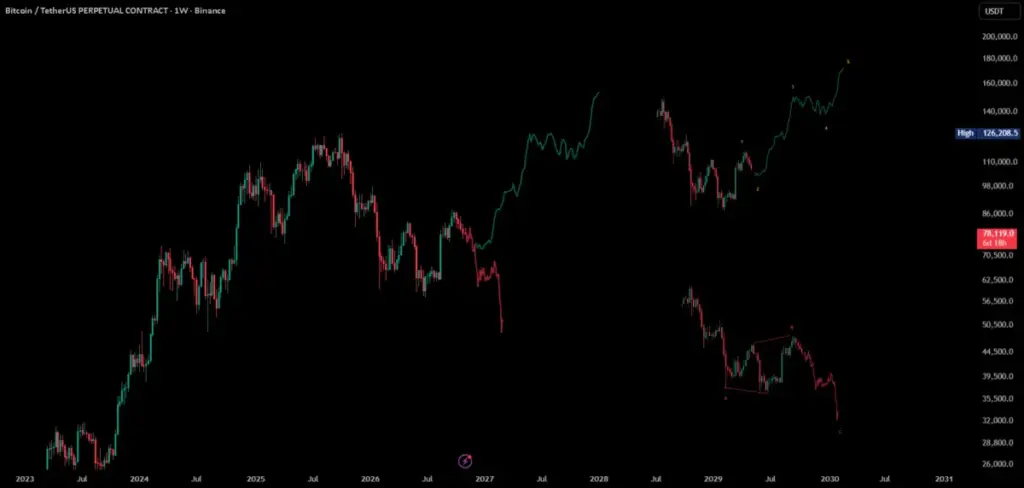
The prevailing base-case interpretation leans toward a larger corrective structure. Under this perspective, the notable descent from the cycle high near the 126,000-dollar mark down into the projected 2026 low is classified as wave A within a broader A-B-C correction. Following this initial impulsive decline, the subsequent recovery phase toward the 87,000-dollar region is categorized as a complex B-wave retracement.
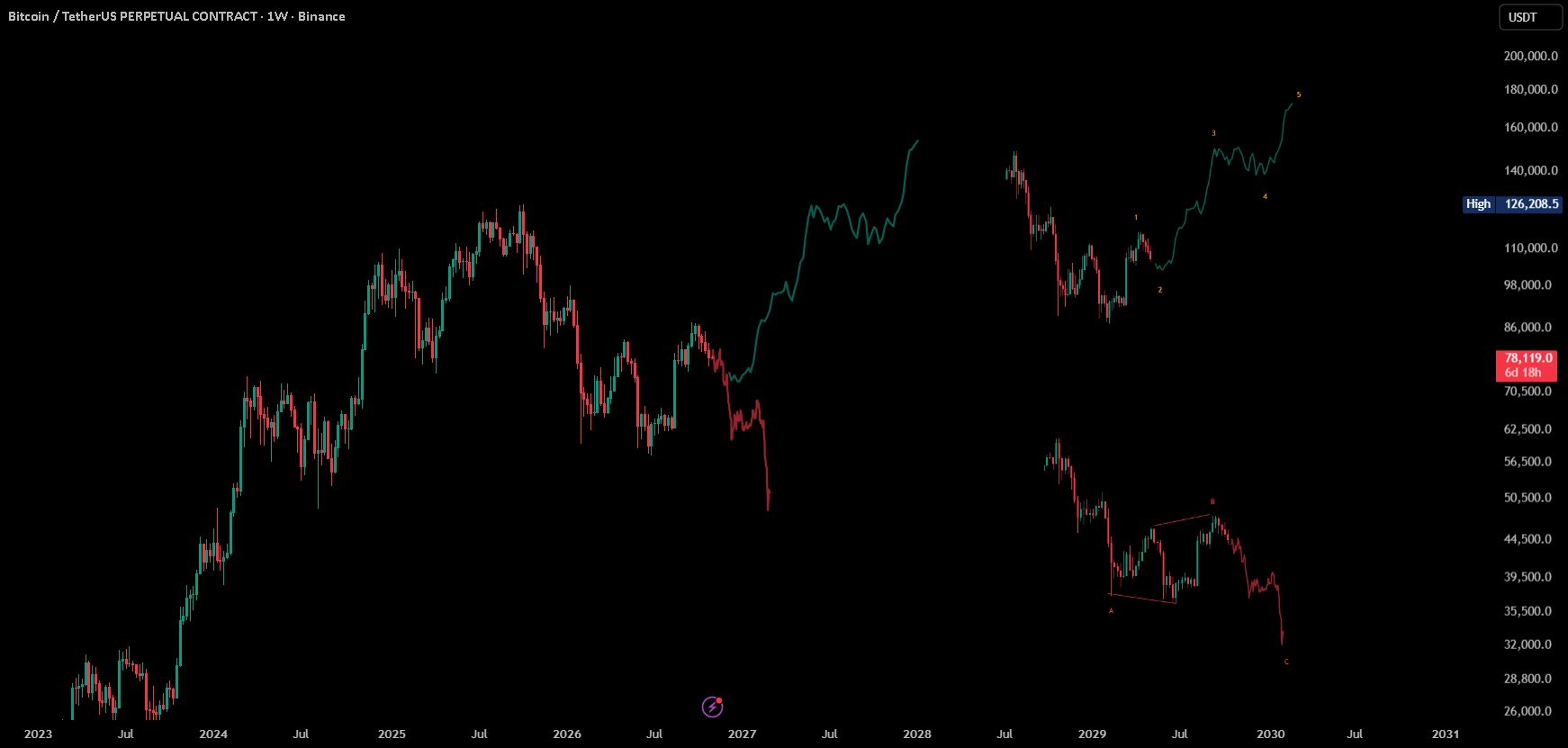
Proponents of this bearish outlook suggest that if this structure holds, a final corrective wave C remains a distinct possibility. Within this scenario, the primary target area of interest spans the 48,000 to 50,000-dollar region. Notably, this prospective downside zone broadly aligns with the estimated long-term-holder realized-price region, offering a historical accumulation zone that has often served as a robust structural floor during previous market cycles.
Conversely, an alternative bullish interpretation proposes that the macro correction may have already concluded near the 57,800-dollar threshold. Under this count, the market has finished its corrective phases and is currently developing a new impulsive advance. For this optimistic outlook to gain broader validation, analysts note that a sustained recovery surpassing the previous recovery high would be necessary. Furthermore, a decisive daily or weekly close above the 87,000-dollar threshold would directly challenge the prevailing bearish lower-high structure, effectively invalidating or significantly weakening the base-case corrective narrative. On the flip side, any ongoing failure to reclaim key cost-basis levels leaves this alternative bullish thesis vulnerable to sudden shifts in momentum.
Macroeconomic Headwinds and Restrictive Financial Conditions
Beyond technical wave counts, the broader macroeconomic backdrop continues to present a challenging environment for risk assets, including cryptocurrencies. Monetary policy decisions from the United States Federal Reserve remain a focal point for institutional investors and macro analysts alike.
During its October meeting, the Federal Reserve opted to maintain its benchmark target interest rate within the 3.75 to 4.00 percent range. Despite holding rates steady, persistent inflation metrics continue to keep central bank officials vigilant. Notably, internal divisions within the Federal Open Market Committee (FOMC) were evident, with two members favoring a 0.25 percentage-point rate increase to further combat stubborn price pressures.
This cautious monetary stance has reverberated across traditional fixed-income markets, directly influencing digital asset valuations. By the end of October, the 10-year United States real yield hovered around 2.6 percent. Sustained positive real yields maintain restrictive financial conditions, increasing the opportunity cost of holding non-yielding assets like Bitcoin. Consequently, the combination of elevated interest rates, persistent inflation concerns, and cautious institutional capital flows creates a persistently restrictive macro climate that weighs on aggressive upside momentum.
On-Chain Dynamics: Short-Term Holder Pressure and Aggregate Resilience
Complementing the macroeconomic and technical analysis, on-chain metrics offer a granular look at capital flows, holder profitability, and aggregate network behavior. Current data reveals a landscape defined by localized weakness among recent market participants, contrasted with overall stability across the broader holder base.
The short-term-holder realized price currently sits at approximately 75,700 dollars, with Bitcoin trading only modestly above this crucial threshold. Accompanying this metric, the short-term-holder market-value-to-realized-value (STH-MVRV) ratio has compressed toward 1.02. This compression indicates that market participants who acquired coins recently retain very little unrealized profit cushion, leaving them highly sensitive to near-term price fluctuations.
Further illustrating this localized vulnerability, the Spent Output Profit Ratio (SOPR) has slipped below the critical 1.0 level. This movement signifies that coins being moved on-chain are, in aggregate, realizing losses as short-term traders capitulate or reallocate holdings under duress. However, despite this acute pressure on recent buyers, the broader market continues to trade well above its aggregate realized price, which sits at approximately 54,000 dollars, with the overall network MVRV resting around 1.43.
These conflicting signals suggest that while short-term holders are increasingly under stress, the wider market has not experienced a broad, systemic capitulation event. While the long-term-holder realized-price band situated between 48,000 and 50,000 dollars remains an essential long-term reference point for macro analysts, on-chain data emphasizes that this zone serves as a structural area of interest rather than a guaranteed absolute market floor. As technical setups and fundamental drivers continue to evolve, market participants remain closely divided on whether Bitcoin will retest lower support regions or successfully establish a durable foundation for its next major advance.
 Crypto Investing & Trading
 Crypto Investing & Trading
 Crypto Investing & Trading