As the broader cryptocurrency market absorbs the heavy shockwaves of a massive $6.3 billion security breach at Binance, the underlying dynamics of the Bitcoin network continue to tell a complex, dual-sided story. Bitcoin miners closed the books on October with their highest monthly revenue generation since November 2025, delivering a surprisingly lucrative period for the industry on paper. However, this headline-grabbing financial milestone masks a severe underlying deterioration in operational profitability. Driven downward by falling asset prices in the wake of the exchange hack, the network’s hashprice has suffered a brutal correction, shedding nearly 18% of its value in just thirty days and placing mounting pressure on profit margins across the sector.
Bitcoin Mining Hashprice Slides 17.54% as Profit Margins Tighten
To understand the precarious balance currently facing the mining industry, one must examine the behavior of the hashprice—a critical mining profitability metric that measures the estimated daily revenue generated per unit of computational power. Typically expressed in U.S. dollars or satoshis per terahash or petahash per day, this figure serves as the primary barometer for the health of mining operations worldwide.
On October 1, 2026, the economic reality for operators was considerably brighter. Data from hashrateindex.com indicates that each petahash per second (PH/s) of active mining power generated an estimated $40.24 in daily revenue. By November 1, however, that figure had dwindled to $33.18. This steep 17.54% decline is directly tied to the severe market turmoil that battered bitcoin prices following the multi-billion-dollar security incident at Binance, which effectively dismantled the momentum of what traders had optimistically hoped would be a strong autumn market rally.

Despite this sharp contraction in per-unit profitability, the network’s macroeconomic infrastructure remains remarkably robust. The total computational power securing the Bitcoin network—known as the hashrate—stands resiliently at 1082.24 exahash per second (EH/s). Meanwhile, the network continues to maintain its algorithmic equilibrium, with average block times hovering steadily around 9 minutes and 52 seconds. While the broader cryptocurrency market downturn has thus far failed to trigger a catastrophic offline stampede of machines, increasingly compressed profit margins are quietly setting the stage for a much stiffer test of financial endurance for operators operating on tighter margins.
October Mining Revenue Hits $1.215 Billion Despite Bitcoin’s Market Decline
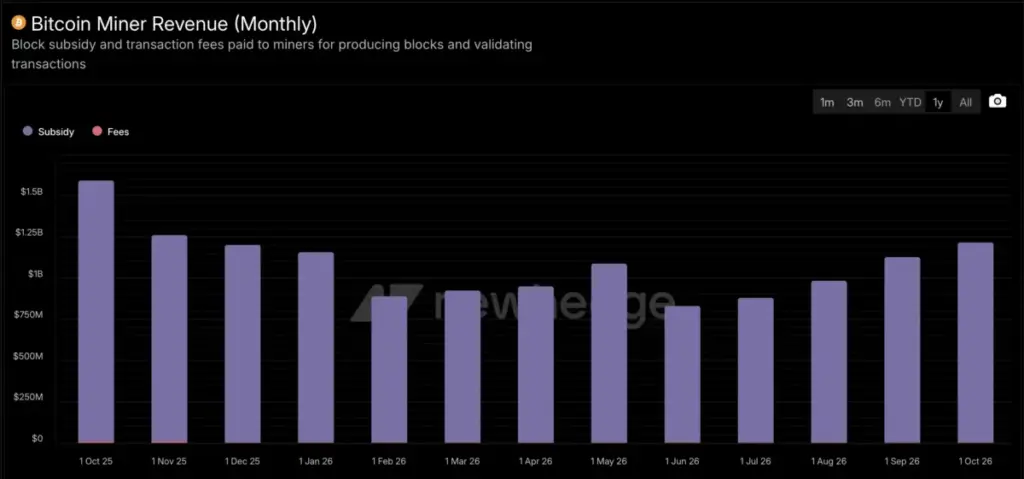
The paradox of the current market environment is starkly illustrated by the total revenue figures logged throughout October. Even as bitcoin prices slumped—capping off a dismal month that marked one of the worst October finishes for the digital asset since 2014 with an overall 7.3% price decline—miners managed to secure their most financially rewarding month in nearly a year.
According to comprehensive monthly mining revenue records sourced from newhedge.io, which track the industry’s performance over a rolling twelve-month period, miners collectively generated a staggering $1.215 billion between October 1 and October 31. This performance places October 2026 near the upper echelon of recent historical revenue cycles. For comparison, November 2025 logged a total of $1.26 billion, while the subsequent month of December 2025 saw miners bring in approximately $1.20 billion.

This juxtaposition highlights a fundamental characteristic of the Bitcoin protocol: while exchange security failures, macroeconomic shifts, and high-profile hacks can severely unsettle market sentiment, instantly erode market liquidity, and dent short-term investor confidence, they leave Bitcoin’s predetermined, immutable block issuance schedule entirely undisturbed. The network continues to mint new bitcoin at its set programmatic rate regardless of external market sentiment or the financial health of individual corporate entities.
In response to these cyclical pressures, mining economics typically unfold through a predictable, time-tested mechanism. When a deteriorating hashprice compresses profit margins, inefficient machinery and older-generation hardware are quickly rendered unprofitable, forcing high-cost operators to power down their rigs. This subsequent reduction in active hashrate triggers automated mining difficulty adjustments, which in turn alleviate financial pressure on the network. The surviving operators then secure a larger proportion of the ongoing block rewards, stabilizing the ecosystem until the next major market shift occurs.
Ultimately, the central question confronting the bitcoin mining industry is not whether infrastructure can physically survive another major market shock, but precisely how much financial punishment individual operators can absorb before their overarching business models become entirely untenable. October proved to be a surprisingly lucrative chapter for bitcoin miners, but as profit margins continue to tighten under the weight of declining hashprices, November may well introduce an entirely different set of operational challenges.
 Bitcoin & Major Altcoins
 Bitcoin & Major Altcoins
 Bitcoin & Major Altcoins