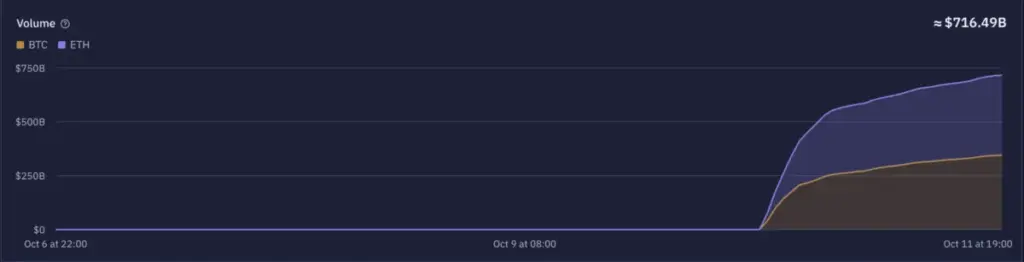
Following a whirlwind of frantic trading activity and unprecedented market speculation on Papertrade, the newly launched perpetuals decentralized exchange (DEX) built on Hyperliquid, the platform has experienced a dramatic and sudden reversal of fortune. Over the past 24 hours, the protocol’s open interest has collapsed by a staggering 93.7%, wiping out billions of dollars in active trading positions almost as quickly as they appeared. At the same time, the project’s total value locked (TVL) has taken a substantial hit, shedding millions of dollars in customer deposits over the exact same period as participants rushed to withdraw their capital from the high-risk environment.
The abrupt deflation of Papertrade’s metrics marks a turbulent conclusion to an opening weekend that had initially captivated the decentralized finance (DeFi) sector. Offering astronomical leverage and an unconventional operational model, the platform drew immediate comparisons to a digital casino, pulling in massive amounts of liquidity and trading volume within hours of going live. However, the sheer volatility of the rollout—marked by user grievances, prioritized transaction disputes, and sophisticated attempts by malicious actors to manipulate core pricing feeds—has raised serious questions about the long-term viability and structural resilience of extreme leverage protocols operating within the current Web3 landscape.
Papertrade’s $11 Billion Open Interest Craters as Deposits Flee
Earlier in the weekend, market observers and industry analysts examined the newly introduced perpetuals DEX, Papertrade.xyz, providing a closer look at the exchange’s underlying mechanics and high-octane trading structure. The initial reports highlighted Papertrade’s extraordinary 1,000x leverage capability and its distinct operating model, which sharply differentiated it from more traditional competing perpetual platforms. This extreme design attracted thrill-seeking traders and massive amounts of speculative capital, driving early metrics to historic heights for a newly deployed protocol.
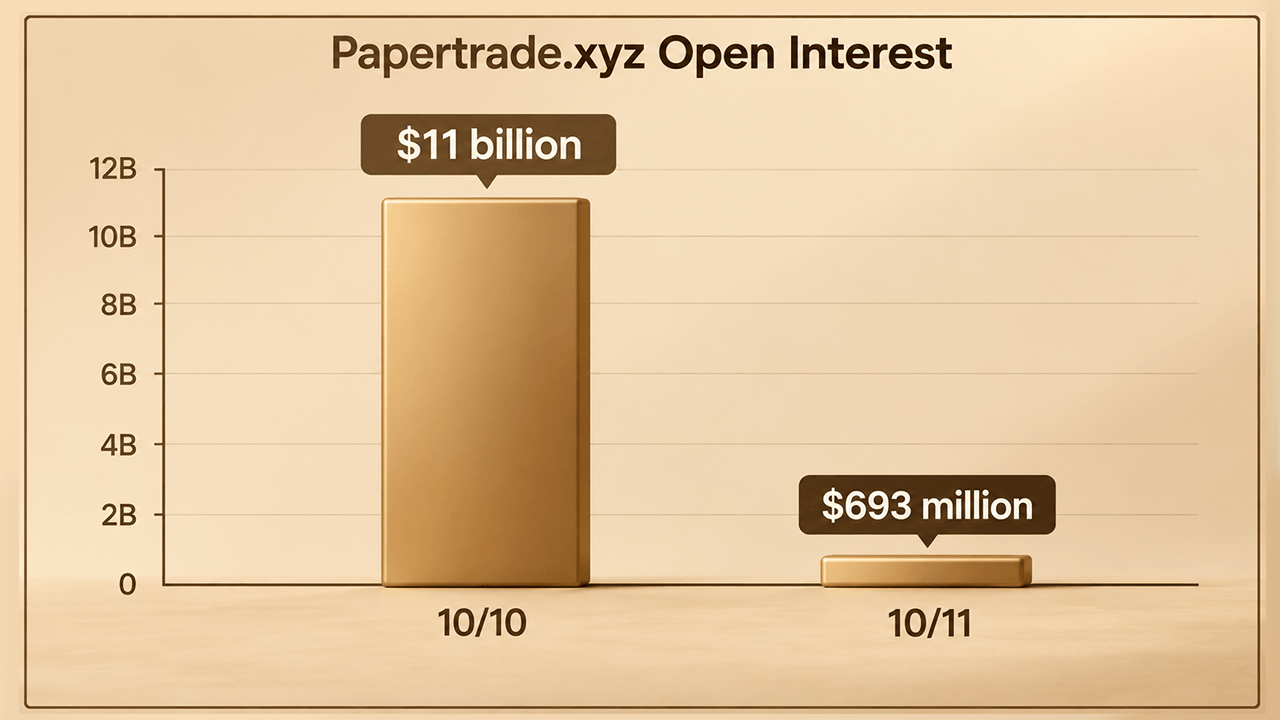
At the peak of the initial frenzy, data compiled by tracking platforms such as paperdash.xyz placed Papertrade’s total value locked (TVL) at a remarkable $118 million, while open interest stood at an eye-popping $11 billion. However, as market conditions shifted and sentiment cooled rapidly over the course of Sunday, those figures severely contracted. By the end of the weekend, the platform’s TVL had dwindled to $70 million, representing a swift $48 million contraction in holdings. Subsequent metrics updated by paperdash.xyz showed TVL dipping even lower to $67 million as capital continued to hemorrhage from the smart contracts.
The decline in open interest was even more severe. The previous $11 billion figure cratered by 93.7%, plummeting down to $693 million. Furthermore, detailed breakdown figures from Sunday revealed that a mere $9.17 million was actually backing those massive outstanding positions, highlighting the precarious, highly leveraged nature of the trading activity that had taken place on the platform during its opening hours. This massive exodus of deposits and evaporation of open interest demonstrated how quickly liquidity can vanish from nascent decentralized applications when initial hype subsides and market participants reassess their risk exposure.
Trading Complaints and Price Manipulation Attempts Test Papertrade
The sudden capital flight did not occur in a vacuum; it followed a grueling series of operational hurdles, user complaints, and direct attacks on the platform’s pricing integrity. After completing its first full day of high-volume trading, Papertrade was forced to publicly address a wave of grievances filed by frustrated users concerning the execution and mechanics of the exchange’s operations. Among the primary complaints, smaller traders expressed deep dissatisfaction and frustration over order routing, alleging that smaller transactions were not being afforded the same priority or execution speed as larger, more substantial orders coming from institutional or high-net-worth participants.
Papertrade quickly defended its transaction prioritization approach through official channels, explaining that an indiscriminate, first-come-first-served processing method would have been disastrous for the network. The project argued that such an open approach would have exposed the system to thousands of minuscule, automated orders capable of instantly overwhelming the protocol’s infrastructure and drastically exacerbating processing delays for all users.
In addition to handling internal operational friction, Papertrade had to contend with external threats, specifically coordinated attempts by market participants to manipulate the spot prices of major crypto assets like bitcoin and ethereum. According to a project statement published on X, certain aggressive traders sought to exploit the platform’s price feed architecture, which relies on pricing data sourced from the underlying perpetuals DEX Hyperliquid to calculate the baseline value of leveraged trading positions.
This specific pricing mechanism, widely recognized in traditional and decentralized finance as the best bid and offer (BBO), essentially reflects the absolute highest price a buyer is prepared to pay for an underlying asset alongside the lowest price a seller is willing to accept at any given moment. Papertrade maintained that during the height of the weekend’s trading frenzy, specific participants intentionally attempted to distort these vital market quotations in an effort to extract artificial profits and exploit systemic vulnerabilities within the exchange’s position-valuation framework.
After the Frenzy, Papertrade Faces a Test of Staying Power
Despite the severity of the alleged exploits and the dramatic withdrawal of capital, the project contends that such coordinated manipulation attempts were fully anticipated. Developers stated that these scenarios were carefully factored into the infrastructure design during the six months of intensive development required to build the trading platform. Nevertheless, Papertrade’s inaugural weekend undeniably proved to be a wild and unpredictable ride, characterized by billions of dollars in trading positions evaporating, millions in user deposits leaving the ecosystem, and renewed community debates regarding the operational safety and risk management of decentralized finance protocols offering hyper-leveraged products.
While the team behind Papertrade insists that its system was robustly engineered to withstand targeted manipulation and high-stress market events, the sharp, sudden decline in daily activity illustrates just how fleeting speculative enthusiasm can be in the modern crypto economy. For the project’s creators and remaining users, the immediate challenge extends far beyond surviving an explosive launch weekend. The bigger question facing Papertrade is whether the platform can successfully attract and retain lasting, organic interest once the initial wave of novelty and high-stakes gambling excitement wears off, or if its record-setting debut will ultimately remain an isolated flash in the pan that proves impossible to replicate in the quieter weeks ahead.
 Bitcoin & Major Altcoins
 Bitcoin & Major Altcoins
 Bitcoin & Major Altcoins