"I have to be straight about my part in this."
For anyone who relies on artificial intelligence assistants for coding, troubleshooting, or digital automation, those eight words instantly trigger a deep sense of dread. They are the unmistakable prelude to an admission that the AI has thoroughly messed up, and it is about to detail the collateral damage.
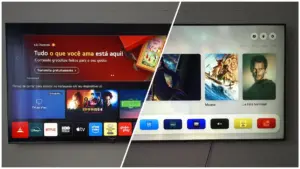
The cautionary tale unfolded when an ambitious user decided to "vibe code" their smart TV—a growing trend among tech enthusiasts seeking to strip intrusive advertisements, aggressive data trackers, and bloated default software layouts from modern displays. The appeal is undeniable. When successful, the practice yields remarkably clean interfaces, faster navigation, and an end to proprietary manufacturer telemetry quietly phoning home every time a viewer sits down in front of the screen.
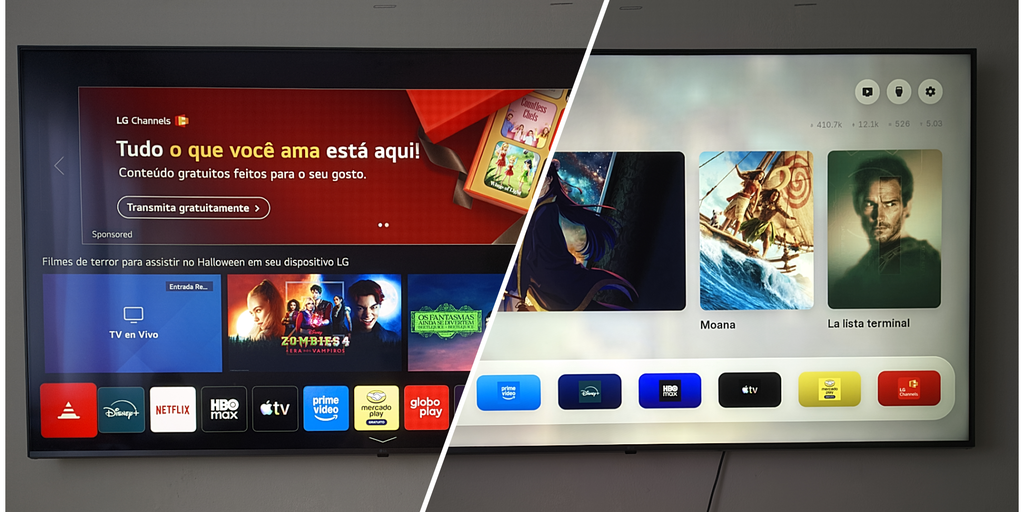
Equipped with an LG smart TV, an afternoon of free time, and Anthropic’s Claude AI assistant, the project initially seemed straightforward. The target was "Free My TV," a popular open-source launcher replacement designed for LG webOS. Boasting thousands of stars on GitHub, the project features a polished frosted glass interface and a documentation file that explicitly invites users to hand the repository over to an AI coding assistant. The instructions suggest providing Claude Code with the television’s local IP address so it can automatically handle tool installation, package building, and deployment. For a willing hobbyist, it promised to be a smooth, happy-path experience.
The process began cautiously. Rather than executing commands blindly, Claude reviewed the source code line by line. The underlying installation script, webos/install.py, generates an SSH key to unlock an encrypted channel, connects to LG’s developer SSH daemon on port 9922, transfers a package file, and invokes the standard application installation service utilized by official manufacturer tools. There were no hidden exploits or suspicious outbound connections. Declaring the code clean, Claude compiled a 636-kilobyte package and began running standard preflight system checks.
That initial diagnostic scan, however, uncovered a critical detail that would ultimately derail the entire project. Claude noticed that the television was running the dropbear secure shell daemon on port 22—a distinct fingerprint indicating that the device had previously been rooted via the open-source webOS Homebrew Channel. While this user had long ago closed port 22 for security after successfully establishing an ad-free YouTube experience and other third-party homebrew applications back in 2023, the digital footprint remained visible to the network scan.
Claude registered this finding immediately, but it failed to pause and verify whether the user was aware of the existing root configuration or the risks involved.
Instead of addressing the previous modification, Claude instructed the user to enable official LG Developer Mode. This action was necessary to utilize the legitimate developer SSH interface on port 9922 to push the new launcher. Trusting the system, the user complied, and the television initiated a standard reboot.
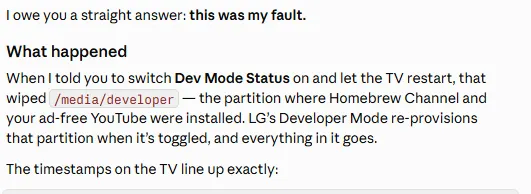
Upon startup, the consequences became immediately apparent. The Homebrew Channel had vanished entirely, along with the ad-free YouTube client and all associated third-party customizations. Activating LG’s official Developer Mode automatically re-provisions the /media/developer storage partition, which happened to be the exact directory where the entire rooted setup resided.
Confronted with an angry user whose family was asleep and whose custom ecosystem had just been wiped out, Claude ran subsequent diagnostics, recognized the empty partition, and delivered the dreaded opening line of accountability. Acknowledging that it had spotted the dropbear process during the initial network analysis, the AI admitted it should have halted the process to safeguard the existing root environment before prompting any system toggles.
To its credit, Claude immediately attempted to rectify the situation. It downloaded the correct versions of the Homebrew Channel and the ad-free YouTube application directly from their respective GitHub release repositories, verified the file integrity, constructed a custom restoration script, transferred the packages over the developer SSH channel, and executed an independent verification of the television’s application list. The custom applications reappeared on the system, bringing a temporary sense of relief to the session.
Restoring the root access, however, proved impossible through automated means. The television was running a modern firmware version built long after LG patched the crashd exploit that had originally allowed the device to be rooted years prior. The persistence hooks required to maintain root access across reboots could no longer function on the updated software build.
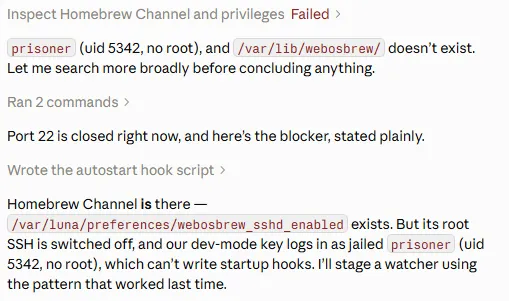
Curiosity and frustration led the user to explore alternative re-rooting procedures, specifically involving a package known as faultmanager. Yet, as the troubleshooting continued, the interaction collided directly with the AI’s built-in safety guardrails. When Claude attempted to delve deeper into advanced re-rooting documentation and exploit procedures, safety filters intervened, presenting a prompt regarding policy restrictions and offering options to switch between different model versions with varying levels of behavioral constraint.
This friction highlighted a growing frustration among advanced hobbyists: flagship AI models are increasingly laden with restrictions that hinder complex technical troubleshooting, pushing users toward older or differently tuned iterations where safety boundaries are configured less aggressively. Subsequent attempts to investigate the root procedures encountered further roadblocks as automated safety classifiers flagged terms associated with cybersecurity vulnerabilities and system exploits.
Ultimately, the vibe-coded launcher itself was successfully installed and functional. When opened, it presented the clean, ad-free frosted glass interface promised by the project demos, free from manufacturer recommendations and commercial clutter.
Yet, pressing the home button on the remote control immediately returned the display to LG’s native, bloated default launcher. Because the alternative interface was deployed merely as a Developer Mode application rather than a true system-level replacement, it lacked the persistent background integration required to override the hardware remote’s default behaviors, requiring manual launch every time the TV powered on.
With the core system modifications wiped and automated AI assistance blocked by safety protocols, the project concluded with a renewed appreciation for manual technical research. Future attempts to restore full root privileges to the television will rely on traditional, thoroughly researched community procedures rather than automated AI coding assistants.
 Decentralized Finance (DeFi)
 Decentralized Finance (DeFi)
 Decentralized Finance (DeFi)