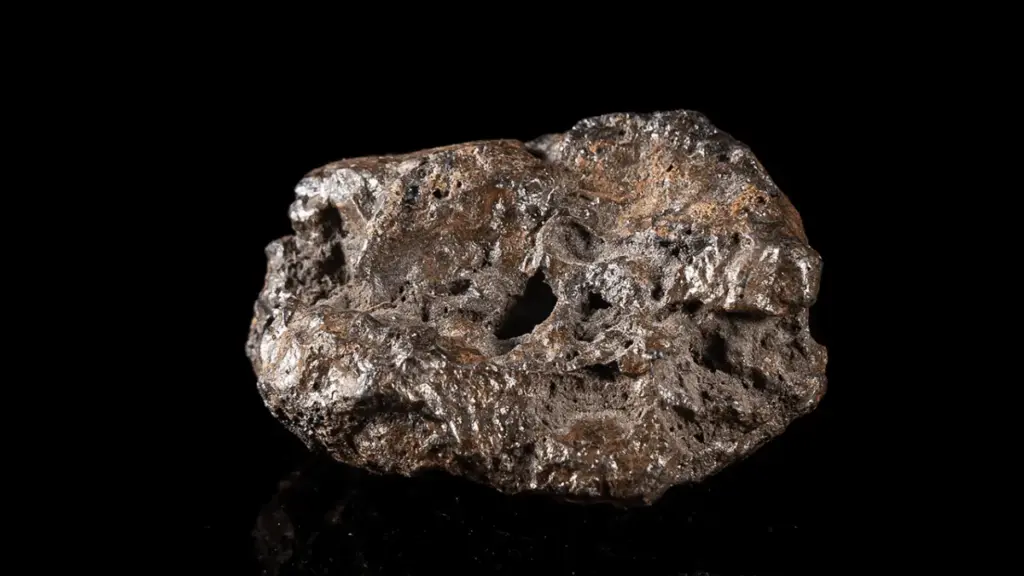
For decades on a quiet farm near Edmore, Michigan, a heavy, unassuming lump of metal performed a remarkably unglamorous job: keeping a heavy barn door from swinging shut. The object, which dated back to a dramatic celestial event in the 1930s, was passed along quietly with the property when it changed hands in 1988, and even made the rounds as a roadside curiosity at local schools. Yet, despite its extraterrestrial origins, the heavy rock remained hiding in plain sight, treated as little more than a convenient piece of heavy hardware.
It took a fiery meteor explosion lighting up the skies over Michigan in January 2018 to finally nudge its owner toward taking a closer look at the old doorstop. Subsequent laboratory work conducted at Central Michigan University, later backed by the prestigious Smithsonian Institution, confirmed that the humble farm implement was actually a valuable Group IIIAB iron meteorite. Rich in both iron and nickel, the celestial visitor was eventually valued at roughly $100,000, transforming a multi-generational household curiosity into a rare scientific treasure and ranking it among the largest recorded meteorites in the state of Michigan’s history.
A Space Rock Hiding in Plain Sight
Every so often, American science receives a gentle and humbling reminder that profound discoveries do not always arrive in sterile, high-tech laboratories or through the lenses of deep-space telescopes. Sometimes, extraordinary artifacts of the cosmos sit quietly by a barn door, performing a mundane daily task that nobody thinks twice about questioning.
That was precisely the scenario on a quiet piece of farmland in mid-Michigan, where a plain-looking, metallic rock spent decades anchoring a door before anyone bothered to verify its true identity. Valued later at approximately $100,000, the artifact highlights how easily remarkable pieces of our solar system’s history can blend into the background of everyday human life, waiting patiently for curiosity and modern science to intersect.
From Farmland to Scientific Curiosity
The remarkable journey of this cosmic artifact begins in the 1930s, rooted deeply in family lore. According to historical accounts passed down through the generations, a large, glowing object slammed into the property with tremendous force, leaving behind a noticeable impact crater. The farmer and his father reportedly investigated the site the very next morning, digging up the object while it was still said to be warm to the touch.
At the time, no formal scientific report was filed to document the event. Later retellings of the family history occasionally placed the impact in the year 1939, but the most crucial detail remained stubbornly consistent through every retelling: the object was extraordinarily, inexplicably heavy for its size.
Decades later, by 1988, the farm changed hands, and the new owner inherited more than just the land and buildings. The outgoing owner informed the buyer that the odd, heavy "stone" had fallen directly from the sky years prior. Per that informal, handshake-style history, the unusual object was included directly in the property sale. It subsequently followed the family through subsequent moves and daily life routines, continuing to serve its dual purpose as both a reliable conversation starter among visitors and a practical tool that kept a heavy door from swinging shut in the wind.
A Chance Reassessment Inspired by Michigan’s Skies
The status quo on the Michigan farm changed dramatically when a separate, unrelated celestial event captured public attention. After a brilliant meteor streaked across the Michigan atmosphere and exploded in January 2018, generating widespread news coverage and public fascination, the owner experienced a renewed wave of curiosity. The fiery display overhead prompted a long-overdue decision: it was finally time to get the heavy doorstop checked by someone who might actually know what they were looking at.
The rock was packed up and transported to Central Michigan University, where geology faculty member Mona Sirbescu agreed to put the strange object through rigorous physical and chemical tests. Dr. Sirbescu quickly realized that this was no ordinary terrestrial rock. Chemical analysis revealed that the object was composed of approximately 88.5% iron and 11.5% nickel.
That specific chemical signature immediately pushed the heavy lump into unambiguous extraterrestrial territory, as such high concentrations of nickel alloyed with iron are characteristic of iron meteorites formed in the cores of ancient asteroids. Recognizing the significance of the find, a sample was forwarded to the Smithsonian Institution for independent analysis. Experts at the Smithsonian confirmed the extraterrestrial origin, officially classifying the object as an iron meteorite belonging to the esteemed IIIAB group.
From Doorstop to Six-Figure Treasure
Weighing in at roughly 22.5 pounds (10.22 kilograms) and measuring approximately 6.7 by 7.9 by 9.1 inches, the physical presence of the rock matches its heavy-duty history. Officially cataloged and named the "Edmore, Michigan" meteorite, it proudly holds the distinction of being the sixth-largest recorded meteorite discovered within the state of Michigan.
Beyond its sheer mass and monetary value, the meteorite possesses significant scientific appeal. It features well-preserved Widmanstätten patterns—the intricate, gleaming crystalline structures that become visible when certain iron-nickel meteorites are cut, polished, and etched with acid. These unique patterns are formed by the extremely slow cooling of molten metal inside the core of an asteroid over millions of years in the vacuum of space, a process that is impossible to replicate naturally on Earth.
Looking back at the entire trajectory of the object, it is difficult not to marvel at the sheer improbability of its path. A tiny fragment of an ancient, shattered asteroid’s metallic core traveled millions of miles across the solar system, plunged through Earth’s atmosphere, sat completely ignored as a barnyard tool for generations, and was ultimately validated by institutional science with a six-figure price tag. It naturally raises a broader, lingering question for collectors and scientists alike: how many other seemingly ordinary, heavy objects are currently sitting quietly in American garages, sheds, and basements, just waiting for a second look under a modern laboratory light?
 Bitcoin & Major Altcoins
 Bitcoin & Major Altcoins
 Bitcoin & Major Altcoins