WASHINGTON — In a coordinated crackdown on international financial evasion and state-sponsored cyber operations, the U.S. Department of the Treasury’s Office of Foreign Assets Control (OFAC) announced sweeping sanctions against 10 individuals and one major entity. The October 28, 2026, action targets a sprawling, sophisticated network of North Korean IT workers and their international facilitators who covertly secure employment at legitimate global businesses to generate hundreds of millions of dollars for Pyongyang’s unlawful weapons programs.
This latest enforcement action strikes directly at the financial pipeline sustaining the Democratic People’s Republic of Korea (DPRK) regime. According to United Nations panels and international intelligence assessments, North Korean IT worker operations now span dozens of countries across the globe, generating an estimated $250 million to $600 million in annual revenue. This steady stream of foreign currency provides crucial funding for North Korea’s ballistic missile and nuclear programs, bypassing traditional economic sanctions through subterfuge, identity theft, and cryptocurrency laundering.
The mechanics of these illicit operations have evolved significantly over the years. North Korean operatives, operating primarily from overseas hubs such as Russia and China, routinely leverage Virtual Private Networks (VPNs), stolen personal identities, and proxy infrastructure to mask their true locations. Posing as non-North Korean freelancers or remote applicants, these workers successfully dupe unsuspecting corporations into hiring them for software development, blockchain engineering, and IT support roles. Once embedded within corporate networks, they not only siphon their salaries back to the regime but also pose severe insider threats, occasionally exploiting access to steal sensitive data, deploy malware, or compromise business systems.
A Multilayered Pipeline: From Corporate Salaries to Crypto Cash-Outs
While previous U.S. law enforcement efforts have heavily targeted domestic facilitators operating "laptop farms"—local intermediaries who forward equipment and manage proxy connections to fake a domestic presence for American companies—the latest OFAC action focuses sharply on the financial conversion layer. Specifically, the Treasury Department is going after the intermediaries who convert the workers’ cryptocurrency earnings into usable fiat currency for the regime in Pyongyang.

According to OFAC and blockchain intelligence findings, North Korean agents routinely receive their wages in stablecoins or other digital assets. To launder these funds and convert them into cash, the network heavily relies on financial facilitators, including Russian nationals who maintain deep, multi-year relationships with state-controlled DPRK front companies.
Among those sanctioned are Russian nationals Vitold Viktorovich Obertas and Ilya Aleksandrovich Boykov, who have been accused of converting millions of dollars in cryptocurrency for front companies that provide cover for DPRK IT workers. Entities such as Alis and Amnokgang—both of which have faced previous U.S. sanctions—serve as administrative umbrellas for these overseas deployments.
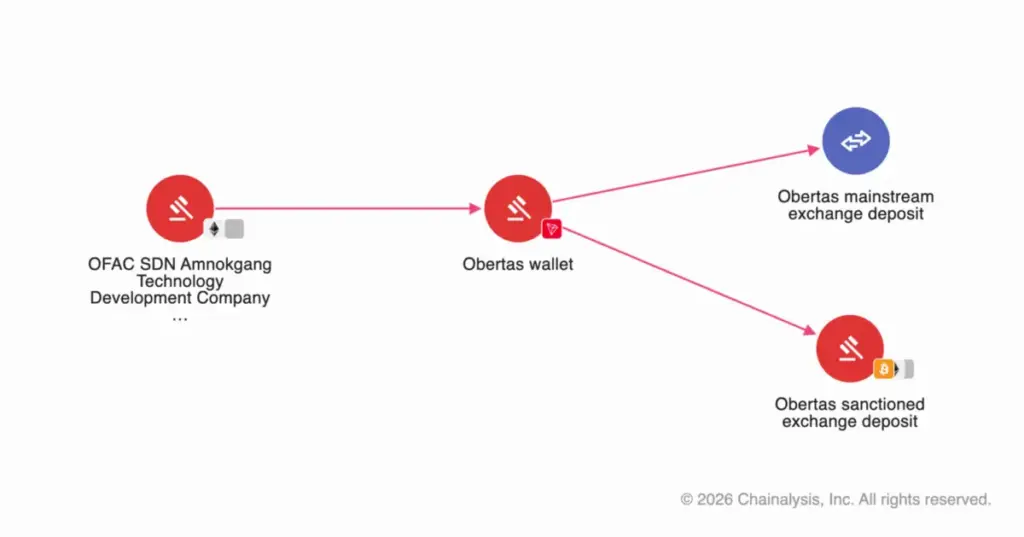
On-chain analysis reveals clear transactional trails linking the wallets of DPRK IT workers to these sanctioned intermediaries. For instance, blockchain investigations into Obertas indicate that he has actively converted millions of dollars in cryptocurrency for North Korean officials since early 2025, with on-chain relationships stretching back as far as 2023. In a typical financial fraud chain, a DPRK worker building code for blockchain and decentralized finance (DeFi) protocols receives bi-weekly stablecoin transfers resembling a standard corporate salary. These funds are subsequently converted into Ethereum (ETH), passed through consolidation addresses, and funneled to facilitators like Boykov, who then route the crypto through sanctioned Russian exchanges such as Garantex to complete the cash-out process.
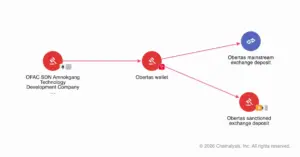
Similarly, Obertas’s wallet received direct transfers from Amnokgang Technology Development Company, which was previously designated in March for managing DPRK IT worker delegations. Obertas allegedly converted nearly $2 million in cryptocurrency into fiat currency for North Korean officials, acting as a vital bridge between illicit digital assets and traditional financial systems.

Expansion into Russia and the Integration of Generative AI
The Treasury Department also designated the First Financial and Technical Development Center (FFTDC), a DPRK-controlled entity operating within Russia that actively deploys overseas IT workers. FFTDC-managed operatives have successfully generated millions of dollars for the North Korean regime while utilizing increasingly advanced technological tools to evade detection.
Notably, the deployment of artificial intelligence has marked a concerning evolution in the IT worker threat landscape. Intelligence and cybersecurity researchers have observed North Korean operatives utilizing generative AI tools to rapidly fabricate customized resumes, draft persuasive cover letters, and prepare for technical interviews. In more brazen instances, operatives have deployed AI-generated profile photos and deepfake video technology during live hiring calls to conceal their national identity and physical appearance. These capabilities lower the technical and linguistic barriers for less-skilled operatives, vastly expanding the pool of workers the regime can deploy and complicating detection efforts for employers who rely on traditional remote interviews and document reviews as their primary security safeguards.
Six Russia-based DPRK IT workers—Kim Kyong Ju, Ri Thae Chol, So Hyon Jin, Han Yu Song, Kim Sung Gwan, and Hyon Se Il—were explicitly named and sanctioned alongside FFTDC. Together, these six individuals have collectively generated more than $750,000 for the entity since 2025. Furthermore, OFAC designated DPRK nationals Kim Ki Hyok and Kim Hyo Dong, who directly managed worker delegations in Russia reporting to umbrella organizations such as the Chinyong Information Technology Cooperation Company, an entity previously targeted by U.S. sanctions in 2023 for similar illicit financing schemes.
Sustained International Response to Digital Sanctions Evasion
Today’s designations underscore a broader, sustained U.S. government effort to counter North Korea’s systematic abuse of digital assets and cryptocurrency ecosystems. Pyongyang has increasingly relied on cyber-enabled financial crimes—including state-sponsored cryptocurrency heists, ransomware attacks, and IT worker fraud—to sustain its economy in the face of heavy international trade restrictions.

Compliance and blockchain analytics firms have responded by updating their screening solutions and labeling newly designated cryptocurrency addresses. Financial institutions, cryptocurrency exchanges, and global corporations hiring remote talent are increasingly urged to implement rigorous screening protocols, monitor transaction exposures, and thoroughly investigate suspicious activities involving overseas technical contractors to mitigate the severe legal and financial risks associated with North Korean sanctions evasion.
 Crypto Wallets & Security
 Crypto Wallets & Security
 Crypto Wallets & Security