North America stood as the most influential region for cryptocurrency markets globally in the 12 months leading up to July 1, 2026. Powered by the deep capital base of United States investors, evolving regulatory frameworks, the proliferation of stablecoins as a practical digital currency, and businesses bridging crypto with traditional finance, the region effectively exported its domestic trends to the rest of the world. According to data from the latest industry reporting period, the U.S. and Canada captured the top spots on the market’s "big-money index"—an unweighted measurement tracking the raw crypto-economic power of covered nations. Combined, their respective crypto economies totaled $3.02 trillion, marking a modest 1.9% contraction from the preceding period.
This minor regional decline was primarily driven by a slowdown in the United States. The U.S. crypto economy, valued at $2.78 trillion, contracted by 2.2% period-over-period. While unsurprising given the challenging backdrop of a brutal bear market, the world’s single-biggest crypto economy managed to largely retain the near-doubling of value it achieved during the 2025 period. Strong institutional foundations—such as the expansion of crypto exchange-traded funds (ETFs), accelerating tokenization, and the widespread adoption of stablecoins—played a critical role in preserving those previous gains.

Industry leaders point to a structural shift rather than a permanent setback. Hoolie Tejwani, Head of Coinbase Ventures, noted that the overall market dynamics compared to 2025 reflect an industry coming of age. The foundational building blocks established previously have successfully transitioned into products boasting real users, active liquidity, and functioning markets. Analysts tracking this evolution have focused on a trio of U.S.-developed products driving significant engagement both domestically and internationally: artificial intelligence-driven commerce, stablecoins, and tokenized assets. Meanwhile, the Canadian market proved resilient against the broader downtrend, expanding its crypto economy by 2.3% to reach approximately $250 billion, supported heavily by its robust peer-to-peer and remittance sectors.
The U.S. Leads the AI On-Chain Economy
The United States’ commanding position in the global artificial intelligence development race has begun to permeate every corner of the digital economy, including blockchain technology. Researchers exploring the shape of this emerging ecosystem have closely examined x402, one of the most popular digital payment rails enabling AI agents to autonomously spend money on-chain.

Autonomous software has officially entered the financial landscape, executing on-chain payments independently, with foundational American crypto enterprises supporting the infrastructure. Key players like Circle, issuer of the leading agent currency USDC, and Coinbase, the creator of the x402 system itself, have been instrumental in this growth. Traditional financial heavyweights are also taking notice. Will Su, Head of Digital Assets Research at BlackRock, highlighted that the firm is monitoring agentic commerce closely, noting that autonomous AI agents have the potential to generate meaningful demand for frequent, low-value payments around the clock.
By the end of the 2026 reporting period, cumulative activity on Base, the leading blockchain for agentic commerce, surpassed 138 million x402 transactions. Traditional payment rails like credit card networks cannot economically process transactions worth less than a dollar, and certainly not transactions valued at a fraction of a cent. However, stablecoins enable settlement costs of less than a cent, making micro-transactions economically viable. This unlocks an entirely new market for pay-as-you-go goods and services, such as data retrieval via application programming interfaces. Circle executives described a clean division of labor emerging within the marketplace: traditional card rails are used for consumer-prompted agent payments, while stablecoin rails handle machine-to-machine settlements that are far too small for traditional card economics.
The vast majority of x402 activity during the extended 16-month review period ending in September 2026 registered as micropayments. More than 87% of all payments ranged between one-hundredth of a cent and a dime, with the most common transaction sizes falling squarely between one and ten cents. Although agentic commerce remains in an experimental phase, clear signs of maturation are taking root. Early user behavior—characterized by one-off participants who tested a feature and abandoned their wallets once funds depleted—has given way to sustained engagement.

AI Payments Become Stickier and More Purposeful
New cohorts of digital wallets are arriving with significantly higher commitments than their predecessors. When grouping wallets by the quarter in which they were first funded, the share of accounts receiving a second funding injection within 30 days climbed dramatically. For wallets established in the third quarter of 2025, about 70.6% received additional funding within that window. By the second quarter of 2026, that figure rose to 89.3%. Counting only wallets that sent transactions across two or more separate days—thereby excluding transient experimenters—the data demonstrates that users are finding enduring utility in agentic payments and willingly replenishing their balances.
User behavior has also grown increasingly purposeful. The temporal gap between a wallet receiving its initial seed funding and executing its first x402 spend has contracted sharply. In late 2025, wallets had a median age of 73 days before initiating an x402 payment. By the third quarter of 2026, that timeframe plummeted to just 18 minutes. Furthermore, the share of wallets spending within their first hour of being funded jumped from 4% in late 2025 to 67% by mid-2026. This temporal compression indicates that newer wallets are deliberately provisioned for immediate agentic commerce rather than parked value or passive testing.

What AI Agents Are Buying On-Chain
As autonomous agents cement their role as active economic participants on the blockchain, the nature of their purchases has evolved. While initial activity was dominated by short-lived speculative fads like memecoins, the maturation of x402 has fostered sustainable information-sector commerce. Autonomous models are increasingly purchasing AI-generated knowledge, code reviews, financial intelligence, and search APIs. Because machines have an insatiable appetite for structured data, on-chain micropayments provide an ideal settlement mechanism.
Beyond data acquisition, AI agents utilize these payment rails for gaming, token issuance, gambling services, and agentic tooling. Significantly, models are also paying for other models. Model inference represents one of the largest categories of x402 transactions, highlighting a self-sustaining loop of machine-to-machine commerce.

Geographic analysis reveals that American-funded AI agents dominate this space, accounting for roughly 30% of all geolocated agent-to-service transactions globally. U.S. wallets represent 88.1% of geolocated AI model inference transactions, 41.8% of payments to agent frameworks and tool catalogs, and 23.2% of payments to data and search APIs.
In contrast, Chinese-attributed wallets concentrated heavily in security and code analysis, accounting for 90% of transactions directed toward such services—primarily flowing into AgentLISA, an AI tool auditing Solidity smart contracts. Chinese operators also captured significant shares in market and financial intelligence as well as payment rails, yet they accounted for just 0.1% of model inference payments. This divergence is largely attributed to AI nationalism and economic reality: Chinese markets heavily favor domestic open-weight models like DeepSeek and Qwen, which are free to use, whereas American markets rely on metered, proprietary models such as ChatGPT and Claude.
The U.S. Imports Digital Gold and Exports Digital Dollars

The formal passage of legislative measures in mid-2025 cemented the United States’ role as the world’s leading exporter of digital dollars. Stablecoins have effectively transformed U.S. sovereign debt into the currency of choice for cross-border businesses and peer-to-peer economies alike. Throughout the 2026 period, stablecoins continued expanding into international use cases, generating billions in economic activity that ultimately benefits U.S. financial institutions and the federal government.
While the U.S. actively exports stablecoins, it simultaneously functions as a major importer of Bitcoin. Since the introduction of spot Bitcoin ETFs in January 2024, the U.S. share of global Bitcoin activity has risen consistently. Conversely, stablecoins represent a smaller share of domestic American crypto activity compared to foreign markets, and that gap has steadily widened. International users gravitate toward dollar-denominated stablecoins to satisfy a demand for stable foreign currency that local banking systems often fail to provide, whereas American investors increasingly view Bitcoin as an infinitely scarce monetary alternative amid rising government debt and spending.
Cross-border Bitcoin flow data underscores this institutional accumulation. In 2026, the U.S. became a net importer of Bitcoin for the first time since 2022. While retail-sized transfers under $10,000 remained net outbound, multi-million-dollar institutional transfers flipped to substantial net inflows, with transactions exceeding $10 million driving tens of thousands of coins into American custody. Meanwhile, stablecoin circulation expanded significantly, with major issuers reporting tens of billions in tokens backed primarily by short-dated U.S. government debt. This dynamic creates a powerful economic feedback loop: imported Bitcoin is accumulated as a store of value, while exported stablecoins proliferate the global dominance of the U.S. dollar.

The U.S. Impact on Tokenization
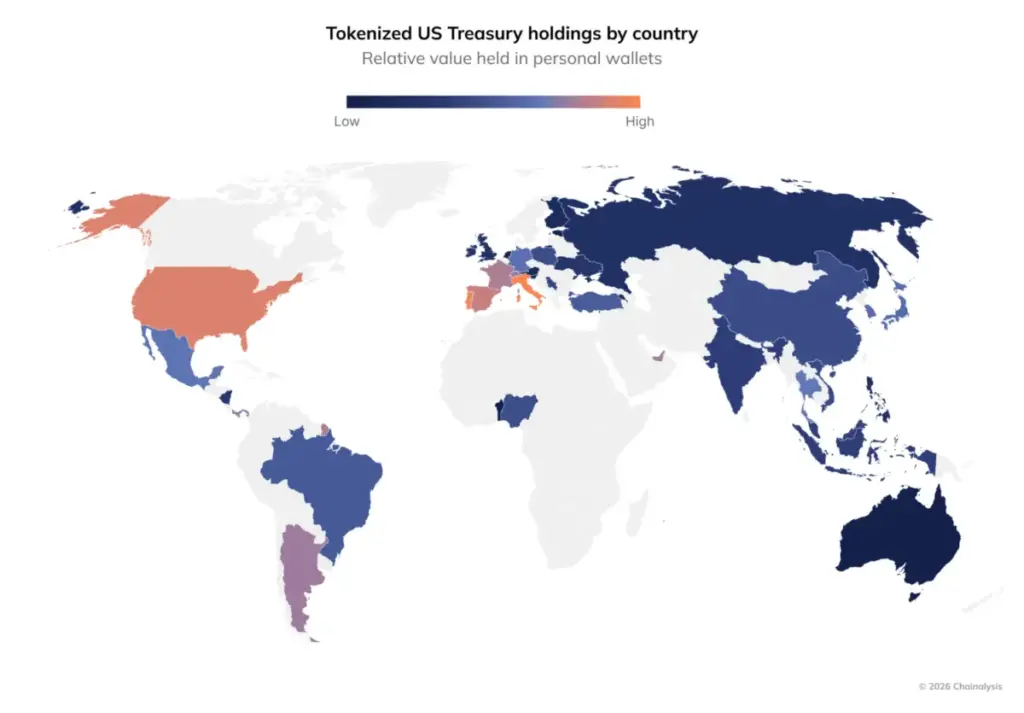
The tokenization of real-world assets expanded rapidly during the 2026 period, with the global market surging 135% year-over-year to finish the second quarter at $36.07 billion. U.S. Treasury debt anchored this sector, representing the single-largest real-world asset class on-chain with $15.42 billion—accounting for roughly 42.8% of all tokenized asset value. While alternative asset categories like private equity and corporate credit experienced rapid percentage growth from smaller baselines, tokenized Treasuries outpaced them significantly in absolute dollar terms.
Geographic distribution patterns reveal a fascinating trend: while U.S. investors make up roughly 11.7% of the global tokenized asset holder base, international investors drive the vast majority of tokenized Treasury value. Countries like Italy, Portugal, and Singapore lead in the valuation of holdings, as tokenization lowers traditional brokerage barriers and allows international retail and institutional participants to purchase fractionalized U.S. sovereign debt directly on-chain. Furthermore, lending patterns indicate that tokenized Treasuries are primarily bought and held as high-yield, liquid instruments rather than posted as collateral, given that traditional finance already offers robust liquidity solutions for government bonds.

Canada Emerges as a Global Peer-to-Peer Leader
Canada secured its position as the second-largest crypto economy in North America and ranked tenth globally in grassroots adoption, expanding its market by 2.3% to $247.7 billion during the 2026 reporting period. Notably, Canada recorded the most robust peer-to-peer crypto economy among G7 nations, placing seventh globally in both domestic and cross-border transaction flows. Stablecoins dominated Canadian cryptocurrency demand, capturing 44% of Canadian dollar-based order book volume by mid-2026, led primarily by USD-pegged stablecoins like USDC.
This heavy reliance on U.S. dollar stablecoins presents a policy challenge for Canadian officials. Because residents favor foreign-denominated digital assets over local alternatives, capital flows indirectly support U.S. government debt rather than domestic sovereign bonds. Although Canadian policymakers recently introduced a stablecoin legislative framework intended to pave the way for domestic Canadian dollar-backed tokens, local stablecoins currently maintain a minuscule market share compared to their U.S. counterparts.

Canada’s vibrant cross-border economy is heavily influenced by its diverse demographic makeup. With roughly 23% of its population born abroad—the highest proportion in the G7—Canada serves as a major hub for international remittances. Outbound stablecoin and Bitcoin transfers targeting fast-growing corridors in India, China, and the Philippines reached $2.36 billion across millions of transactions during the reporting period. Driven by high traditional remittance fees averaging nearly 7% through conventional banking channels, Canadian residents increasingly turn to blockchain rails to settle cross-border obligations for a fraction of a cent.
Domestic peer-to-peer transaction volumes in Canada have also closely tracked the population size of temporary visa and study permit holders, rising and falling in parallel over recent years. This correlation underscores how populations with active cross-border financial lives naturally gravitate toward efficient, low-cost digital settlement tools for everyday transactions, ranging from rent payments to general commerce.
The Infrastructure Is American, the User Base Is Global

Ultimately, the defining characteristic of North America’s crypto landscape in 2026 is the concentration of foundational infrastructure within the United States. American institutions, regulatory frameworks, and developers sit firmly at the center of the tokenized treasury market, the global digital dollar supply, and the burgeoning agentic AI economy. While the primary builders and issuers operate domestically, the active user base driving demand is increasingly international. As foreign jurisdictions like the European Union, Singapore, and Brazil advance their own regulatory frameworks to foster local digital asset alternatives, the future global balance will depend heavily on sustained market adoption and the ongoing evolution of international policy.
 Crypto Wallets & Security
 Crypto Wallets & Security
 Crypto Wallets & Security