North America stood as the most influential region for global cryptocurrency markets during the 12 months leading up to July 1, 2026. Driven by a deep U.S. investor base providing vital capital, lawmakers updating regulatory frameworks, stablecoins serving as a reliable digital currency, and businesses bridging crypto with traditional finance, the region continues to export its financial innovations to the rest of the world. According to data from the latest reporting period, the United States and Canada topped the unweighted "big-money index," which measures the sheer crypto-economic power of covered countries. Together, their respective crypto economies totaled $3.02 trillion during the 2026 reporting period, marking a modest 1.9% decline from the previous year.
This regional contraction primarily stemmed from a slowdown within the United States. The U.S. crypto economy, valued at $2.78 trillion, contracted by 2.2% period-over-period—an unsurprising outcome against the backdrop of a brutal bear market. Nevertheless, the world’s single-biggest crypto economy largely retained the near-doubling of value it achieved during the 2025 period. Strong institutional forces, such as the rising popularity of crypto exchange-traded funds (ETFs), accelerating tokenization of real-world assets, and the widespread proliferation of stablecoins, helped the market hold onto those critical gains.
Industry leaders point to structural maturity as the defining characteristic of this phase. Hoolie Tejwani, Head of Coinbase Ventures, noted that much of what distinguishes the market from 2025 comes down to maturation. The fundamental building blocks established previously are successfully transforming into products with real users, deeper liquidity, and active markets.

The latest industry data highlights a trio of U.S.-developed crypto products attracting major domestic and international activity: AI commerce, stablecoins, and tokenized assets. All three products serve as clear manifestations of growing American influence over the global digital asset ecosystem. Meanwhile, the Canadian market—while significantly smaller than its southern neighbor—bucked the broader downtrend, posting a 2.3% increase in its $250 billion crypto economy, heavily supported by vibrant peer-to-peer activity driven by its immigrant populations.
The US is Leading the AI On-Chain Economy
The United States has firmly established its lead in the global artificial intelligence development race, and that dominance is rapidly influencing every corner of the broader economy, including cryptocurrency. Researchers analyzing x402—one of the most popular digital payments rails that allows AI agents to spend money autonomously—have gained a clearer picture of how this nascent machine economy is taking shape.
Autonomous software has officially begun executing on-chain payments, with the United States emerging as its primary engine. Cornerstone American digital asset companies, including Circle, the issuer of the leading stablecoin USDC, and Coinbase, the developer of the x402 payment system, are actively supporting this technological rise. Financial institutions are also paying close attention. Will Su, Head of Digital Assets Research at BlackRock, noted that the firm is closely monitoring agentic commerce, explaining that autonomous AI agents have the potential to generate meaningful demand for frequent, low-value payments around the clock.

By the end of the 2026 period, more than 138 million x402 transactions had been recorded on Base, making it the most popular blockchain network for agentic commerce. Traditional payment rails like credit card networks cannot profitably process micro-transactions worth less than a dollar, and certainly not fractions of a cent, due to fixed processing overhead. However, stablecoins capable of settling transactions for a fraction of a cent make it economically viable for machines to spend tiny amounts of money. This capability unlocks an entirely new market for pay-as-you-go digital goods and services, such as purchasing targeted data through automated API calls.
Circle describes a clean division of labor emerging between traditional and blockchain rails: credit card networks handle consumer-prompted agent payments, while stablecoin rails manage machine-to-machine settlements that are far too small for traditional card economics. The vast majority of x402 activity registered as micropayments, with over 87% of payments falling between a hundredth of a cent and a dime, and the most common transaction size resting between one and ten cents.
AI Payments Are Becoming Stickier
Although agentic commerce remains in its experimental phase, clear signs of maturation are emerging across the ecosystem. Early activity on the x402 protocol was characterized by one-off users trying out the technology—such as executing a single crypto trade—before abandoning the network once their initial funds were exhausted. That dynamic has begun to shift significantly as recurring engagement takes hold.

Subsequent cohorts of funded wallets have demonstrated progressively higher commitment levels. Grouping wallets by the calendar quarter in which they were first funded reveals that the share receiving a second funding injection within 30 days rose from 70.6% for wallets established in the third quarter of 2025 to 89.3% for those funded in the second quarter of 2026. In the on-chain economy, topping up a depleted wallet functions as the digital equivalent of renewing a subscription after the initial invoice is processed. Analysts tracked only wallets that sent funds on two or more separate days, effectively filtering out one-time experimenters to focus on users integrating agentic payments into their long-term routines.
Furthermore, users of the x402 protocol are demonstrating increasingly purposeful behavior. This trend is visible in the shrinking timeframe between a wallet’s initial seed funding and its first x402 expenditure. In late 2025, wallets were, at the median, 73 days old before initiating an x402 payment; by the third quarter of 2026, that gap plummeted to just 18 minutes. This temporal compression indicates that newer wallets are being intentionally constructed to immediately engage in agentic commerce. Rather than parking value or merely testing the protocol, users are funding wallets because a specific computational task is already queued and ready for execution.
What AI Agents Are Buying with x402
As AI agents increasingly function as independent economic actors, each acting as a distinct user of the blockchain, market observers have closely tracked what these autonomous models are purchasing on-chain. While the early days of x402 saw massive inflows into speculative fads like memecoins, the maturation of the protocol has given rise to more durable forms of commerce, particularly within the information sector.

Autonomous robots and software agents are heavily purchasing AI-generated knowledge on-chain. Millions of transactions now flow from AI wallets into specialized information services, including code review platforms, financial intelligence tools, and data and search APIs. Because agents require a constant stream of machine-readable data, on-chain micropayments offer an ideal settlement mechanism.
Beyond raw data, AI agents utilize these payment rails to purchase gaming assets, token issuance tools, gambling services, and agent frameworks. Notably, a significant share of transactions involves AI agents paying for other AI agents. Model inference has emerged as one of the largest categories for x402 transaction volume, highlighting an interconnected machine-to-machine economy.
The U.S. Dominates in AI-to-AI Commerce
American-funded AI agents currently transact with x402 services at a much higher rate than agents backed by any other country. Based on geolocated on-chain activity, the United States holds a commanding 30% share of total agent-to-service transactions.

U.S. wallets account for 88.1% of all geolocated AI model inference transactions on the protocol, 41.8% of payments directed toward agent frameworks and tool catalogs, and 23.2% of payments destined for data and search APIs—representing the core inputs required to build and sustain agentic software. In contrast, Chinese-attributed wallets displayed a different usage pattern, concentrating heavily on security and code analysis. Approximately nine out of ten transactions entering security and code analysis services originated from Chinese-linked wallets, flowing primarily into AgentLISA, an automated model that audits Solidity smart contracts. Chinese operators also captured significant shares in market intelligence and payment rails, but accounted for just 0.1% of model inference spending, likely reflecting both the availability of free open-weight domestic models like DeepSeek and Qwen and broader trends in national AI adoption.
The U.S. Imports Digital Gold and Exports Digital Dollars
The formalization of the digital asset landscape via legislative updates has underscored a broader reality: the United States is the world’s leading exporter of digital dollars. Stablecoins have successfully transformed U.S. government debt into the currency of choice for cross-border businesses and peer-to-peer economies alike. During the 2026 period, stablecoins found expanded utility abroad, generating billions of dollars in economic activity that ultimately benefits both U.S. corporations and the federal government.
While the United States actively exports stablecoins, it simultaneously functions as a major importer of bitcoin. Following the introduction of spot bitcoin exchange-traded funds, the U.S. share of global bitcoin activity has risen steadily through successive reporting periods. Conversely, stablecoins represent a smaller share of domestic American crypto activity compared to foreign markets, and that gap has steadily widened. While international users adopt dollar stablecoins to satisfy a demand for stable foreign currency exchange that local banking systems often fail to meet, American investors increasingly lean on bitcoin as an inflation-resistant store of value amid rising global government debt.

Cross-border bitcoin flows into and out of the U.S. reflect a distinct bifurcation between retail and institutional participants. Smaller retail transfers under $10,000 ran net outbound consistently, whereas large-denomination transfers shifted firmly toward net inflows, with the bracket exceeding $10 million accounting for tens of thousands of incoming coins. Institutional accumulation, bolstered by discussion surrounding strategic reserve frameworks, has added a strong structural bid to the private market.
Meanwhile, stablecoin issuance continues to scale, with tens of billions of dollars in tokens circulating against massive quarterly on-chain trading volumes. Institutions increasingly rely on stablecoins as the primary routing layer between traditional fiat, regional stablecoins, and global dollar liquidity.
The U.S. Impact on Tokenization
The United States maintained its dominant position within the rapidly expanding tokenized real-world asset sector during the 2026 reporting period. Tokenized U.S. Treasury bonds emerged as the single largest real-world asset category, accounting for $15.42 billion on-chain—representing 42.8% of all tokenized RWA value. Overall, the tokenization market closed out the second quarter of 2026 with a total valuation of $36.07 billion, marking a staggering 135% growth rate period-over-period.

As tokenized assets become increasingly functional across decentralized lending, collateral, and trading markets, the variety of tokenized financial instruments has broadened. While alternative categories like corporate credit and private equity experienced exponential percentage gains from smaller baselines, Treasury debt expansion outpaced the next three categories combined in absolute dollar terms.
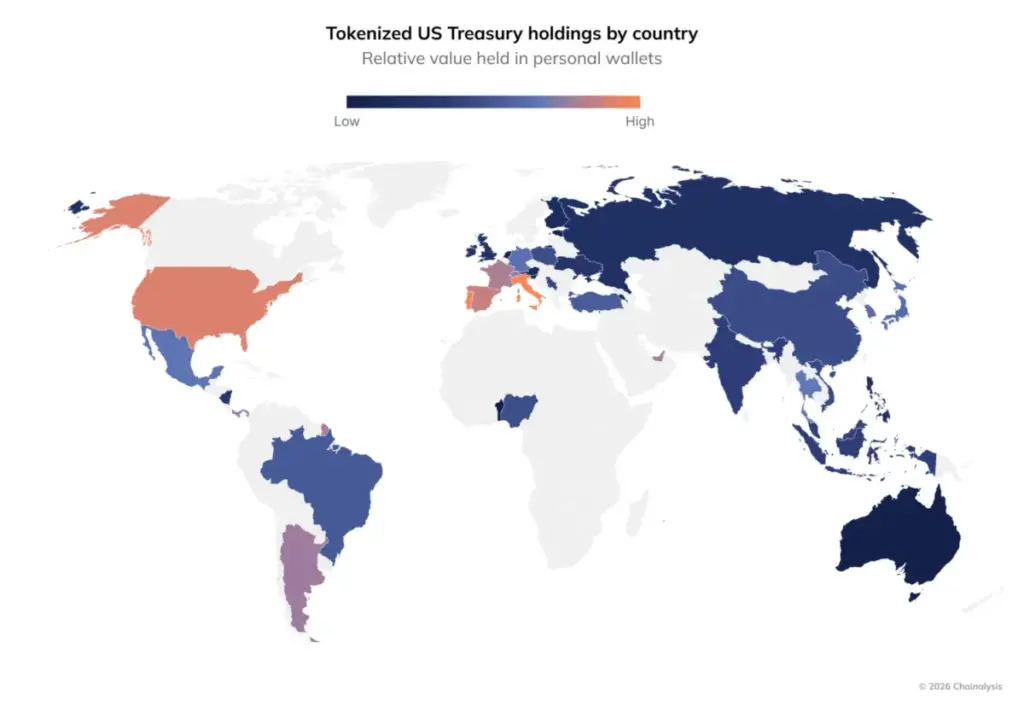
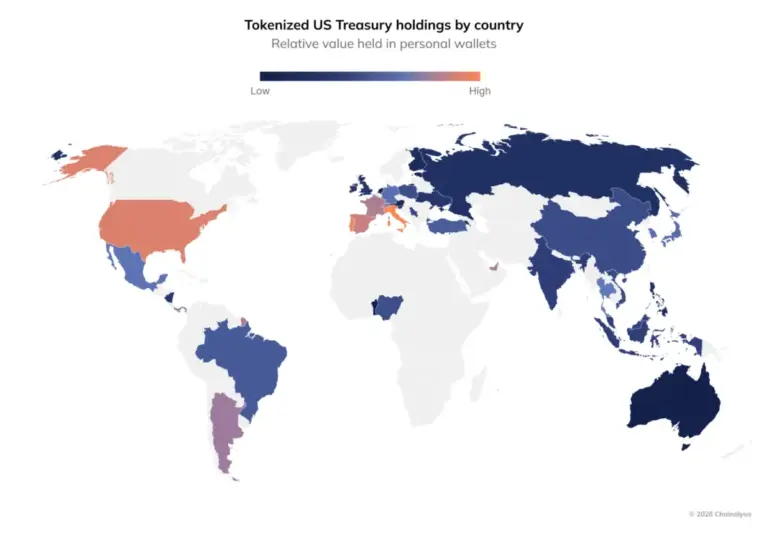
Interestingly, while U.S.-based holders account for roughly 11% of the global tokenized RWA holder base, tokenized U.S. Treasuries exhibit a different geographic distribution. Geolocated data indicates that European and Asian jurisdictions—including Italy, Portugal, Singapore, and Japan—represent significant shares of tokenized Treasury holders and asset values. By lowering minimum position sizes and eliminating the necessity of maintaining a direct U.S. brokerage relationship, tokenized financial products allow international retail investors to access sovereign debt instruments directly.
Canada Emerges as a Global Leader in Peer-to-Peer Crypto
Canada, ranking as the second-largest country in the regional economic index and maintaining a strong position in grassroots adoption, saw its crypto economy expand by 2.3% to reach $247.7 billion between mid-2025 and mid-2026. Beneath this modest aggregate growth lies a high rate of everyday cryptocurrency adoption among Canadian residents, setting the country apart from many other developed G7 economies.

Stablecoins drive a substantial portion of Canadian crypto demand, capturing 44% of Canadian dollar-based order book volume by June 2026, up significantly from 30% the previous year. USDC dominates this segment, while local Canadian dollar-backed stablecoins capture minimal trading volume. This dynamic creates a distinct policy challenge for Canadian authorities, as reliance on USD-denominated stablecoins inadvertently funnels foreign sovereign debt demand toward the United States rather than supporting domestic bond markets.
Furthermore, Canada’s robust cross-border activity is heavily influenced by its large immigrant population, with foreign-born residents comprising approximately 23% of the total population—the highest share within the G7. Remittance corridors connecting Canada to countries such as India, China, and the Philippines have expanded rapidly, processing billions of dollars in stablecoin and bitcoin transfers. Because traditional remittance channels impose steep average fees, regular senders increasingly utilize low-cost blockchain rails to support family obligations, manage international assets, and reduce transactional friction.
As the underlying infrastructure layer remains anchored in American financial technology while user bases scale globally, regulatory authorities in Canada and other international jurisdictions continue to craft policies aimed at balancing domestic financial sovereignty with the undeniable efficiency of blockchain-native payments.
 Crypto Wallets & Security
 Crypto Wallets & Security
 Crypto Wallets & Security