
North America cemented its status as the most influential region for the global cryptocurrency market during the 12-year reporting period ending July 1, 2026. Backed by a deep domestic investor base in the United States, rapidly evolving regulatory frameworks, the widespread integration of stablecoins, and an ongoing push by traditional financial institutions to bridge the gap with decentralized technology, the region continues to export its financial innovations to the rest of the world.
According to market data, the United States and Canada comfortably topped the global "big-money index"—an unweighted measurement tracking the sheer crypto-economic power of covered countries. Combined, their respective crypto economies totaled $3.02 trillion during the 2026 reporting period. While this represents a modest 1.9% contraction compared to the previous year, the dip was primarily driven by a localized slowdown within the United States amidst a challenging market cycle.
The U.S. crypto economy contracted by 2.2% to $2.78 trillion. However, industry experts view this minor correction as a natural stabilization following the near-doubling of market values recorded during the 2025 period. Rather than retreating, the market has matured, shifting from speculative hype to utility-driven adoption. Institutional forces, including the explosive growth of spot crypto exchange-traded funds (ETFs), accelerating tokenization of real-world assets, and the ubiquitous proliferation of stablecoins, have ensured that the foundational gains of previous years remain securely locked in place.
Hoolie Tejwani, Head of Coinbase Ventures, noted that the current landscape reflects the structural maturation of the industry. The building blocks established in 2025 have successfully transformed into operational products boasting active users, deep liquidity, and thriving markets in 2026. This evolution is particularly visible across three U.S.-developed crypto sectors currently capturing global attention: artificial intelligence commerce, stablecoin liquidity, and asset tokenization. Meanwhile, Canada’s crypto economy bucked the regional downtrend entirely, expanding by 2.3% to reach $250 billion, supported by robust peer-to-peer activity and a dynamic immigrant population.

The US Leads the AI On-Chain Economy
The United States has firmly established its leadership in the global artificial intelligence development race, a dominance that is rapidly spilling over into the digital asset ecosystem. To understand how this intersection is taking shape, researchers have closely tracked x402, one of the most prominent digital payment rails enabling autonomous software and AI agents to execute financial transactions independently on-chain.
Autonomous software is increasingly paying for digital resources, services, and APIs directly on the blockchain. Cornerstone American crypto enterprises are heavily supporting this nascent economy. Circle, the issuer of the USDC stablecoin—which serves as a primary currency for autonomous agents—and Coinbase, the developer of the x402 protocol, are actively building out the infrastructure required for machine-to-machine commerce. Traditional financial powerhouses are also taking notice. Will Su, Head of Digital Assets Research at BlackRock, highlighted that the firm is monitoring agentic commerce closely, noting that AI agents have the potential to generate meaningful demand for frequent, low-value payments operating around the clock.
By the conclusion of the 2026 reporting period, cumulative activity on Base, the leading blockchain network for agentic commerce, surpassed 138 million x402 transactions. On-chain settlement rails make economic activity feasible in ways that traditional legacy payment systems simply cannot accommodate. Micro-payments valued at fractions of a cent—such as transactions worth less than a penny—are fiscally unviable for conventional credit card networks to process due to overhead and processing fees. Conversely, stablecoin transactions costing less than a cent to settle make it economically practical for AI agents to spend microscopic amounts of money continuously. This technological capability unlocks an entirely new market for pay-as-you-go digital goods and services, including real-time data retrieval via API calls.
Circle executives describe a clean division of labor emerging within the digital payments landscape, where traditional card rails handle consumer-prompted agent payments, while stablecoin rails power machine-to-machine settlements that are far too small for traditional card economics. Data from the 16-month period ending in September 2026 reveals that the vast majority of x402 activity consists of micro-payments. Over 87% of all recorded payments ranged between a hundredth of a cent and a dime, with transaction sizes of one to ten cents proving the most common.

AI Payments Are Becoming Stickier
Although agentic commerce remains largely in its experimental phase, clear indicators point toward rapid maturation. During the early days of the x402 protocol, adoption was characterized by transient users executing one-off trades or demonstrations before abandoning their wallets once initial funds were exhausted. That behavioral dynamic has undergone a fundamental shift.
Wallet retention cohorts demonstrate a steady increase in user commitment over time. When grouping wallets by the quarter in which they were initially funded, the share of wallets receiving a secondary funding injection within 30 days climbed dramatically. For wallets funded in the third quarter of 2025, the 30-day top-up rate stood at 70.6%. By the second quarter of 2026, that figure rose to 89.3%. In the on-chain ecosystem, topping up a depleted wallet functions as the decentralized equivalent of renewing a subscription after the initial invoice is processed. By filtering out single-use experimenters and counting only wallets that transacted across multiple days, analysts confirmed that users are finding enduring utility in agentic payment systems.
Furthermore, x402 users are exhibiting increasingly purposeful behavior. The time gap between a wallet’s initial seed funding and its first x402 transaction has compressed significantly. In late 2025, newly funded wallets sat idle for a median duration of 73 days before initiating an x402 payment. By the third quarter of 2026, that latency dropped to just 18 minutes. Concurrently, the share of wallets executing a payment within their first hour of funding surged from 4% in Q3 2025 to 67% in Q3 2026. Rather than parking value or testing protocols casually, users are provisioning wallets specifically because a computational task is already queued and ready for execution.
What AI Agents Are Buying with On-Chain Rails
As Tejwani of Coinbase Ventures observed, AI agents are rapidly evolving into autonomous economic actors, with every individual agent functioning effectively as a novel user of the blockchain network. While the earliest phases of x402 adoption were dominated by short-lived fads, such as speculative memecoins like PING that attracted massive inflows before fading, protocol maturation has given rise to sustainable commercial use cases centered primarily around the information sector.

Autonomous algorithms and AI models are utilizing on-chain micro-payments to purchase machine-readable knowledge. Millions of transactions now flow continuously from AI wallets into specialized information services, including automated code review platforms, financial intelligence feeds, and advanced data and search APIs. Additionally, agents are directing funds toward gaming ecosystems, token issuance platforms, gambling services, and foundational agent development toolkits.
Notably, a significant portion of agentic expenditure is directed toward other AI services. Model inference ranks among the largest expenditure categories for x402 transactions, with agents paying autonomously for the computational intelligence required to run subsequent cognitive tasks.
The United States Dominates AI-to-AI Commerce
Geolocated transaction data indicates that American-funded AI agents account for a disproportionate share of global x402 activity, holding roughly 30% of all agent-to-service transactions globally. U.S.-linked wallets account for 88.1% of all geolocated AI model inference payments, 41.8% of expenditures directed toward agent frameworks and tool catalogs, and 23.2% of payments destined for data and search APIs.
Conversely, regional variations in adoption reveal interesting strategic divergences. Chinese-attributed wallets demonstrated a heavy concentration in security-focused expenditures, accounting for approximately 90% of transactions directed toward security and code analysis services, most notably AgentLISA, a language model utilized for auditing Solidity smart contracts. Chinese-linked operators also held prominent positions in market and financial intelligence services with a 46.7% share, and payment settlement rails with a 35% share. However, Chinese-funded AI agents accounted for a negligible 0.1% of model inference payments.

This stark imbalance is largely attributed to a combination of AI nationalism and economic realities. The domestic Chinese market readily utilizes open-weight models developed within China, such as DeepSeek and Qwen, which are often free to deploy. Meanwhile, American markets rely heavily on proprietary, metered models like ChatGPT and Claude. Consequently, the commercial market for machine-bought intelligence remains heavily concentrated in jurisdictions where paid inference APIs represent the most viable operational option.
The operational scale of agentic payments presents unique compliance and monitoring challenges that diverge sharply from conventional payment architectures. Individual transactions occur with a speed, frequency, and scale that preclude manual per-transaction screening. Instead, regulatory and compliance frameworks must adapt to evaluate the structural setup of the system. The funding event identifies the initial sender, budget authorizations reflect deliberate human decisions, and receiving entities remain known counterparties. The mechanical predictability of automated agent spending actually enhances the detectability of behavioral anomalies compared to human-driven financial flows. Accountability must ultimately trace back to the human operators and entities that deploy and fund the agents, operating at machine speed rather than through traditional manual checkpoints.
The United States Exports Digital Dollars While Importing Digital Gold
The formalization of stablecoin oversight through legislative actions, such as the passage of the GENIUS Act in mid-2025, has codified what global crypto economies already recognize: the United States is the primary global exporter of digital dollars. Stablecoin infrastructure has effectively converted U.S. sovereign debt into the preferred transactional currency for cross-border commerce and international peer-to-peer economies. Throughout the 2026 reporting period, stablecoins continued penetrating new international markets, generating billions of dollars in economic activity that benefits both U.S. corporations and the federal government.
While the United States acts as a net exporter of stablecoins, it concurrently functions as a net importer of Bitcoin. Following the approval and launch of spot Bitcoin ETFs in early 2024, the U.S. share of global Bitcoin trading and holding activity has risen steadily across every subsequent reporting period. Conversely, stablecoins represent a proportionally smaller share of domestic American crypto activity than they do in international jurisdictions, a divergence that widened throughout 2026.

Data mapping the intensity of Bitcoin versus stablecoin activity highlights a clear structural split. While international markets increasingly lean on USD-backed stablecoins to bypass local banking limitations and foreign exchange restrictions, American investors increasingly treat Bitcoin as an immutable, scarce store of value. Will Su of BlackRock noted that institutional interest in Bitcoin as an alternative monetary asset remains robust, particularly as global government debt and public expenditures reach historic highs.
Cross-border Bitcoin flow analysis indicates that the United States shifted to a net importer of Bitcoin in 2026 for the first time since 2022. While retail-sized transfer brackets under $10,000 consistently registered as net outbound, high-value institutional transfers flipped sharply toward net inflows. Transactions exceeding $10 million alone accounted for an influx of over 53,200 Bitcoin during the period, illustrating a clear dichotomy where retail users send Bitcoin outward while institutional entities accumulate it domestically. Furthermore, discussions surrounding a potential federal Strategic Bitcoin Reserve have provided implicit sovereign backing to complement private institutional accumulation.
On the stablecoin front, approximately 99.1% of all traded order book volume remains pegged to the U.S. dollar. Tokens generated by American issuers circulate globally without ever touching correspondent banking networks or appearing in traditional trade balance statistics. Every circulating stablecoin represents a direct claim on underlying reserves composed primarily of short-dated U.S. government debt. Circle reported $73.3 billion of USDC in circulation at the close of the quarter—representing a 19% year-on-year increase—against a staggering $14.8 billion in quarterly on-chain settlement volume. Circle executives emphasized that institutions increasingly utilize stablecoins as the foundational routing layer between fiat currencies, local stablecoins, and global dollar liquidity pools.
Despite legislative efforts in other jurisdictions to foster competing currencies—such as the European Union’s Markets in Crypto-Assets (MiCA) framework designed to encourage euro-denominated stablecoin issuance, or licensing frameworks introduced in Singapore and Hong Kong—alternative stablecoins command minimal market share. Euro-backed stablecoins account for a mere 0.45% of global order book volume, demonstrating that regulatory readiness has far outpaced organic market adoption.

The US Impact on Asset Tokenization
The United States maintained its dominant position in the rapidly expanding real-world asset (RWA) tokenization sector throughout the 2026 reporting period. Tokenized U.S. Treasury bonds emerged as the single largest real-world asset class on-chain, commanding $15.42 billion and accounting for 42.8% of total tokenized RWA value globally. The broader tokenization market finished the second quarter of 2026 with a cumulative valuation of $36.07 billion, marking a robust 135% growth rate period-over-period.
Tom Murphy, head of communications for Securitize, pointed out that asset managers are aggressively launching tokenized investment funds, public corporations are exploring the tokenization of equity shares, financial institutions are deploying native stablecoin infrastructure, and tokenized assets are becoming fully integrated within lending, collateral, and trading markets.
While niche sectors experienced explosive percentage growth—such as corporate credit expanding by 3,156% and private equity climbing 1,340%—these jumps translated from modest baselines into billions of dollars. Meanwhile, tokenized U.S. Treasury debt grew by 125%, adding over $8.5 billion in absolute value to reach $15.42 billion, overshadowing the combined capitalization of the next three RWA categories.
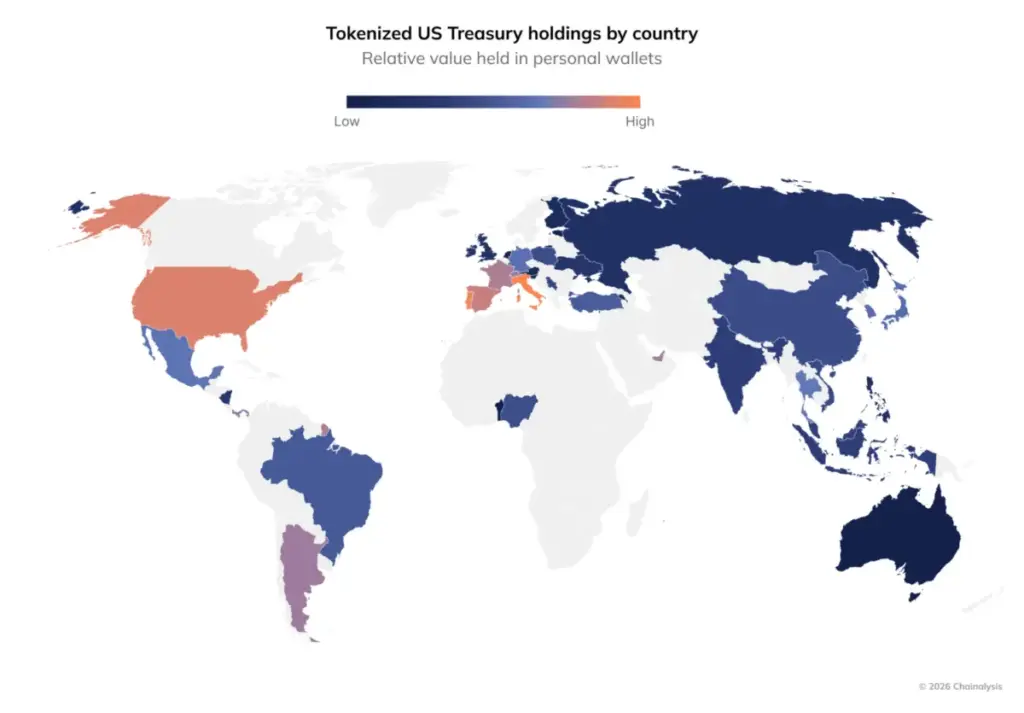
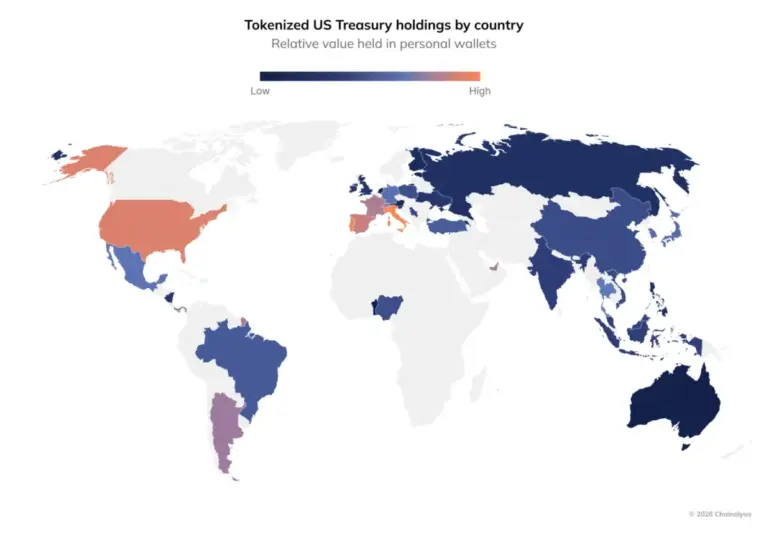
Geolocated holder data reveals an interesting international distribution for tokenized U.S. Treasuries. While U.S. residents account for roughly 11.7% of the global tokenized RWA holder base and hold 11.4% of its aggregate value, tokenized Treasuries exhibit a different pattern. Italy accounts for 29.9% of geolocated tokenized Treasury holdings by value, followed by Portugal at 18.8% and Singapore at 18.2%, with the United States ranking fourth at 10.5%. Conversely, retail participation metrics display an inverse distribution; Japan leads the holder count with 16.4% of all individual holders while accounting for just 0.4% of total asset value. This dynamic indicates that a broad international retail base, alongside concentrated foreign institutional whales, is actively accumulating tokenized U.S. public debt, thereby extending American monetary influence abroad.

Lending patterns across decentralized finance platforms further demonstrate that tokenized Treasuries are primarily acquired as long-term holdings rather than utilized as dynamic collateral. While wallets lending tokenized private credit expanded by 1,618%—accounting for 77% of all value lent against tokenized RWAs—and commodity-backed lending grew 875%, tokenized Treasury lending contracted by 23%. This divergence stems from the fundamental liquidity profiles of the underlying assets. Private credit instruments are inherently illiquid in their traditional formats, making tokenization and collateralization highly advantageous. Conversely, U.S. Treasuries already represent the most liquid collateral instruments within conventional financial markets, meaning holders seeking immediate liquidity rely on existing traditional mechanisms.
Securitize executives emphasize that the ultimate trajectory of tokenization will render distinctions between "crypto" and "tradfi" obsolete, resulting in a singular financial system operating on modernized technological infrastructure. Parallel institutional tokenization layers built on permissioned enterprise networks, such as Canton, continue to facilitate compliant settlements for regulated financial institutions without registering on public blockchain holder counts, suggesting that the true scale of asset tokenization is even larger than public datasets indicate.
Canada Emerges as a Global Leader in Peer-to-Peer Crypto
Canada, ranking as the second-largest crypto economy in North America and placing 10th globally in grassroots adoption metrics, saw its digital asset market expand by 2.3% during the 2026 reporting period to reach $247.7 billion. Beneath this modest aggregate growth lies a deeply ingrained pattern of daily grassroots utilization that far exceeds typical adoption rates observed in other advanced economies. Among all G7 nations, Canada boasts the most robust peer-to-peer crypto economy, securing seventh place globally in both domestic and cross-border financial flows.
Stablecoins capture the largest share of Canadian cryptocurrency demand. By June 2026, stablecoins accounted for 44% of Canadian dollar-based order book trading volume, up significantly from 30% a year prior. USDC dominates this volume, while trading activity directed toward native Canadian dollar-backed stablecoins remains negligible.

This dynamic presents a complex policy dilemma for Canadian authorities. As Morva Rohani, Executive Director of the Canadian Web3 Council, noted, the heavy reliance on U.S. dollar-denominated stablecoins inadvertently generates foreign demand for U.S. government debt at the expense of potential demand for domestic sovereign debt. Canadian policy-makers are monitoring this trend closely. Although Canada recently passed a comprehensive Stablecoin Act to pave the way for regulated Canadian dollar stablecoin issuers, local offerings currently possess minuscule market capitalization compared to their U.S. dollar counterparts.
Canada’s Cross-Border Remittance Economy
Canada’s heavy reliance on stablecoins directly fuels an active cross-border remittance economy. In unweighted economic indexes, Canada ranks first globally in cross-border crypto flows. A primary catalyst for this phenomenon is Canada’s demographic composition; approximately 23% of the country’s population is foreign-born, representing the highest proportion within the G7.
Remittance corridors connecting Canada to India, China, the Philippines, Nigeria, and Pakistan experience heavy transaction volumes. Residents often maintain active financial obligations in their countries of origin, supporting relatives, servicing foreign debt, or managing overseas assets. Traditional remittance providers impose high friction and steep fees, with World Bank data indicating that traditional transfer costs from Canada average 6.7%, often exceeding 7% when utilizing commercial banks. Stablecoin and blockchain-based rails allow users to bypass high intermediary fees, settling transfers instantly for a fraction of a cent.
During the 2026 reporting period, stablecoin and Bitcoin transfers destined for India, China, and the Philippines totaled $2.36 billion—a 141% year-on-year surge. This volume was distributed across 3.56 million individual transactions, averaging approximately 75,100 unique monthly senders with a mean transfer size of $663. While global traditional remittances reached approximately $905 billion in 2024—with India, China, and the Philippines ranking among the top global recipients—crypto-based remittance rails represent a rapidly expanding fraction of these massive financial flows.

Demographic Drivers Behind Domestic P2P Volume
Domestic peer-to-peer crypto adoption within Canada closely correlates with demographic shifts in temporary visa and study permit holders. Historical data tracking permit volumes for nationals from key remittance nations, including China, India, and the Philippines, reveals a direct parallel with domestic P2P transaction volumes. As temporary resident populations expanded between 2021 and 2026, domestic crypto volumes rose in tandem; subsequent policy adjustments aimed at reducing temporary visa approvals resulted in corresponding contractions in transaction activity.
While the correlation is primarily associational rather than causal, individuals managing complex cross-border financial lives naturally gravitate toward cheaper, more efficient settlement options. Anecdotal reports across Canadian communities confirm that residents increasingly utilize digital assets for daily commerce, ranging from small business transactions and utility payments to residential rent settlements.
The Infrastructure Layer is American; the User Base is Global
The overarching narrative of North America’s cryptocurrency economy in 2026 centers on infrastructure dominance rather than localized retail holding. American institutions, corporate issuers, and protocol developers occupy the core of three massive on-chain markets: tokenized U.S. Treasury debt, USD-denominated stablecoins, and autonomous AI agent payment rails. In each vertical, the end-users driving demand reside primarily outside the United States, while the underlying technological infrastructure monetizing that activity remains rooted domestically. Canada exemplifies this dynamic, experiencing growth fueled by dollar-denominated rails controlled entirely outside its domestic banking system.
This structural concentration faces growing international competition. Regulatory initiatives such as the European Union’s MiCA framework, Singapore’s stablecoin licensing regimes, and Brazil’s central bank digital currency pilots represent explicit efforts to construct sovereign alternatives to dollar-centric infrastructure. Whether these regional alternatives capture meaningful market share or merely reinforce the global dominance of the digital dollar will depend entirely on broader market adoption. As pending regulatory guidance—ranging from Canadian stablecoin frameworks to emerging U.S. policies concerning tokenization and agentic commerce—takes effect, it will establish the future parameters of the global digital asset economy.
 Crypto Wallets & Security
 Crypto Wallets & Security
 Crypto Wallets & Security







