North America firmly cemented its position as the most influential region for global cryptocurrency markets during the 12-year reporting period ending July 1, 2026. Driven by the deep investor base and capital of the United States, updating regulatory frameworks, the widespread integration of stablecoins, and the convergence of traditional finance with decentralized rails, North American crypto trends continue to be exported worldwide.
According to regional data, the United States and Canada comfortably topped the global "big-money index"—an unweighted measurement tracking the raw crypto-economic power of covered nations. Together, their respective crypto economies totaled $3.02 trillion during the 2026 period. This represented a modest 1.9% contraction compared to the previous period, a dip stemming primarily from a minor slowdown in the United States amid a broader, brutal bear market.

Despite the U.S. crypto economy sliding 2.2% to $2.78 trillion, the world’s single-largest crypto market largely preserved the near-doubling of value it achieved during the 2025 cycle. Structural institutional forces—most notably the rise of spot crypto exchange-traded funds (ETFs), accelerating real-world asset tokenization, and the proliferation of stablecoins—helped the country retain those historic gains.
Industry leaders point to a maturing landscape rather than a structural retreat. Hoolie Tejwani, Head of Coinbase Ventures, noted that much of the activity observed compared to 2025 reflects the maturation of the industry. The foundational building blocks established in prior years have successfully materialized into products boasting real users, liquidity, and active markets.

The US is Leading the AI On-Chain Economy
The United States’ commanding lead in the global artificial intelligence development race is rapidly reshaping adjacent sectors, including digital assets. A prime example is the emergence of x402, one of the most prominent digital payment rails enabling autonomous software and AI agents to execute financial transactions on-chain.
Autonomous software is increasingly paying for digital services autonomously, with foundational American companies spearheading the ecosystem. Circle, the issuer of the leading agent currency USDC, and Coinbase, the developer of the x402 system, are actively supporting this paradigm shift. Major traditional financial institutions are also taking notice. Will Su, Head of Digital Assets Research at BlackRock, noted that the firm is closely monitoring agentic commerce, highlighting that AI agents possess the potential to generate meaningful demand for frequent, low-value payments around the clock.

By the end of the 2026 period, cumulative transactions utilizing x402 on Base—the leading blockchain network for agentic commerce—surpassed 138 million. Traditional payment rails like credit card networks cannot economically process transactions worth fractions of a cent due to fixed processing overhead. However, blockchain-based stablecoins capable of settling transactions for a fraction of a cent make micro-payments economically viable. This unlocks entirely new business models, such as pay-as-you-go data retrieval via API calls.
Circle characterizes this evolution as a clean division of labor: traditional card rails serve consumer-prompted agent payments, while stablecoin rails facilitate machine-to-machine settlements that are fundamentally too small for traditional card economics. Data from the 16-month period ending September 2026 underscores this trend, with over 87% of x402 payments valued between a hundredth of a cent and a dime, clustering most heavily between one and ten cents.

AI Payments are Becoming Stickier
While agentic commerce remains in an experimental phase, quantitative indicators reveal clear signs of operational maturation. Early transaction volumes were characterized by one-off users testing the technology and abandoning their wallets once initial funds were exhausted. However, recent cohorts demonstrate sustained commitment.
When grouping wallets by the quarter they were first funded, the share securing a second funding injection within 30 days rose dramatically—climbing from 70.6% for wallets initialized in the third quarter of 2025 to 89.3% for those funded in the second quarter of 2026. This behavior mirrors traditional subscription renewals. Furthermore, the duration between wallet funding and initial spending has compressed significantly. In late 2025, the median wallet age before an initial x402 spend was 73 days; by the third quarter of 2026, that interval plummeted to just 18 minutes. Approximately two in three new wallets now execute transactions within their first hour of being funded, indicating that users are deploying capital with pre-planned utility rather than parking speculative value.

The utility driving this adoption centers heavily on information services. AI agents are actively purchasing AI-generated knowledge, code reviews, financial intelligence, and search APIs. Additionally, agents are paying for model inference, gaming infrastructure, token issuance, and agentic tooling.
Geographic analysis reveals that American-funded AI agents dominate this space, capturing a 30% share of all geolocated agent-to-service transactions globally. U.S. wallets account for 88.1% of geolocated AI model inference transactions, 41.8% of payments for agent frameworks and tooling, and 23.2% of data and search API expenditures. Conversely, Chinese-linked wallets concentrate heavily on security and code analysis—representing 90% of transactions directed toward smart contract auditing services like AgentLISA—while largely bypassing U.S.-developed metered models in favor of free domestic open-weight models.

The US is Importing Digital Gold and Exporting Digital Dollars
The formalization of stablecoin frameworks, reinforced by legislative actions such as the mid-2025 passage of the GENIUS Act, solidified the United States’ role as the primary global exporter of digital dollars. Stablecoins have effectively converted U.S. sovereign debt into the preferred currency for peer-to-peer economies and cross-border commercial trade.
While stablecoin adoption flourishes internationally, domestic U.S. crypto activity exhibits a divergent trend: the heavy accumulation of Bitcoin. Since the regulatory approval and launch of spot Bitcoin ETFs in January 2024, the U.S. share of global Bitcoin activity has expanded steadily. Stablecoins represent a smaller proportion of domestic U.S. crypto volume compared to international markets, highlighting a structural difference where American users rely on established banking systems for fiat while looking to Bitcoin as an alternative store of value. Institutional participation has been a primary driver, with large-scale cross-border inflows led by institutional allocations into Bitcoin exceeding retail outflows.

Simultaneously, U.S. dollar-denominated stablecoins continue their global proliferation. Circle reported $73.3 billion of USDC in circulation at the close of the quarter—representing a 19% year-on-year increase—against $14.8 billion in quarterly on-chain volume. These tokens function as a routing layer between fiat currencies, local stablecoins, and global dollar liquidity, backed primarily by short-dated U.S. government debt reserves. While international jurisdictions such as the European Union under MiCA, Singapore, and Hong Kong have introduced competing stablecoin licensing frameworks, non-dollar-pegged assets currently command minimal order book volume, demonstrating that regulatory readiness continues to outpace international market adoption.
The US Impact on Tokenization
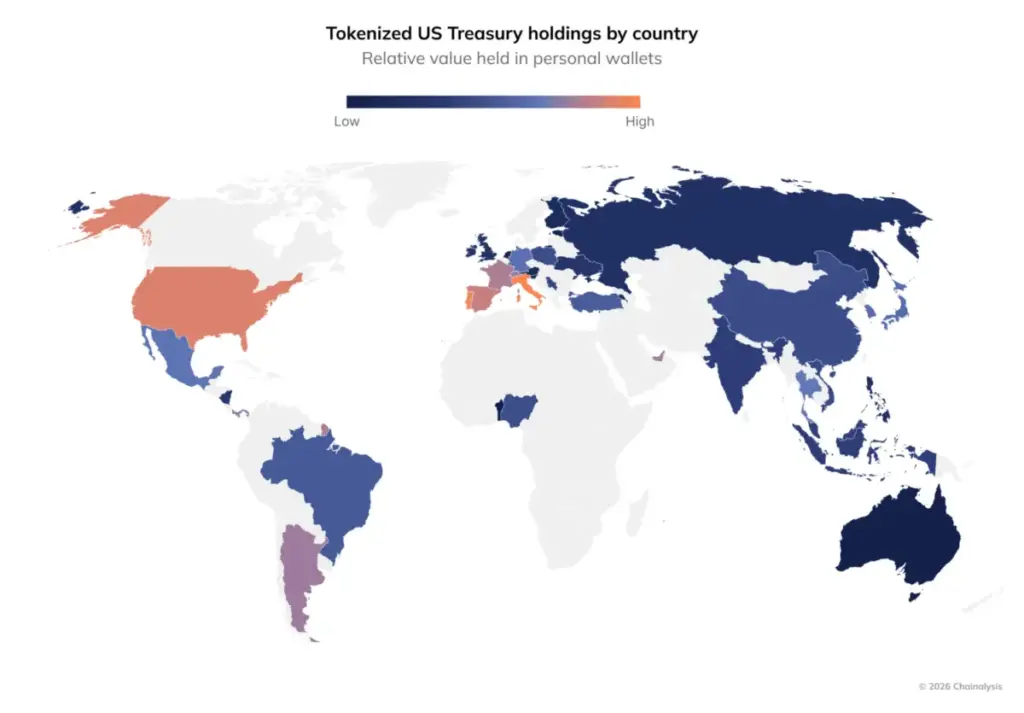
The United States also drives the rapidly expanding real-world asset tokenization sector. Global tokenized RWA market capitalization reached $36.07 billion at the conclusion of the second quarter of 2026, reflecting a 135% year-over-year expansion. Tokenized U.S. Treasury bonds represent the single largest asset class within this segment, totaling $15.42 billion and accounting for 42.8% of all tokenized RWA value.

Asset managers, public corporations, and financial institutions are increasingly placing equities, corporate credit, and private equity on-chain to leverage the speed, programmability, and global interoperability of blockchain infrastructure. While U.S. holders make up roughly 11.7% of the global tokenized RWA holder base, international investors—particularly in European and Asian markets like Italy, Portugal, and Singapore—drive a significant portion of tokenized Treasury holdings. This mechanism allows retail investors abroad to bypass traditional brokerage hurdles and directly access U.S. sovereign debt instruments.
Market utilization patterns indicate that tokenized Treasuries are primarily held as yield-generating assets rather than posted as lending collateral, distinguishing them from illiquid alternative assets like private credit, which have experienced substantial growth in decentralized lending markets.

Canada is a Global Leader in Peer-to-Peer and Remittances
While dwarfed in total volume by its southern neighbor, Canada’s $247.7 billion crypto economy demonstrated resilience, expanding 2.3% during the 2026 period. Canada stands out among G7 nations for maintaining an exceptionally robust peer-to-peer crypto economy, ranking seventh globally in both domestic and cross-border flows.
Stablecoins account for 44% of Canadian dollar-based order book volume, up from 30% the previous year, with USDC representing the dominant asset. According to Morva Rohani, Executive Director of the Canadian Web3 Council, the reliance on U.S. dollar-denominated stablecoins creates a policy challenge by driving foreign demand for U.S. sovereign debt rather than domestic alternatives. In response, Canada recently enacted a stablecoin framework to foster domestic Canadian dollar-backed stablecoin issuance, though local market adoption remains nascent compared to USD counterparts.

Canada’s preeminence in cross-border remittance flows is deeply tied to its demographics. With roughly 23% of its population born abroad—the highest proportion in the G7—Canada serves as a major remittance hub. Stablecoin and Bitcoin transfers destined for key corridors in India, China, and the Philippines reached $2.36 billion across the reporting period, representing a 141% year-over-year increase across 3.56 million transactions. Driven by the stark cost efficiencies of blockchain settlement compared to traditional banking fees—which often exceed 6%—immigrant populations and temporary visa holders are increasingly turning to digital assets to manage cross-border financial obligations.
As North American market infrastructure continues to evolve, the underlying narrative centers on American-built technological rails powering global financial demand, while local economies grapple with the integration of digital dollars, tokenized assets, and autonomous AI-driven commerce.
 Crypto Wallets & Security
 Crypto Wallets & Security
 Crypto Wallets & Security