
Eastern Asia’s cryptocurrency economy stands as one of the most diverse and dynamic ecosystems in the world. Ranging from completely distinct regulatory frameworks to varying risk appetites and business objectives, individual nations across the region continuously push users toward vastly different operational use cases. Although the broader regional crypto economy contracted modestly between July 2025 and June 2026—aligning with a global bear market—this decline was far from uniform. Institutional platforms in Hong Kong experienced an 87% year-over-year surge in incoming funds, marking the fastest institutional growth rate in East Asia. Meanwhile, Japanese users increasingly migrated toward decentralized exchanges (DEXs), where inflows climbed by 36%.
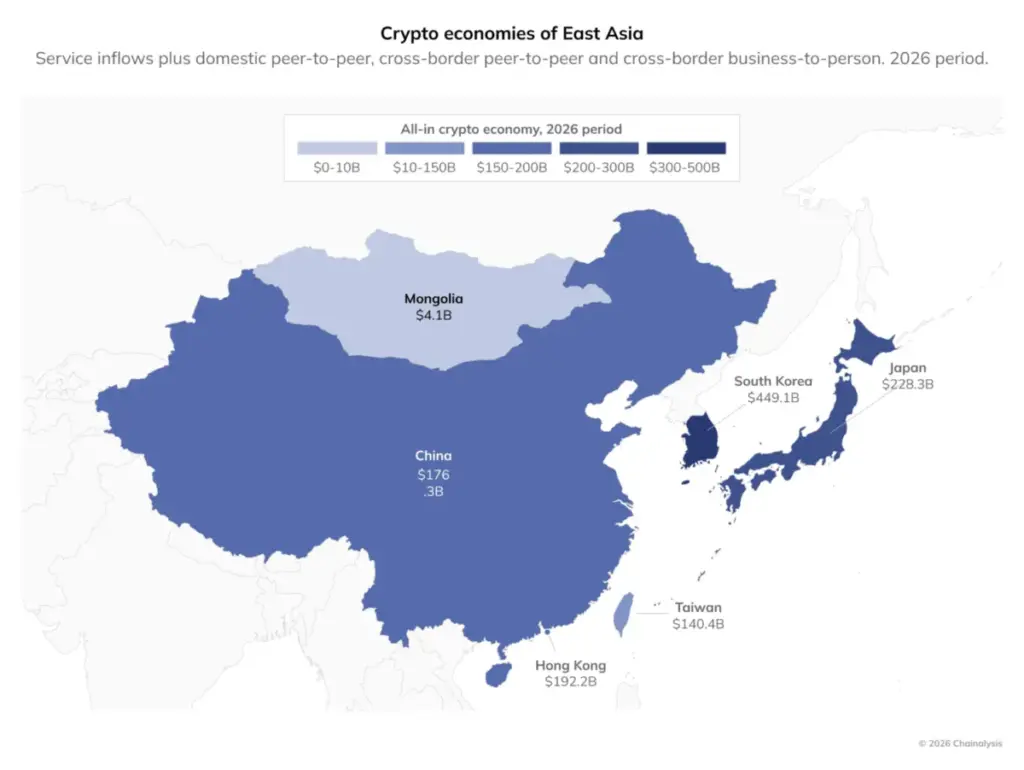
This regional contraction tells only part of the story regarding some of the world’s largest standalone digital asset hubs. South Korea, which ranks fifth in global grassroots adoption metrics, anchored a massive $449 billion crypto economy during the 2026 period, representing a 12.3% period-over-period expansion. This growth was propelled by a 16.3% increase in the South Korean exchange ecosystem and an unprecedented retail pivot toward buying and selling artificial intelligence-linked crypto assets.
According to regional experts, Eastern Asia remains a rare geographic anomaly. As Daniel Kim, CEO of Tiger Research, points out, Asia combines deep grassroots retail participation with substantial institutional firepower. However, local dynamics vary significantly. While locations like Hong Kong and Japan function primarily as institutional or advanced trading hubs, other countries lean heavily into grassroots adoption, utilizing digital assets either as mainstream financial instruments or as alternative financial channels to navigate strict domestic oversight.

South Korea Leads the Region as a Retail-Driven Crypto Powerhouse
South Korea’s all-in crypto economy reached $449 billion, growing 12.3% period-over-period alongside an additional $51.1 billion in exchange-related flows. Francis Kang, executive director of Korea Blockchain Week, notes that this expansion is heavily tied to the country’s famously retail-driven market environment and its direct alignment with broader macroeconomic tech trends, particularly the global AI trade.
Significantly, this growth occurred largely ahead of major traditional financial institution participation at scale. Legislative roadblocks have historically slowed institutional onboarding for payments and investments. It was not until February 2026 that the government began easing a longstanding ban prohibiting corporate crypto trading. Kang describes institutional engagement with digital assets in South Korea as being in a "preparatory mode," even as systemic institutional trends take root. Every major bank and securities firm in the country now maintains a specialized digital asset team, with most actively running stablecoin, tokenization, or custody pilots.
A primary catalyst for South Korea’s retail dominance has been the absence of capital gains taxes on crypto throughout the 2026 period. Although a long-delayed 22% profit tax is scheduled to take effect at the start of 2027, the National Assembly has postponed implementation previously and could potentially do so again. This looming tax deadline coincides with the gradual introduction of institutional participants.

In February 2025, the Financial Services Commission announced a regulatory roadmap opening the market to nonprofits, exchanges, listed companies, and registered professional investment corporations, though investment-driven corporate participation has yet to scale fully in practice. If the 2027 tax takes effect on schedule while corporate access simultaneously broadens, South Korea could see a fundamentally transformed market where retail activity cools down and institutional capital serves as a meaningful counterweight for the first time. Jinhyeong Jo, a senior examiner at Korea’s Financial Intelligence Unit, emphasizes that the ultimate outcome of ongoing National Assembly discussions will profoundly influence retail investor demand and overall market participation.
The AI Cryptocurrency Trade Dominates South Korea
South Korean retail investors have consistently favored high-risk, high-reward opportunities, a tendency most visible in the explosive growth of the AI cryptocurrency trade. South Korea’s traditional equities market is heavily anchored by SK Hynix, a dominant memory chip manufacturer supplying the hardware infrastructure for the global data center boom.
Parallel to the rise of SK Hynix in traditional markets, AI-crypto trading surged locally. By June 2026, AI-focused digital assets and infrastructure tokens became the single most popular thematically defined investment category by share of South Korean won-denominated trading volume, eclipsing traditional payment tokens like XRP.

This trend makes South Korea a clear outlier globally. In contrast, Japanese yen trading of AI-crypto assets reached a mere 0.91% in June 2026, making won-denominated activity roughly 19.5 times higher than the Japanese rate. Other major global currencies also saw negligible thematic volumes, with the Brazilian real at 0.20%, the British pound at 0.03%, and the euro at 1.02%.
A diverse array of AI cryptocurrencies attracted substantial bids from South Korean traders throughout the period. Worldcoin (WLD) led the sector with $7.41 billion in trading volume, followed by newcomer token SAHARA at $3.2 billion, VIRTUAL at $2.7 billion, BIO at $2 billion, and NEAR at $1.7 billion. While specific leading tokens within this category experienced rapid turnover—with 2025 leaders like VIRTUAL and KAITO giving way to newer projects—the data indicates that Korean retail traders navigate this sector with a speed and intensity unmatched by any other measured market.
Japan’s Consumer Crypto Economy and Regulatory Horizons
Japan’s $228 billion crypto economy often commands attention for its growing institutional activity. Unlike its regional peers, the core driving force behind Japan’s market is increasingly found within banks and financial corporations rather than individual consumers. Experts analyzing the world’s fourth-largest economy by GDP describe an environment where the most consequential digital asset developments happen within regulated institutions.

Nevertheless, Japan’s population of 122 million maintains a remarkably active consumer base. Data from the 2026 period reveals that approximately one in four individuals withdrawing funds from domestic Japanese exchanges subsequently deposit them into decentralized finance (DeFi) protocols. Furthermore, decentralized exchanges captured nearly 35% of market share within Japan’s services industry during the period—the highest share of any market in the region. Japanese engagement with DEXs has climbed over 200% since 2022, while centralized exchange activity has remained flat, challenging the assumption that Japan’s consumer footprint is negligible.
Taishi Sato, CEO of DeFimans and an SBI subsidiary, points out that highly visible consumer activity centers heavily on perpetual futures, or "perps." He attributes the popularity of derivatives in Japan to the sophistication of retail traders who are already well-versed in foreign exchange markets and understand the hedging strategies required to trade perps. Local traders frequently use platforms like Hyperliquid alongside equity portfolios to manage directional and macroeconomic exposure rather than treating them purely as crypto-native trading environments.
Regarding direct token investments, store-of-value assets like Bitcoin remained the most popular category, commanding 73.8% of yen trading volume in the 2026 period. However, store-of-value dominance slipped by 4.32 percentage points amidst a 27% drop in overall volume. Conversely, smart contract tokens such as Ethereum and Solana emerged as the primary gainers, capturing 15.4% of yen volume after a 17.7% absolute increase in trading activity.

Historically, high taxes have suppressed broader consumer adoption, with local crypto traders facing a maximum marginal rate of up to 55% under tax laws active through the 2026 period. However, a series of tax reforms advanced in July 2026 are expected to catalyze growth across all sectors of the Japanese market, particularly retail participation. If eligible gains transition from the current top rate to a separate 20% taxation model as anticipated, Japanese retail trading volumes could experience a significant boost.
Financial firms are similarly preparing for this shift. Yuya Hasegawa, a market analyst at Bitbank, notes that Japanese banks, brokers, and payment companies are actively recognizing digital assets—including stablecoins, real-world assets, tokenized deposits, and payments—as viable business lines. Experts are closely tracking newly introduced domestic payment tools, such as the yen-denominated stablecoins JPYC (launched in October 2025) and JPYSC (launched by SBI Group in June 2026), which facilitate international remittances, OTC trading, and FX settlement.
Hong Kong Emerges as Eastern Asia’s Institutional Hub
Hong Kong’s $192 billion crypto economy is defined less by its sheer size and more by the institutional nature of its participants. Deliberate government policy has positioned digital assets at the center of the city’s financial strategy, with regulatory clarity serving as the primary driver of participation.

SB Seker, Head of APAC at Binance, highlights that Hong Kong’s recent trajectory demonstrates how regulatory clarity and financial innovation can advance in parallel. The city’s inaugural Five-Year Plan and successive Policy Addresses explicitly identify stablecoins, tokenized finance, and central bank digital currencies as strategic priorities. Having issued its first stablecoin licenses in 2026, Hong Kong has successfully transitioned into live market testing with institutional participants. QCP Group notes that this regulatory direction naturally favors larger, well-controlled, and properly licensed operators, raising operational standards while bolstering overall market credibility.
This structured framework has successfully attracted institutional platforms, including over-the-counter desks, custody providers, and market makers. These entities captured 16% of Hong Kong’s service inflows during the 2026 period—up from roughly 9% two years prior and nearly triple the share recorded by any other regional market.
Hong Kong pulled in nearly $24 billion in inbound business-to-business service transfers during the study period, representing roughly six times the volume received by Japan and 44 times South Korea’s total. Substantial outbound flows of approximately $11 billion confirm that Hong Kong functions as a two-way institutional corridor for capital moving across Asia. Cumulative net business-to-business inflows accelerated steadily from mid-2022 onward, reaching $17.4 billion by mid-2026. This data indicates that institutional capital is not merely passing through Hong Kong as transient volume, but is instead settling securely within the local regulated perimeter.

China’s Stablecoin Use Surges Amid Social Credit Expansion
Tracking mainland China’s crypto economy remains inherently challenging due to the government’s enduring ban on domestic cryptocurrency services. Nonetheless, a substantial underground digital economy persists, estimated at a minimum of $176 billion during the 2026 period, with true volumes likely higher.
China’s crypto ecosystem is overwhelmingly driven by peer-to-peer (P2P) transactions rather than exchange-based inflows and outflows. Domestic P2P trading accounted for 59.1% of China’s total crypto economy in the 2026 period, marking a 3.5-fold increase in share compared to the previous cycle. A major catalyst behind this rapid P2P expansion appears linked to the expansion of China’s social credit system. In March 2025, state officials formally integrated behavioral scoring and blacklisting policies into the financial sector and internet infrastructure to restrict access to travel, credit, employment, and banking services.
Following this policy expansion in March 2025, monthly adoption rates for stablecoins used in domestic payments shifted decisively upward, maintaining consistent growth over 13 consecutive months. Monthly additions escalated from roughly $240 million in March 2025 to nearly $5 billion a year later. This structural shift is further corroborated by transaction size data showing massive surges in sub-$100, $100-$1,000, and $1,000-$10,000 transfer ranges.

Furthermore, economic metrics illustrate that China’s self-custodied stablecoins turn over at an extraordinary velocity of 33.2 times per year—more than triple the global average of 9.3 times and vastly outpacing regional peers like Japan (9.9 times), Hong Kong (6.1 times), and South Korea (5.1 times). Moving $104.1 billion across 18.1 million separate transfers on $3.1 billion in average holdings during the 2026 period, Chinese users consistently treat stablecoins as active working capital for domestic transactions rather than passive stores of value.
Ultimately, East Asia provides a striking case study in how varying regulatory approaches shape crypto markets. While China’s prohibition pushed local users toward decentralized peer-to-peer networks, markets like Hong Kong, Japan, Singapore, and South Korea have built supervised-access frameworks designed to bring digital assets into licensed perimeters. As institutional participation gathers momentum in Hong Kong and retail activity evolves across South Korea and Japan, upcoming data will provide further clarity on how regional markets navigate the balance between compliance and innovation.
 Crypto Wallets & Security
 Crypto Wallets & Security
 Crypto Wallets & Security







