
The cryptocurrency landscape across Central and Southeast Asia and Oceania (CSAO) is undergoing a profound structural evolution, characterized by a paradox of regional economic contraction and hyper-focused localized growth. According to new regional data covering the period from July 1, 2025, to June 30, 2026, the CSAO region—ranking as the sixth-largest crypto economy globally—experienced an overall 6.8% contraction in its aggregate digital asset economy. Yet beneath this surface-level downturn, the region has witnessed a vibrant proliferation of specialized use cases, ranging from advanced institutional tokenization and cross-border commercial settlements to resilient peer-to-peer (P2P) remittance networks.
While macroeconomic headwinds and shifting regulatory environments created turbulence in certain major markets, most territories within the CSAO region managed to expand their footprints in at least one distinct category of crypto activity. Institutional participation gathered immense momentum in financial powerhouses like Singapore and Australia. Meanwhile, grassroots peer-to-peer trading activity defied global trends in nations such as the Philippines, Thailand, and Vietnam. In India, speculative retail interest remained exceptionally robust, and across the entire region, stablecoins rapidly solidified their position as the preferred financial instrument for moving capital across international borders.
The Region’s Largest Crypto Economies
The CSAO crypto economy is anchored by three massive markets—Singapore, Australia, and India—each exhibiting distinct economic drivers, regulatory trajectories, and institutional trends.

Singapore recorded the largest measured digital asset economy in the region, generating an impressive $284 billion in total crypto activity during the 2026 tracking period. This represented a substantial 55.4% year-over-year expansion. A significant portion of Singapore’s growth was propelled by institutional-platform activity, which surged 94% to reach $60 billion. This high-value institutional volume was heavily concentrated among a select cohort of elite market makers, over-the-counter (OTC) trading desks, and institutional-grade brokerages. However, the financial hub’s broader crypto expansion remained remarkably well-rounded, evidenced by a 30% increase in capital flows into centralized exchanges (CEX) and a striking 69% increase in decentralized exchange (DEX) activity.
Australia secured its position as the region’s second-largest digital asset economy, boasting $173.1 billion in total economic activity. Although Australia’s overall activity dipped by 5.6%—largely dragged down by a sharp contraction in DEX value flows—both centralized exchanges and institutional platforms demonstrated resilient growth. Institutional flows within the country were predominantly captured by dedicated custodian services and OTC trading desks.
India, conversely, experienced one of the sharpest contractions in the CSAO region, with its crypto economy shrinking by 14.7% amid broader global market pressures. Despite this downturn, India remains an economic heavyweight in absolute terms, recording $135 billion in total economic activity during the 2026 period. Its centralized exchange activity remained particularly formidable, establishing India as the CSAO region’s undisputed leader in terms of CEX inflows.

Beneath Regional Decline, Pockets of Growth
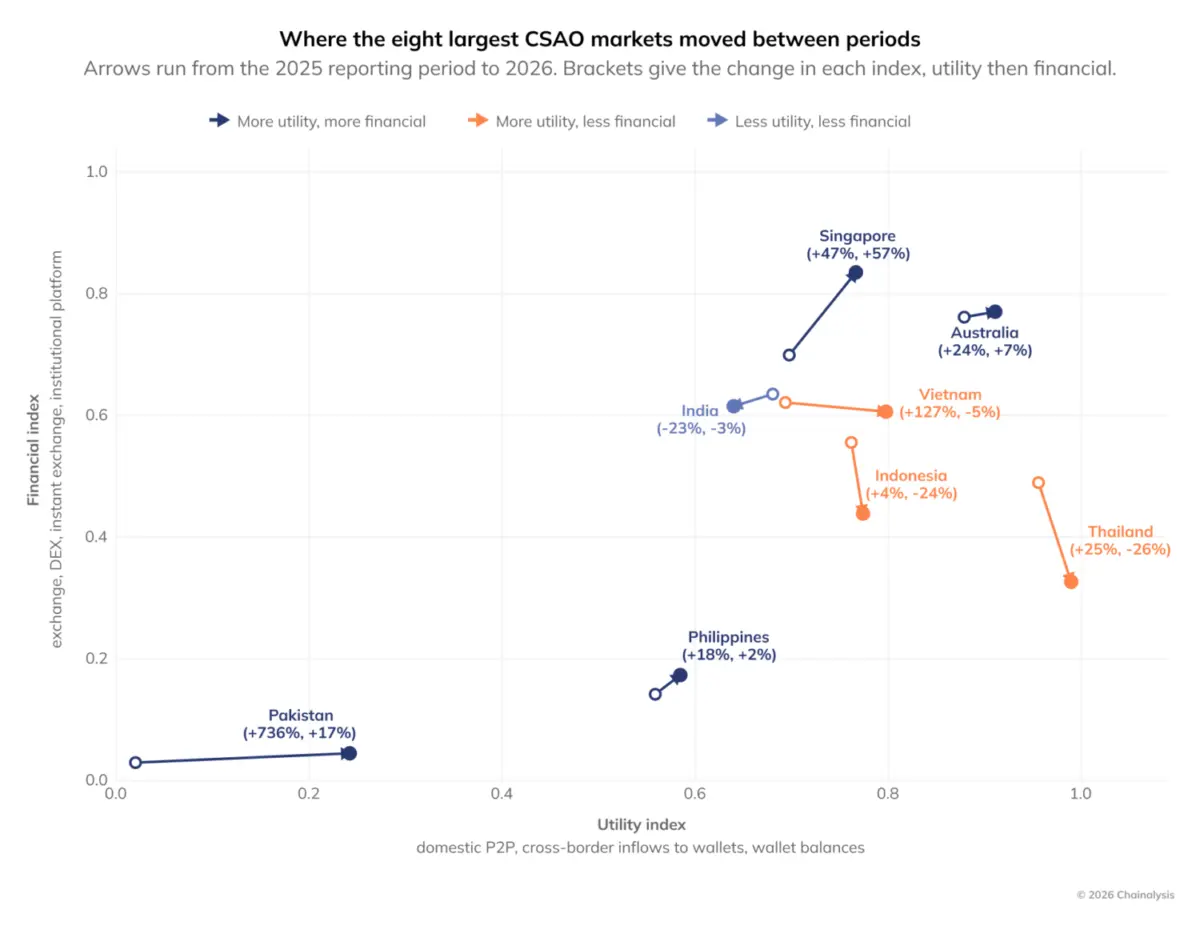
To accurately decipher the health and direction of digital asset adoption, analysts categorize activity into two distinct vectors: the financial index and the utility index. The financial index tracks capital moving into exchange services, reflecting traditional financial activities such as trading, lending, and staking. Conversely, the utility index measures the real-world functional integration of digital assets, tracking metrics like peer-to-peer payments and cross-border remittances that support day-to-day life and commerce.
Singapore and Australia both achieved growth across both the financial and utility indexes, underpinned by robust overall economic development and expanding institutional participation. In Australia, institutional platform activity expanded by 33.3% to reach $39.92 billion, driven by sustained inflows into market makers, OTC desks, and digital asset custodians.
Other emerging markets displayed fascinating localized trajectories. Pakistan recorded a staggering 736% surge on the utility index, though industry experts note this exponential growth occurred off a remarkably shallow baseline. During the preceding 2025 period, Pakistan recorded a mere $69 million in domestic P2P and cross-border utility activity—a nominal figure on the global stage. By the 2026 period, this figure climbed to $351 million. This notable rebound followed a pivotal regulatory shift in April 2026, when Pakistan officially dismantled a draconian seven-year ban that had historically prohibited domestic commercial banks from maintaining business relationships with cryptocurrency enterprises.

Meanwhile, the Philippines, Thailand, and Vietnam all registered significant gains in their utility metrics, propelled by surging peer-to-peer activity. Together, these three nations accounted for an outsized 14.4% of the global total for small-value P2P transfers during the 2026 period.
A closer examination of practical utility reveals a unifying regional trend: stablecoins overwhelmingly dominate cross-border capital flows. In every single CSAO market analyzed, cross-border stablecoin activity vastly outpaced domestic transactions. Malaysia exhibited the most pronounced disparity, with cross-border stablecoin activity running 29.5 times larger than domestic usage. Across the entire CSAO region, the average ratio stood at 3.2 to 1.
This structural divide is largely a byproduct of advanced domestic payment infrastructure. Many nations in Central and Southeast Asia and Oceania already possess highly efficient, instantaneous domestic digital payment rails, rendering stablecoins redundant for everyday local purchases. As David Low, CEO of Malaysian digital asset exchange Hata, observed, stablecoins offer a relatively weak value proposition for everyday domestic transactions. However, where the economic opportunity becomes compelling is in cross-border settlement, where traditional banking corridors remain slow and expensive.

In the Philippines, remittances are serving as a primary catalyst for stablecoin adoption. Nichel Gaba, founder and CEO of the Philippine Digital Asset Exchange (PDAX), noted that the country hosts the fourth-largest remittance market globally. Driven by a massive overseas diaspora sending financial support back home, Gaba estimates that approximately 5% to 10% of inbound remittances are now settled via stablecoins, with all major remittance operators actively deploying stablecoin settlement pipelines into the country.
Business-to-business cross-border stablecoin payments have similarly transitioned from theoretical concepts into deployed commercial realities within the $284 billion Singaporean crypto economy. According to Srivatsan Tirumalai, former executive director of architecture and engineering at Singapore-based financial services group UOB, corporate treasuries and regional merchants are increasingly utilizing regulated stablecoins to bypass administrative delays, cut transaction fees, and circumvent conventional banking friction, achieving instantaneous cross-border settlement.
While several countries maintain substantial domestic stablecoin markets—such as Thailand with $10.4 billion and Vietnam with $6.9 billion—their cross-border stablecoin volumes consistently dwarf domestic circulation by 50% to over 100%.

The Philippines, Thailand, and Vietnam Beat Global P2P Growth
While institutional players leverage stablecoins for wholesale settlement, retail participants across Southeast Asia continue to rely heavily on small-value peer-to-peer transfers for day-to-day economic coordination.
During the 2026 period, the Philippines, Thailand, and Vietnam collectively processed 5.4 million small-value P2P transfers under $10,000. This volume accounted for 14.4% of the global total, an extraordinary statistic given that the combined population of these three nations represents a mere 2.5% of the worldwide cryptocurrency economy.
Micro-transactions underpinned the vast majority of this activity. More than four out of five domestic transfers executed within these three countries were valued under $1,000, yielding an average transfer size of $618. By comparison, the average transfer size across the remainder of the global crypto economy stood at $1,210.

Institutional Activity Is Gaining Ground, Opening New Use Cases
Institutional participation has emerged as a transformative force reshaping the CSAO digital asset ecosystem. Across the region, institutional platforms—encompassing market makers, prime brokers, OTC desks, custodians, and institutional-exclusive exchanges—processed $152.3 billion during the reporting period, representing a 40% increase year-over-year. By the conclusion of the second quarter of 2026, institutional-platform activity climbed to account for 18.9% of all regional crypto service inflows.
Traditional financial institutions, including commercial banks and institutional asset managers, are aggressively evaluating how blockchain infrastructure and digital assets can be integrated into their existing product suites and market frameworks. Singapore and Australia are spearheading this institutional dialogue.
Nicolas Gilardi, head of risk and compliance at Australian exchange BTC Markets, noted a definitive philosophical shift in the Australian market. Where 2025 was defined by retail accumulation, 2026 became characterized by functional utility—specifically utilizing digital assets as collateral, settlement instruments, and tokenized financial assets. Daniel Yang, head of compliance at Singaporean trading firm QCP Group, echoed this sentiment, emphasizing that Singapore’s institutional narrative has successfully broadened beyond simple trading returns to encompass corporate treasury management, digital payments, and core financial market infrastructure.

This institutional maturation is rippling across neighboring jurisdictions as well. In Malaysia, Hata CEO David Low noted that discussions among traditional financial institutions have decisively evolved from questioning whether to participate in digital assets to determining the optimal strategic entry point. Similar sentiments were echoed by industry leaders in Indonesia and Thailand, where engagement between licensed crypto platforms and legacy financial entities is rapidly intensifying around real-world asset tokenization and investment tokens.
Australia’s Crypto Market Is Broadening
Australia’s domestic crypto market outpaced both regional and global averages in institutional adoption. Institutional platforms within Australia absorbed $40 billion in capital inflows during the 2026 period, constituting 24.8% of all domestic service inflows. Market makers captured 35% of these institutional inflows, prime brokers and OTC desks attracted 19%, and custody and collateral providers accounted for 26%.
Industry stakeholders attribute this growth to the proliferation of investment vehicles tailored to traditional financial sensibilities, including self-managed superannuation funds (retirement accounts) and regulated wrappers such as exchange-traded funds (ETFs). Tokenization initiatives have also gained substantial traction. Project Acacia, a collaborative venture between the Reserve Bank of Australia and the Digital Finance Cooperative Research Centre, has been actively investigating the integration of digital money and tokenized assets across wholesale financial market infrastructure.

Furthermore, evolving regulatory clarity has fortified institutional confidence. Amy-Rose Goodey, CEO of the Digital Economy Council of Australia, pointed to critical regulatory milestones, including the implementation of expanded anti-money laundering and counter-terrorism financing frameworks covering crypto-to-crypto exchanges and custody providers. Additional confidence stems from the Australian Securities and Investments Commission’s anticipated licensing framework for digital asset and tokenized custody platforms, scheduled for full implementation in 2027.
Beyond institutional dynamics, Australia’s cross-border crypto economy has exhibited distinct asset-allocation patterns. While Bitcoin continues to dominate the movement of high-value capital—historically funneling heavily toward North American liquidity hubs—stablecoins have rapidly overtaken Bitcoin in terms of transaction frequency for small and medium-sized outbound transfers, often coursing through Eastern Asian trade corridors. Data from the reporting period indicates that outbound stablecoin transfer counts from Australia surged from approximately 100,000 transactions in 2021-2022 to roughly 2 million transactions in 2025-2026, with cumulative stablecoin cross-border value surpassing $3 billion.
Singapore Strengthens Its Position as Regional Crypto-Finance Hub
Singapore continues to solidify its stature as the premier institutional crypto-finance hub of the CSAO region. The city-state registered comprehensive growth across virtually every major adoption metric during the 2026 period.

Industry participants attribute Singapore’s sustained momentum to a measured, incremental regulatory approach implemented by the Monetary Authority of Singapore. Clear legislative frameworks, such as the Digital Payment Token licensing regime and the formal stablecoin regulatory framework, have provided regulated financial institutions and institutional investors with the legal certainty required to deploy capital into digital asset initiatives.
This regulatory clarity directly correlates with Singapore’s surging institutional-platform volumes, which expanded by 94% year-over-year—vastly outperforming the broader regional growth rate of 19% and the global benchmark of 15%. Reflecting this institutionalization, the proportion of Singapore-attributed cryptocurrency held in personal self-custody wallets declined sharply from a peak of 88% in April 2023 to 28% by June 2026. Singapore now holds a lower percentage of assets in self-custody than the broader CSAO regional average of 41% or the global benchmark of 32%, underscoring its evolution into a centralized jurisdiction for professional trading, custody, and institutional market intermediation.
Additionally, Singapore has maintained its status as a consistent net receiver of cross-border crypto inflows, accumulating a cumulative net inbound balance of approximately $5 billion by mid-2026.

India’s CEX Activity Remains Strong
India maintained its standing as the CSAO region’s third-largest overall crypto economy while capturing the crown as the region’s largest market for centralized exchange activity. Between July 2025 and June 2026, India-based users absorbed $88.4 billion in centralized exchange inflows, narrowly surpassing Singapore at $82.3 billion, Australia at $79.3 billion, and Vietnam at $69.8 billion.
Ashish Singhal, co-founder of Indian exchange CoinSwitch, noted that India’s digital asset market remains fundamentally investment-driven, with participants primarily purchasing, holding, and selling digital assets as speculative and diversifying instruments. However, the demographic profile of the investor base is maturing, drawing in an influx of older investors aged 35 and above alongside high-net-worth portfolios. Edul Patel, CEO of Indian exchange Mudrex, observed a parallel psychological shift among domestic users, moving away from short-term speculative trading toward long-term asset accumulation, with crypto increasingly treated as a portfolio diversifier alongside equities, gold, and mutual funds.
Despite strong overall exchange inflows, India presents a unique structural anomaly regarding domestic platform usage. The share of exchange volume captured by domestic Indian platforms plummeted in mid-2022 from approximately 7% down to 0.7%, where it has remained depressed. By comparison, domestic platforms across other CSAO markets process an average of roughly 7% of their local trading volumes. Industry executives attribute this capital migration primarily to regulatory friction, specifically the 1% tax deducted at source (TDS) introduced on virtual digital asset transactions in India in 2022, which compliant local exchanges are legally mandated to enforce while offshore competitors frequently evade.

Takeaways for Central and Southeast Asia and Oceania
The trajectory of the Central and Southeast Asia and Oceania crypto economy will depend heavily on the successful translation of institutional interest and retail utility into enduring long-term infrastructure. Industry leaders emphasize that sustained regional expansion relies on predictable regulatory clarity, robust investor protection, and dependable supporting market architecture.
At the same time, expanding institutional involvement raises the strategic stakes. As Ashwin Chockalingam, chief financial officer at Malaysian fintech firm Blox, cautioned, a major industry failure could severely jeopardize fragile trust among mainstream consumers, institutional partners, and regulators just as institutional confidence takes root.
Ultimately, the future of digital assets in the CSAO region extends far beyond speculative trading. The overarching opportunity lies in leveraging blockchain technology and tokenized infrastructure to fundamentally transform how the region executes commercial payments, structures financial markets, and coordinates cross-border trade. As Mudrex CEO Edul Patel summarized, the region is witnessing a definitive historical transition—shifting decisively from viewing crypto purely as an investable asset class to embracing crypto and blockchain technology as core foundational financial infrastructure.
 Crypto Wallets & Security
 Crypto Wallets & Security
 Crypto Wallets & Security







