
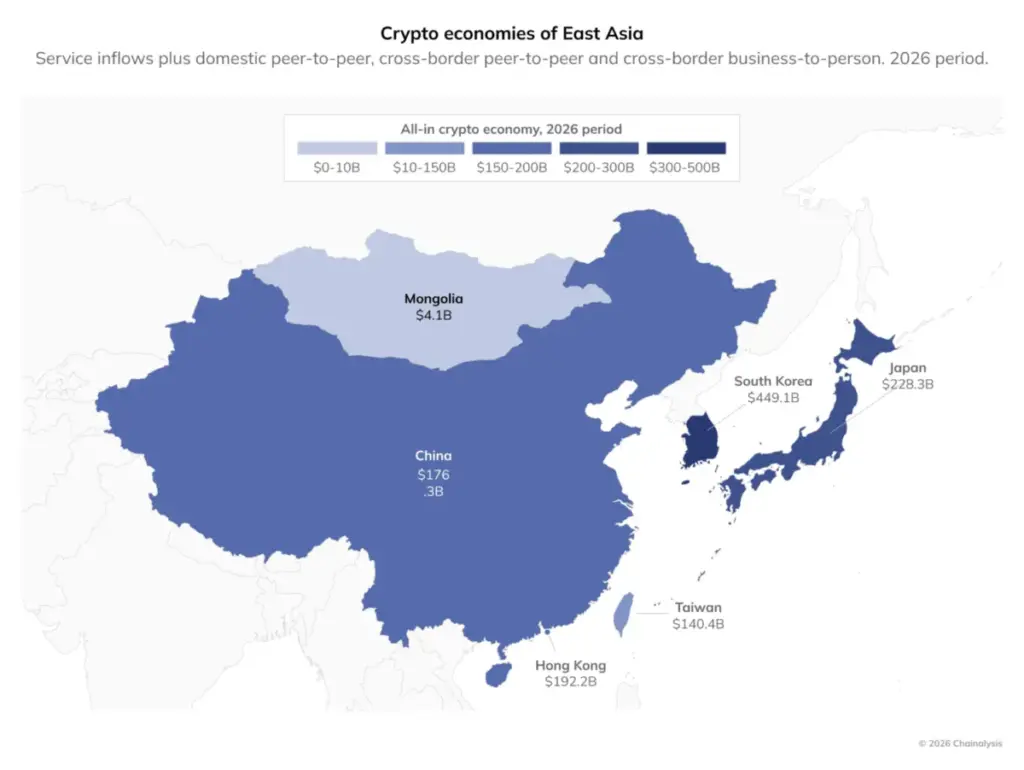
Eastern Asia remains one of the most economically diverse and dynamic cryptographic landscapes in the world. From country to country, sharply contrasting regulatory frameworks, distinct risk appetites, and diverse commercial objectives are steering users toward entirely different use cases. While the region’s broader digital asset economy contracted modestly between July 2025 and June 2026, aligning with a global bear market, this downturn was far from uniform. Instead, the regional contraction masks pockets of explosive growth, underscored by a massive influx into institutional platforms in Hong Kong and a pronounced retail pivot toward decentralized exchanges in Japan.
Industry observers note that the region occupies a rare sweet spot in the global financial ecosystem. As Daniel Kim, CEO of Tiger Research, points out, Asia stands out as a rare territory boasting both deep grassroots retail participation and formidable institutional power. Yet, how this power manifests depends heavily on national borders. Markets like Hong Kong and Japan are increasingly serving as institutional and sophisticated trading hubs, while countries like South Korea experience heavy grassroots demand for financial instruments, and Mainland China reflects a reliance on alternative financial channels driven by unique domestic pressures.

South Korea Emerges as the Region’s Largest Crypto Market
Topping the regional scale, South Korea anchored a massive $449 billion all-in cryptocurrency economy during the 2026 tracking period, marking a 12.3% period-over-period expansion. This growth was further bolstered by an additional $51.1 billion in direct exchange-related flows. Francis Kang, executive director of Korea Blockchain Week, notes that this expansion is largely attributable to the country’s famously retail-driven market dynamics, which have found a powerful parallel in the broader global tech and AI trade.
Significantly, this growth has unfolded largely in the absence of major domestic financial institutions operating at scale. Legislative roadblocks and historical caution have slowed institutional entry into digital assets for payments or investments. It was only in February 2026 that the government began easing a longstanding ban on corporate crypto trading. According to Kang, institutional engagement in South Korea remains largely in a "preparatory mode," even as the underlying momentum takes shape. Every major domestic bank and securities firm now houses a digital asset team, running pilots focused on stablecoins, tokenization, and custody.

Adding to the retail momentum, South Korea’s crypto market enjoyed an environment free of specific capital gains taxes throughout the 2026 period. While a long-delayed 22% tax on crypto profits is officially scheduled to take effect at the beginning of 2027, the National Assembly has postponed the implementation before and could potentially do so again. This looming tax deadline coincides with a broader regulatory roadmap announced by the Financial Services Commission in February 2025, which gradually opens the market to nonprofits, exchanges, listed companies, and registered professional investment corporations. Jinhyeong Jo, a senior examiner at Korea’s Financial Intelligence Unit, notes that the ultimate outcome of ongoing legislative discussions will have a profound impact on retail investor demand and future market participation.
The AI Cryptocurrency Trade Dominates South Korea
South Korean retail investors have historically favored high-risk, high-reward opportunities, a tendency most visible in the country’s enthusiastic embrace of the artificial intelligence narrative. Domestically, the traditional equity market is heavily anchored by manufacturing giants like SK Hynix, which produces the essential memory chips powering the global data center and AI explosion.

In parallel with this equity boom, AI-focused cryptocurrencies surged in popularity. By June 2026, digital assets tied to AI projects and infrastructure became the single most popular thematically defined investment category by won-denominated trading volume, eclipsing traditional payment tokens such as XRP. This concentration makes South Korea an extreme outlier globally. Japanese yen trading pairs for AI crypto reached a modest 0.91% in June 2026, making South Korean won-denominated activity nearly twenty times higher. By comparison, other major currencies saw negligible volumes in the category, with the Brazilian real at 0.20%, the euro at 1.02%, and the British pound at just 0.03%.
During the reporting period, traders poured capital into a wide assortment of AI tokens. Worldcoin (WLD) led the field with $7.41 billion in trading volume, followed by newer entrants like Sahara, Virtual, Bio, and Near. Market data highlights that Korean retail traders are cycling through these thematic categories at a much higher velocity and intensity than any other measured market, demonstrating an aggressive appetite for emerging tech narratives.

Japan’s Evolving Consumer and Institutional Crypto Economy
Japan’s $228 billion crypto economy frequently commands attention for its growing institutional footprint, driven increasingly by commercial banks and financial firms rather than retail consumers alone. Yet, beneath the headlines of corporate adoption, the country’s 122 million citizens maintain an active and evolving footprint in decentralized finance.
Data from the 2026 period indicates that roughly one in four individuals withdrawing funds from Japan-domiciled centralized exchanges subsequently deposit those funds into decentralized finance protocols. Furthermore, decentralized exchanges captured nearly 35% of Japan’s services industry market share, representing the highest proportion in the region. Japanese engagement with decentralized platforms has climbed more than 200% since 2022, while centralized exchange activity has remained comparatively flat, challenging the assumption that Japanese consumers play a minimal role in on-chain markets.

Taishi Sato, CEO of DeFimans, observes that a significant portion of this visible activity centers on perpetual futures. He attributes this popularity to a sophisticated trader population already well-versed in foreign exchange and currency trading, who naturally utilize on-chain derivatives venues like Hyperliquid alongside traditional equities to manage macroeconomic and directional exposure.
When investing in spot tokens, Japanese traders heavily favor established stores of value. Bitcoin accounted for 73.8% of yen-denominated trading volume during the 2026 period, though its absolute volume dipped alongside a 4.32 percentage point drop in market share. Conversely, smart contract tokens such as Ethereum and Solana emerged as the primary gainers, expanding their share of yen trading volume from 10% in 2025 to 15.4% in 2026.

According to Arisa Toyosaki, general manager of Binance Japan, the country’s retail base has historically been constrained by a conservative investing culture and punitive tax laws, which imposed a maximum marginal tax rate of 55% on crypto gains. However, tax reforms advanced in mid-2026 are expected to ease these frictions by moving eligible gains toward a separate 20% taxation structure, potentially revitalizing retail trading volumes moving into 2027.
Concurrently, financial institutions are beginning to treat digital assets—including stablecoins, tokenized deposits, and real-world asset tokenization—as legitimate new business lines rather than speculative trades. Yuya Hasegawa, a market analyst at Bitbank, notes that the introduction of locally useful financial tools like yen-denominated stablecoins, such as JPYC and the SBI Group’s JPYSC, will help bridge the gap between traditional banking infrastructure and on-chain markets.

Hong Kong Establishes Itself as Eastern Asia’s Institutional Hub
Hong Kong’s $192 billion crypto economy is characterized less by raw retail volume and more by the caliber of its participants. Guided by deliberate government strategies, the city has positioned regulatory clarity as the primary catalyst for sustainable growth. SB Seker, head of APAC at Binance, notes that Hong Kong’s trajectory demonstrates how financial innovation and rigorous regulatory compliance can successfully advance in parallel.
Under its strategic policy frameworks, which prioritize stablecoins, tokenized finance, and central bank digital currencies, Hong Kong issued its initial batch of stablecoin licenses and initiated institutional market testing. QCP Group observes that this tightly regulated environment naturally favors larger, well-controlled operators, raising compliance standards while bolstering overall market credibility.

This regulatory certainty has attracted institutional platforms—including over-the-counter desks, custody providers, and market-makers—which captured 16% of Hong Kong’s service inflows during the 2026 period, up from approximately 9% two years prior. No other Eastern Asian market exceeds 6% in this category. During the same timeframe, Hong Kong pulled in nearly $24 billion in inbound business-to-business transfers, vastly outpacing its regional neighbors and functioning as a two-way corridor for institutional capital flowing across Asia. Cumulative net business-to-business inflows reached $17.4 billion, indicating that institutional capital is settling permanently inside the city’s licensed regulatory perimeter.
China’s Stablecoin Adoption Surges Amid Social Credit Expansion
Tracking Mainland China’s crypto economy remains inherently challenging due to the government’s official ban on domestic crypto services. Nevertheless, robust activity persists. Available data estimates China’s crypto economy at a minimum of $176 billion for the 2026 period, driven overwhelmingly by peer-to-peer transactions rather than exchange inflows. Domestic peer-to-peer activity represented 59.1% of China’s total crypto economy during the period, reflecting a dramatic threefold increase in share compared to previous years.

A major driver behind this accelerating peer-to-peer adoption appears linked to domestic policy shifts, specifically the expansion of China’s social credit system into the financial and internet sectors. By utilizing behavioral scoring and blacklists to restrict access to traditional credit, travel, and financial services, the system has increasingly intersected with banking compliance infrastructure.
Data indicates a sharp acceleration in domestic stablecoin payments beginning in March 2025, maintaining consistent month-over-month growth for over a year. This trend suggests two primary behaviors among users: individuals blacklisted by traditional credit systems turning to censorship-resistant alternatives, and citizens seeking to bypass strict domestic financial monitoring when conducting routine online commerce. Furthermore, the velocity of money within China’s self-custodied stablecoin holdings reached an extraordinary 33.2 turnovers per year—more than triple the global average—indicating that users are actively deploying stablecoins as functional working capital rather than holding them as static stores of value.

As regulatory models across East Asia continue to diverge—ranging from outright prohibition in China to supervised access regimes in Hong Kong, Japan, Singapore, and South Korea—the region provides a clear testing ground for the future of global digital finance. Whether these supervised environments successfully funnel all forms of domestic and cross-border activity into compliance remains to be seen, but ongoing data collection continues to map the shifting gravity of the global crypto economy.
 Crypto Wallets & Security
 Crypto Wallets & Security
 Crypto Wallets & Security







