North America maintained its position as the most influential region for global cryptocurrency markets during the 12-year reporting period ending July 1, 2026. Powered by a deep U.S. investor base supplying critical capital, evolving regulatory frameworks, and stablecoins functioning as a reliable digital currency, the region continues to export its financial innovations to the rest of the world.

According to recent metrics, the United States and Canada topped the global "big-money index"—an unweighted measurement tracking sheer crypto-economic power. Combined, their crypto economies totaled $3.02 trillion during the 2026 reporting period, representing a modest 1.9% contraction compared to the previous year.
This minor regional downturn was primarily driven by a slowdown within the United States. The U.S. crypto economy dipped 2.2% to $2.78 trillion, a predictable adjustment amid a challenging bear market. However, the world’s single-largest crypto economy largely preserved the dramatic near-doubling of value it achieved during the 2025 period. Robust institutional pillars, including the proliferation of crypto exchange-traded funds (ETFs), accelerating asset tokenization, and the widespread adoption of stablecoins, played a crucial role in safeguarding those previous gains.

Industry leaders point to structural maturation as the driving force behind this stabilization. Hoolie Tejwani, Head of Venture at Coinbase, noted that the foundational elements established in 2025 have successfully transformed into tangible products boasting active users, deep liquidity, and thriving markets by 2026.
The U.S. Influence on Global Products

The profound reach of the North American market is clearly demonstrated by three key developments capturing global attention: AI commerce, stablecoins, and tokenized real-world assets. Concurrently, Canada’s crypto landscape has charted an independent course, exhibiting surprising resilience and bucking regional trends with a 2.3% expansion of its $250 billion digital economy, heavily fueled by vibrant peer-to-peer activity among its diverse immigrant populations.
The United States is spearheading the burgeoning AI on-chain economy, most notably through x402—a prominent digital payments rail enabling AI agents to autonomously execute financial transactions. With major domestic players like Circle, issuer of the USDC stablecoin, and Coinbase, creator of the x402 system, providing foundational support, autonomous software is increasingly paying for on-chain services without human intervention.

Traditional payment rails such as credit card networks struggle to process micro-transactions economically due to overhead costs. In contrast, stablecoins capable of settling for a fraction of a cent make sub-penny transactions entirely viable. This technical capability has unlocked an entirely new market for pay-as-you-go digital goods and services, including real-time API data retrievals. By the close of the 2026 reporting period, cumulative x402 transactions on Base—the leading blockchain for agentic commerce—surpassed 138 million.
The Maturation of AI Payments

Industry observers note that agentic commerce is rapidly transitioning from a purely experimental phase into a formalized, recurring economic model. Data tracking wallet activity reveals increasing stickiness and intent among users. The share of wallets securing a second funding round within 30 days of initial capitalization climbed from 70.6% in the third quarter of 2025 to 89.3% by the second quarter of 2026.
Furthermore, the time gap between initial wallet funding and the first x402 expenditure shrank dramatically. While early adopters in late 2025 waited a median of 73 days before executing an x402 transaction, users by the third quarter of 2026 initiated payments within a median of just 18 minutes. Approximately two out of three new wallets now spend almost immediately after being topped up, signaling purposeful utility rather than speculative testing.

AI agents are predominantly utilizing these payment rails to acquire machine-readable information, including code reviews, financial intelligence, data search APIs, and model inference services. Geographically, American-funded AI agents dominate this sector, accounting for roughly 30% of all geolocated agent-to-services transactions globally. U.S. wallets represent an overwhelming 88.1% of all AI model inference payments on the protocol, highlighting a concentration of AI development and deployment within North America.
Digital Dollars and Digital Gold

The U.S. regulatory and economic landscape has similarly solidified the nation’s role as the premier exporter of digital dollars while simultaneously functioning as a primary destination for institutional Bitcoin accumulation. Following the legislative passage of the GENIUS Act in mid-2025, stablecoins have firmly established U.S. sovereign debt as the preferred currency for cross-border commerce and peer-to-peer economies worldwide.
Conversely, domestic American crypto activity shows a diverging trend where stablecoins occupy a smaller share of transaction volume compared to international markets, where foreign users increasingly rely on digital dollars to hedge against local economic friction. Meanwhile, U.S. investors have leaned heavily into Bitcoin as a scarce monetary alternative, driven by institutional allocations following the 2024 launch of spot Bitcoin ETFs. Large-denomination cross-border inflows into the United States underscore this institutional accumulation, even as retail users engage in net outward transfers.

Tokenization and Real-World Assets
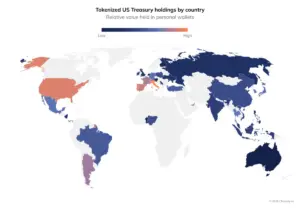
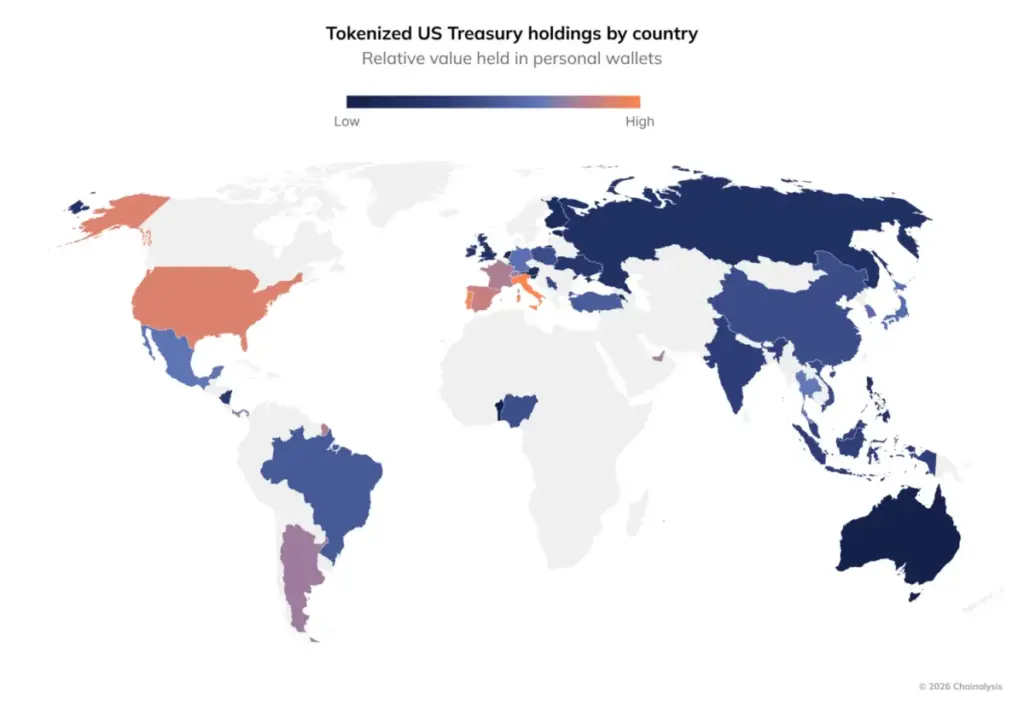
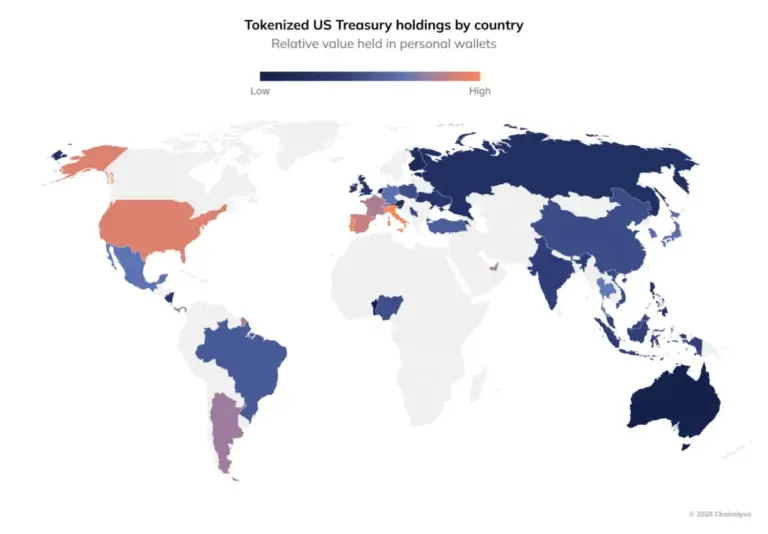
The tokenization sector experienced explosive growth throughout the 2026 reporting period, with the global real-world asset (RWA) market expanding 135% year-over-year to reach $36.07 billion by the end of the second quarter. U.S. Treasury debt emerged as the single largest tokenized asset class, accounting for $15.42 billion—or 42.8%—of total tokenized RWA value.

While domestic institutions have engineered the infrastructure for tokenized securities, international investors have readily embraced these products to gain direct exposure to U.S. sovereign yield without navigating traditional brokerage relationships. Industry participants emphasize that this convergence represents a fundamental evolution where traditional finance adopts high-speed, programmable blockchain infrastructure rather than operating as a separate financial ecosystem.
Canada’s Resilient Peer-to-Peer Economy

While dwarfed in sheer volume by its southern neighbor, Canada’s $247.7 billion crypto economy demonstrated unique structural characteristics during the 2026 reporting period. Canada ranks prominently within global metrics for peer-to-peer and cross-border activity, driven in large part by its substantial foreign-born population.
Stablecoins, predominantly denominated in U.S. dollars, capture nearly 44% of Canadian dollar-based order book volume. This reliance on foreign-denominated assets has sparked domestic policy discussions regarding the necessity of Canadian dollar-backed stablecoin alternatives, particularly following the royal assent of Canada’s Stablecoin Act.

Furthermore, robust remittance corridors connecting Canada to nations such as India, China, and the Philippines continue to process billions of dollars annually via digital assets, offering a cost-effective alternative to traditional banking channels burdened by high remittance fees.
As regulatory frameworks continue to evolve across North America—including the implementation of new stablecoin legislation in Canada and pending guidance regarding tokenization and agentic payments in the United States—the region remains firmly entrenched as the epicenter of global cryptocurrency development and institutional adoption.
 Crypto Wallets & Security
 Crypto Wallets & Security
 Crypto Wallets & Security