
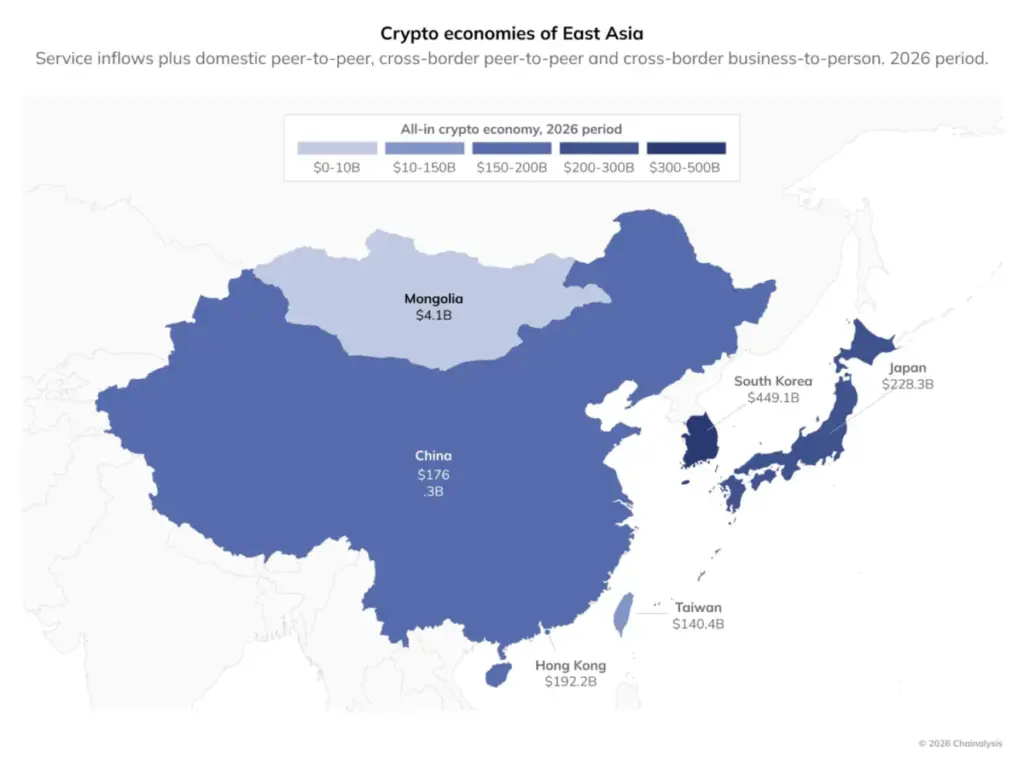
Eastern Asia’s cryptocurrency landscape stands as one of the most diverse and dynamic digital asset ecosystems in the global economy. Spanning multiple jurisdictions with wholly distinct regulatory frameworks, distinct risk appetites, and varied business objectives, users across the region are continuously pushed toward drastically different use cases. While the broader regional crypto economy contracted modestly overall between July 2025 and June 2026, aligning with a global bear market, this downturn was far from uniform. Growth hotspots emerged across different sectors, driven by institutional adoption in financial centers like Hong Kong, soaring decentralized finance engagement in Japan, and unique retail trends in South Korea and mainland China.
Regional leaders and market observers note that Asia remains a rare geographic territory housing both immense grassroots retail depth and powerful institutional backing. As regulatory policies diverge sharply from country to country—ranging from outright prohibitions to carefully structured licensing regimes—the region offers a vivid real-world case study on how government oversight shapes digital asset behavior.

South Korea Leads the Region as Retail Traders Pivot to AI Cryptocurrencies
South Korea solidifies its status as the regional leader, anchoring a staggering $449 billion all-in crypto economy that grew 12.3% period over period between mid-2025 and mid-2026, alongside an additional $51.1 billion in direct exchange-related flows. This expansion is heavily fueled by the country’s famously retail-driven market, where individual investors actively seek out high-risk, high-reward opportunities.
Much of this retail enthusiasm has converged around the broader "AI trade." In parallel with the explosive growth of South Korea’s mainstream stock market—which is heavily dominated by memory-chip giant SK Hynix powering the global data center boom—AI-focused cryptocurrencies captured the imagination of local traders. By June 2026, digital assets tied to artificial intelligence projects and infrastructure became the single most popular thematically defined investment category by share of won-denominated trading volume, comfortably outpacing traditional payment tokens like XRP.

The sheer scale of this trend makes South Korea a global outlier. Won-denominated trading activity in AI crypto assets reached levels nearly twenty times higher than Japanese yen-denominated trades and vastly outpaced equivalent volumes recorded in the Brazilian real, British pound, and euro. Leading the charge among these tokens was Worldcoin, which pulled in $7.41 billion in volume, followed by newcomer tokens such as Sahara, Virtual, Bio, and Near.
This rapid retail turnover occurs against a backdrop of impending structural change. Throughout the 2026 study period, South Korean retail crypto trading benefited from the absence of capital gains taxes. However, a long-delayed 22% tax on crypto profits is scheduled to take effect at the start of 2027. Concurrently, the government is gradually easing longstanding bans on corporate crypto trading, opening pathways for nonprofits, exchanges, and listed companies. While major financial institutions have largely remained in a preparatory mode—running pilots for stablecoins, tokenization, and custody through newly formed digital asset teams—the potential convergence of new tax policies and broader corporate access in 2027 could fundamentally transform the Korean market into a space where institutional capital serves as a meaningful counterweight to retail demand.

Japan’s Evolving Market Balances Institutional Ambition with Consumer DeFi Activity
Japan’s $228 billion crypto economy is frequently characterized by its strong institutional momentum, driven primarily by banks, financial firms, and regulated brokers in the world’s fourth-largest economy by GDP. Yet, the nation’s 122 million citizens maintain a robust and active consumer footprint that continues to challenge perceptions of a purely enterprise-focused market.
Data from the 2026 period highlights significant consumer engagement with decentralized finance. Approximately one in four individuals who withdraw funds from Japan-domiciled centralized exchanges subsequently deposit them into DeFi protocols. Furthermore, decentralized exchanges captured nearly 35% market share of Japan’s services industry, outperforming every other regional neighbor. While centralized exchange activity has remained flat since 2022, Japanese engagement with DEXs has surged by more than 200%. Local experts attribute this to a sophisticated trader population well-versed in foreign exchange markets, allowing them to seamlessly utilize perpetual futures and platforms like Hyperliquid to manage real-world macroeconomic risks alongside traditional equity portfolios.

Direct token investments by Japanese retail participants continue to favor store-of-value assets like Bitcoin, which claimed nearly 74% of yen trading volume. However, store-of-value volume slipped amid a broader 27% contraction, while smart contract tokens such as Ethereum and Solana experienced a 17.7% increase in trading volume, ending the period with a 15.4% market share.
High tax rates—historically featuring a maximum marginal rate of up to 55%—have long constrained broader consumer crypto adoption in Japan. However, advanced tax reforms introduced in mid-2026 aim to lower eligible gains to a separate taxation rate of roughly 20%, a move local industry leaders expect will catalyze retail and institutional activity alike as the market heads toward 2027. Financial institutions are simultaneously laying the groundwork for broader digital asset businesses, highlighted by the introduction of yen-denominated stablecoins like JPYC and the SBI Group’s JPYSC designed to facilitate international remittances, over-the-counter trading, and real-world asset settlements.

Hong Kong Emerges as East Asia’s Premier Institutional Hub
Hong Kong’s $192 billion crypto economy is defined less by raw consumer volume and more by the heavy presence of institutional players drawn by deliberate government policy and regulatory clarity. Through its strategic policy addresses and official multi-year plans, Hong Kong has firmly positioned digital assets, stablecoin licensing, tokenized finance, and central bank digital currencies at the center of its financial future.
This regulatory framework has successfully attracted institutional platforms, including over-the-counter desks, primary custody providers, and market-making desks. Institutional platforms captured 16% of Hong Kong’s service inflows during the 2026 period—nearly three times the proportion of any regional neighbor—up from roughly 9% two years prior.

Accumulating nearly $24 billion in inbound business-to-business crypto transfers, Hong Kong functions as a major two-way corridor for institutional capital flowing across Asia. Cumulative net B2B inflows climbed steadily to reach $17.4 billion by mid-2026. This data indicates that institutional capital is not merely passing through the city in transient transactions, but is actively settling within a regulated perimeter, contrasting sharply with regions relying heavily on unregulated peer-to-peer channels.
China’s P2P Stablecoin Economy Surges Amid Expanding Social Credit Frameworks
Despite mainland China’s official and longstanding prohibition on domestic cryptocurrency services, a substantial underground crypto economy persists, estimated at a minimum of $176 billion during the 2026 period. Unlike other regional markets where centralized exchanges dominate, China’s crypto economy relies overwhelmingly on peer-to-peer flows between individuals, accounting for nearly 59% of its total estimated volume.

A dramatic acceleration in China’s domestic P2P stablecoin market began around March 2025, coinciding closely with the expansion of the Chinese government’s social credit system into finance and internet compliance. Analysts and researchers suggest that individuals facing financial or travel restrictions under behavioral scoring systems may increasingly turn to censorship-resistant crypto alternatives to conduct everyday commerce and bypass traditional banking monitoring.
The velocity of money within China’s self-custodied stablecoin holdings underscores this functional shift. Chinese users turn over their stablecoin balances at an extraordinary rate of 33.2 times per year—more than triple the global average and significantly higher than regional peers like Japan, Hong Kong, and South Korea. This high turnover rate indicates that participants treat stablecoins primarily as working capital and practical domestic payment rails rather than long-term stores of value.

Ultimately, East Asia demonstrates the profound and varied impacts that public policy exerts on digital asset adoption. While prohibitive bans in mainland China drive users toward decentralized peer-to-peer channels, structured licensing regimes in Hong Kong attract billions in institutional capital, and retail-heavy markets in South Korea and Japan navigate pending tax reforms and technological trends. As these distinct ecosystems continue to evolve, upcoming data from the region will provide further clarity on how supervised access and grassroots demand reshape the future of global crypto economics.
 Crypto Wallets & Security
 Crypto Wallets & Security
 Crypto Wallets & Security







