North America has solidified its position as the most influential region for global cryptocurrency markets during the 12 months leading up to July 1, 2026. Driven by a deep domestic investor base in the United States, evolving regulatory frameworks, the widespread integration of stablecoins, and traditional financial institutions bridging the gap with blockchain infrastructure, North America continues to export its crypto trends to the rest of the world.
According to data from the latest industry reporting period, the United States and Canada claimed the top spots on the unweighted "big-money index," which measures the sheer economic power of covered countries. Their combined crypto economies totaled $3.02 trillion during the 2026 reporting period, representing a modest 1.9% contraction compared to the previous year.

This minor regional decline was primarily fueled by a slowdown in the United States. The U.S. crypto economy dipped 2.2% to $2.78 trillion, a predictable outcome amid a challenging bear market. Despite the contraction, the world’s single-biggest crypto market managed to retain the near-doubling of value it achieved during the 2025 reporting period. Institutional drivers—such as the expansion of crypto exchange-traded funds (ETFs), accelerating asset tokenization, and the rapid proliferation of stablecoins—helped cushion the market against steeper losses.
Industry leaders note that the current environment reflects structural maturation rather than stagnation. The building blocks established in previous years are successfully translating into commercial products with active user bases, deep liquidity, and thriving markets. Within this evolving ecosystem, three major U.S.-developed product categories are capturing international attention: AI commerce, stablecoins, and tokenized real-world assets. Meanwhile, Canada’s crypto economy has demonstrated remarkable resilience, expanding by 2.3% to reach approximately $250 billion, supported by unique demographic and peer-to-peer transaction trends.

The United States Leads the AI On-Chain Economy
The United States’ commanding lead in global artificial intelligence development is actively reshaping adjacent sectors, including digital assets. A prime example is the emergence of x402, a prominent decentralized payments rail designed specifically to allow autonomous software agents to transact on-chain without human intervention.
As autonomous agents begin executing commercial tasks and making payments independently, the United States has surfaced as the dominant hub for agentic infrastructure. Cornerstone American crypto enterprises are heavily supporting this nascent sector. Circle, the issuer of USDC, provides the primary digital currency utilized by agents, while Coinbase serves as the principal architect of the x402 payment system. Major traditional financial institutions are also taking notice. Will Su, Head of Digital Assets Research at BlackRock, noted that the firm is monitoring agentic commerce closely, anticipating that autonomous AI agents could generate substantial demand for frequent, low-value payments operating around the clock.

By the conclusion of the 2026 reporting period, more than 138 million x402 transactions had been processed on Base, the leading blockchain network supporting agentic commerce. Traditional credit card networks are fundamentally unsuited for processing micro-transactions worth fractions of a cent due to fixed processing overhead. However, blockchain-based stablecoin settlements that cost less than a cent to execute make machine-to-machine micro-payments economically viable, unlocking entirely new pay-as-you-go business models, such as instantaneous data retrieval via application programming interfaces.
Circle describes a clear division of labor emerging within digital payments: traditional card rails remain optimized for consumer-prompted agent transactions, whereas stablecoin networks handle machine-to-machine settlements that are far too small for traditional card economics. Transaction data confirms this shift, with more than 87% of x402 payments valued between a hundredth of a cent and a dime, and the most common transaction size falling between one and ten cents.

AI Payments Transition from Experimentation to Operational Maturity
While agentic commerce began as an experimental novelty characterized by transient users who abandoned platforms once their initial funds were depleted, recent metrics indicate a structural shift toward long-term engagement.
Wallet retention figures illustrate growing commitment. When grouping wallets by the quarter in which they were first funded, the proportion that received a secondary funding injection within 30 days climbed steadily. For wallets initially funded in the third quarter of 2025, approximately 70.6% were re-funded within a month. By the second quarter of 2026, that figure jumped to 89.3%. In the context of on-chain activity, topping up a depleted wallet functions similarly to renewing a software subscription.

Furthermore, user behavior has become increasingly purposeful. The temporal gap between a wallet’s initial seed funding and its first x402 transaction has compressed dramatically. In late 2025, wallets had a median age of 73 days before initiating an x402 payment. By the third quarter of 2026, that interval plummeted to just 18 minutes. Approximately two out of three new wallets now execute transactions within their first hour of funding, demonstrating that users are provisioning wallets for immediate, specific operational tasks rather than passive speculation.
As autonomous agents establish themselves as active economic participants, their purchasing habits have matured. While early protocol activity was dominated by speculative memecoins, current volume increasingly flows toward information-based services. AI models are systematically purchasing code reviews, financial intelligence, search APIs, and model inference capacity.

Geographic data reveals that American-funded AI agents dominate this space, capturing a 30% share of all geolocated agent-to-service transactions. U.S. wallets account for 88.1% of geolocated AI model inference payments, 41.8% of expenditures on agent frameworks, and 23.2% of data and search API purchases. In contrast, Chinese-linked wallets have concentrated heavily on security applications, accounting for approximately 90% of transactions directed toward automated smart contract auditing services like AgentLISA, alongside significant activity in market intelligence and settlement rails. However, Chinese-funded agents account for a negligible share of model inference purchases, a divergence likely driven by the widespread adoption of domestic, open-weight models in China compared to metered U.S. alternatives.
The United States Exports Digital Dollars While Importing Digital Gold
The formalization of regulatory clarity in the United States, including the mid-2025 passage of the GENIUS Act, has reinforced the nation’s status as the world’s leading exporter of digital dollars. Stablecoins have effectively transformed U.S. government debt obligations into the currency of choice for cross-border commerce and peer-to-peer economies abroad.

While stablecoins flow outward, the United States has simultaneously emerged as a major importer of Bitcoin. Following the approval of spot Bitcoin ETFs in early 2024, the U.S. share of global Bitcoin market activity has expanded steadily. Conversely, stablecoins comprise a smaller proportion of domestic U.S. crypto activity than they do internationally, reflecting the fact that American users already enjoy robust access to traditional dollar banking infrastructure. International users adopt dollar-backed stablecoins to solve foreign exchange and banking access challenges, whereas domestic American investors increasingly utilize Bitcoin as an inflation hedge and institutional store of value.
Cross-border data indicates that the United States transitioned into a net importer of Bitcoin in 2026 for the first time in four years. While retail-sized transfers under $10,000 remained net outbound, large-scale institutional transactions—particularly brackets exceeding $10 million—drove substantial net inflows.

On the stablecoin side, over 99% of traded order book volume is pegged to the U.S. dollar, driving continuous foreign demand for short-dated U.S. government debt held as reserves. Major issuers like Circle report tens of billions of dollars in stablecoins circulating alongside trillions in on-chain settlement volume, positioning stablecoins as the primary routing layer for global liquidity.
Tokenization and the Convergence of Traditional and Decentralized Finance
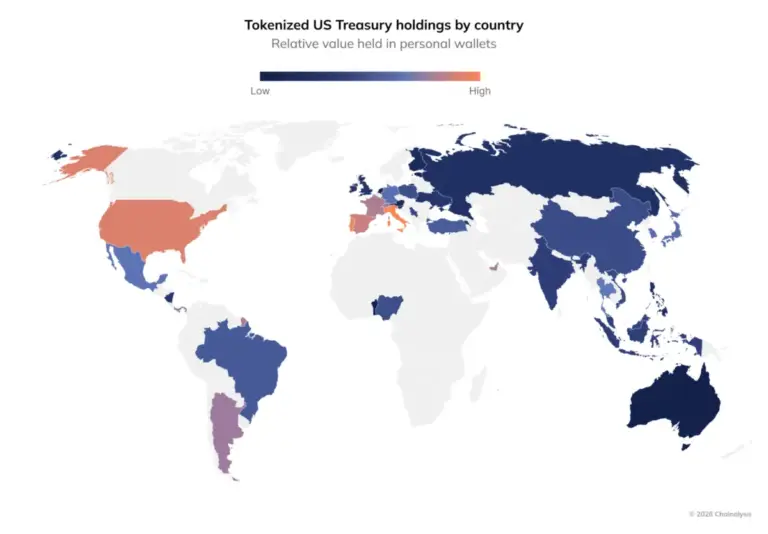
The United States continues to dominate the rapidly expanding tokenized real-world asset sector, which grew 135% year-over-year to reach $36.07 billion by the middle of 2026. Tokenized U.S. Treasury debt remains the largest asset class within this ecosystem, accounting for $15.42 billion—or roughly 42.8%—of total tokenized RWA value.

Asset managers, public corporations, and financial institutions are increasingly leveraging blockchain infrastructure to enhance asset speed, programmability, and global interoperability. While categories such as corporate credit and private equity have experienced exponential percentage growth from smaller baselines, U.S. government debt remains the anchor of the tokenized asset market.
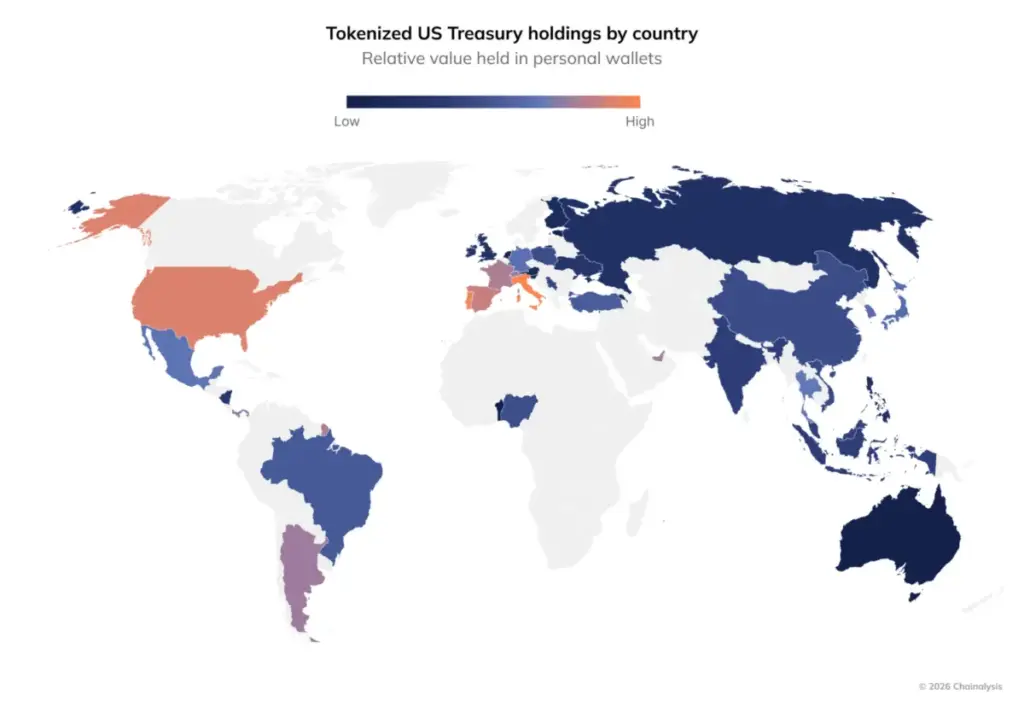
Geographic distribution data reveals an interesting dynamic: foreign investors drive a significant share of tokenized U.S. Treasury holdings, with jurisdictions like Italy, Portugal, and Singapore leading in total value held. By lowering minimum investment thresholds and eliminating the necessity for traditional U.S. brokerage accounts, tokenized financial instruments allow international retail and institutional participants to gain direct exposure to U.S. sovereign debt.

Canada Emerges as a Global Peer-to-Peer Leader
To the north, Canada’s crypto economy expanded by 2.3% to reach $247.7 billion during the 2026 reporting period, securing its place as the second-largest market in the region. Notably, Canada stands out among G7 nations for maintaining a remarkably robust domestic peer-to-peer crypto economy, ranking seventh globally in both domestic and cross-border transaction flows.
Stablecoins account for 44% of Canadian dollar-based order book trading volume, with USDC dominating the sector while local Canadian dollar stablecoins remain largely marginal. This reliance on USD-denominated stablecoins has prompted discussions among domestic policymakers regarding the long-term impact on domestic sovereign debt demand, leading to the introduction of Canada’s new stablecoin legislative framework aimed at fostering local alternatives.

Canada’s prominent cross-border remittance economy is heavily influenced by its diverse demographic profile. With approximately 23% of its population born abroad—the highest proportion in the G7—residents regularly utilize digital asset rails to send funds to key corridors including India, China, and the Philippines. Remittance-sized transfers to these three nations totaled $2.36 billion across millions of transactions during the reporting period, driven by the significant cost advantages of blockchain settlement compared to traditional remittance providers.
Data also indicates a strong correlation between Canada’s domestic peer-to-peer transaction volumes and temporary visa and immigrant population trends, suggesting that individuals with active cross-border financial ties are naturally inclined to adopt efficient, cost-effective digital settlement alternatives.

As North American crypto markets continue to mature, the defining characteristic of the region remains its role as a global infrastructure provider. While international users drive demand for dollar-backed stablecoins, tokenized assets, and AI commerce rails, American institutions and developers remain firmly at the center of the underlying technological architecture.
 Crypto Wallets & Security
 Crypto Wallets & Security
 Crypto Wallets & Security