Cryptocurrency continues to exist as a multifaceted global movement with drastically different meanings depending on who is using it and where they reside. For capital allocators in the Western world, digital assets often represent a technological upgrade and an opportunity for tokenized financial assets to reshape traditional trading infrastructure. For low-wage workers navigating challenging economic conditions in the Global South, stablecoins function as an essential lifeline—enabling rapid value transfers and serving as a reliable hedge against severe political and economic uncertainty. Meanwhile, for everyday individuals across the globe, cryptocurrency increasingly functions as an alternative asset class for personal investment.
Data from the latest annual Geographies report captures one of the most extreme volatility cycles in cryptocurrency market history. Spanning the 12-month period between July 1, 2025, and June 30, 2026, the market experienced unprecedented turbulence. Bitcoin surged to a new all-time high before suffering its largest-ever dollar-value retreat, shedding an astonishing $67,000 from peak to trough. Overall, the broader crypto market cap endured a punishing 50% drawdown, resulting in a staggering $2.1 trillion contraction. Market observers noted it as the most severe bear market since the cascading failures and corporate scandals that rocked the industry in 2022.

Despite the heavy blow to speculative valuations, the global crypto economy—measured through a combination of service inflows, domestic peer-to-peer activity, and cross-border transfers—contracted by a modest 1.6%. Total economic activity on-chain reached $9.4 trillion during the 12-month period ending June 30, 2026, showing remarkable stability when compared to the $9.5 trillion recorded during the previous period. Analysts point out that the downturn could have inflicted far deeper wounds. Because the overall market was valued at half of its previous peak, participants had to work twice as hard to maintain equivalent value flows.
Had cryptocurrency remained strictly a speculative investment vehicle, the lower prices of 2026 likely would have suppressed global value flows far more severely than the 2023 downturn. During the 2023 period, activity dropped by 23% in percentage terms and $1.2 trillion in absolute dollar terms, despite a much smaller contraction in the overall crypto market capitalization. The primary factor blunting the recent contraction was a growing diversification of use cases worldwide, which kept economic activity moving even as speculative enthusiasm waned.

Retail-Sized Crypto Transfers See Sharpest Growth
A significant share of the global crypto economy originates from centralized services, decentralized finance protocols, and other platforms used to buy, sell, trade, borrow, lend, and transfer digital assets. Tracking these inflows helps economists understand which demographic segments are driving network engagement. During the 2026 monitoring period, small-dollar retail inflows into these services showed surprising strength. Transfers valued under $100 surged by 78.4%, while transactions ranging from $100 to $1,000 climbed by 58.6%.
Although retail-level participation accounts for a modest slice of the broader economic picture—amounting to roughly $273 billion out of nearly $10 trillion in total activity—it signals that everyday users remained engaged and persistent throughout a prolonged bear market. Institutional-sized transactions also demonstrated notable resilience despite the steep pullback in asset prices. Transfers of $1 million or more declined by just 7.2% period-over-period. Given that institutional holdings were worth up to 50% less at the market’s lowest points, maintaining high-volume activity required executing twice as many transactions to match previous benchmarks, a challenge the institutional market successfully navigated.

Cross-Border Stablecoin Transfers Experience Explosive Growth
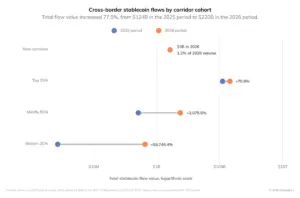
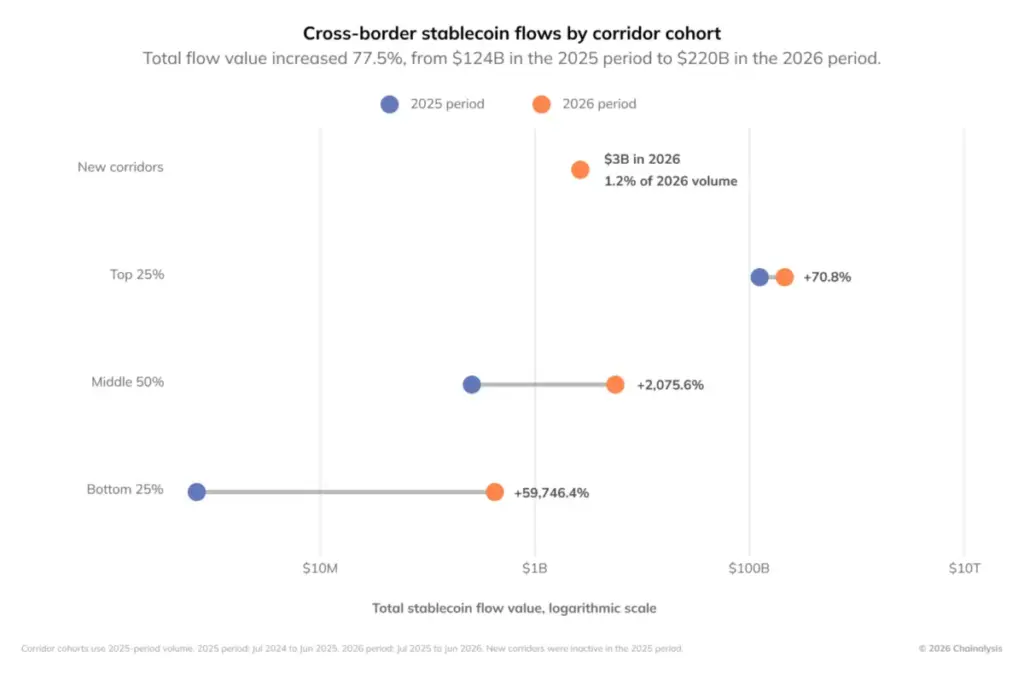
The widespread adoption of stablecoins has been heavily catalyzed by emerging regulatory frameworks across key international jurisdictions, including the GENIUS Act in the United States, Markets in Crypto-Assets (MiCA) regulations in the European Union, and proactive policy actions in Japan, Hong Kong, Singapore, and the United Kingdom. Conservative estimates indicate that monthly cross-border stablecoin value more than doubled, climbing from $11 billion in January 2025 to $24 billion by June 30, 2026, with actual volumes likely significantly higher. Total cross-border stablecoin transfers surged by 77.5% over the 12-month period, jumping from $124.2 billion to $220.3 billion.
This robust cross-border expansion is largely driven by everyday payments averaging around $3,000—a transaction size far too small to reflect institutional treasury management. Instead, these flows align with practical, real-world utility: individuals paying international suppliers, remitting funds back to their home countries, or moving personal savings away from domestic fiat currencies experiencing high inflation or instability.

Philip Gradwell, vice president of economics at Tether, noted that network activity has evolved into a steady, predictable rhythm routed through personal wallets rather than speculative bursts. This behavior reflects genuine trade and commercial activity. As stablecoins integrate deeper into global commerce, transaction flows have expanded rapidly across previously quiet economic corridors. The bottom three quartiles of global corridors saw trade values rise from $0.26 billion to $8.66 billion, with researchers tracking 4,708 newly established payment corridors carrying a cumulative $2.64 billion. Much of this growth was anchored by USDT, which provides instantaneous settlement for roughly a penny per transaction, requiring little more than a mobile phone for access.
Peer-to-Peer Rallies Globally as Speculation Cools
While centralized crypto services faced a challenging year with total inflows dropping 4.3% from $9.30 trillion to $8.90 trillion, peer-to-peer (P2P) activity experienced a massive global rally. Value moving directly between personal wallets within domestic economies surged by 302.9%, growing from $56.8 billion to $228.7 billion. Consequently, P2P transactions expanded from 0.6% of combined service and P2P activity to 2.5%, registering proportional gains across all eight tracked world regions.

The divergence highlights a fundamental shift in user behavior. Traditional service inflows are heavily tied to trading and onboarding, which fluctuate directly with market sentiment and asset prices. When the market capitalization is cut in half, speculative turnover drops accordingly. Stablecoin payments, however, are denominated in fiat equivalents and sized strictly according to user utility, continuing uninterrupted regardless of whether the broader market is in a bull or bear phase.
On-chain balances—representing the total USD value of cryptocurrency held in personal wallets and service platforms—contracted alongside falling asset valuations, dropping from a peak of $0.86 trillion in September 2025 to $0.44 trillion in June 2026. However, stablecoin balances remained remarkably steady, hovering between $98 billion and $109 billion throughout the nine-month drawdown. Because stablecoins are pegged to the fiat dollar, their on-chain value does not fluctuate with crypto market sentiment. As other digital assets lost value, stablecoins formed an economic anchor, eventually representing 22.5% of all global crypto balances by June 2026.

Brazil Emerges as the Global Leader in Grassroots Adoption
When combining service flows, domestic peer-to-peer activity, cross-border transfers, and accumulated wallet balances, Brazil secured the number-one ranking for grassroots cryptocurrency adoption worldwide. While Brazil did not claim the top spot in any single isolated category, its economy demonstrated consistent, robust performance relative to its size, outpacing more established markets like the United States. Analysts attribute this leadership to a thriving $252.5 billion domestic crypto economy heavily driven by Latin America’s broader collective pivot toward stablecoins as a reliable hedge against persistent regional currency volatility.
Following closely behind Brazil in the global grassroots adoption index are the United States, Nigeria, Japan, the Republic of Korea, India, Ukraine, Thailand, South Africa, and Canada rounding out the top ten. The rankings demonstrate that cryptocurrency utility has taken deep root not merely as an speculative asset in wealthy Western nations, but as a critical economic tool for communities across emerging markets facing distinct macroeconomic pressures.
 Crypto Wallets & Security
 Crypto Wallets & Security
 Crypto Wallets & Security