North America cemented its status as the most influential region for the global cryptocurrency markets during the 12-year reporting period ending July 1, 2026. Backed by the deep investor capital of the United States, modernized regulatory frameworks, widespread stablecoin utility, and an accelerating convergence between digital assets and traditional finance, the North American crypto landscape continues to export its innovations worldwide. According to data from the region’s latest big-money index—an unweighted measurement of sheer crypto-economic power—the United States and Canada combined for a massive $3.02 trillion crypto economy, experiencing only a modest 1.9% contraction compared to the previous period.
This minor regional cooling was primarily driven by a domestic slowdown within the United States. The U.S. crypto economy dipped 2.2% period-over-period to $2.78 trillion, a performance widely viewed as unsurprising given the harsh backdrop of a broader market downturn. Despite this contraction, the world’s largest individual crypto market managed to retain nearly all of the explosive gains it achieved during the 2025 period, when its economy nearly doubled. Institutional catalysts, including the burgeoning adoption of spot crypto exchange-traded funds (ETFs), accelerated asset tokenization, and the proliferation of stablecoins, proved instrumental in cementing those gains.

Hoolie Tejwani, Head of Coinbase Ventures, noted that the current market environment reflects a broader maturation of the industry. The foundational building blocks established throughout 2025 have successfully transformed into operational products boasting real users, robust liquidity, and active markets by 2026. This evolution highlights a trio of U.S.-developed crypto products that are currently capturing significant activity both domestically and abroad: artificial intelligence commerce, stablecoin settlements, and tokenized real-world assets. Simultaneously, the Canadian market demonstrated remarkable resilience, expanding by 2.3% to reach a $250 billion crypto economy, fueled in large part by its vibrant immigrant populations and active peer-to-peer networks.
The US Leads the AI On-Chain Economy
The United States has seized a commanding lead in the global artificial intelligence development race, an advantage that is rapidly reshaping every sector of the economy, including digital assets. To better understand how this burgeoning machine-driven economy is taking shape, researchers examined x402, one of the most popular digital payment rails designed specifically to allow AI agents to independently spend money on-chain.

Autonomous software is increasingly executing financial transactions without human intervention, and the United States has emerged as the epicentre of this new builder ecosystem. Foundational American crypto companies, such as USDC issuer Circle and Coinbase—the original creator of the x402 system—are actively providing the infrastructure required to support these autonomous tools. Financial institutions are also taking note. Will Su, Head of Digital Assets Research at BlackRock, indicated that the firm is closely monitoring agentic commerce, noting that autonomous AI agents have the potential to generate meaningful demand for frequent, low-value payments around the clock.
By the close of the 2026 reporting period, cumulative x402 transactions on Base, the leading blockchain for agentic commerce, surpassed 138 million. Traditional payment rails like credit card networks are fundamentally unsuited for this type of activity because transactions worth mere fractions of a dollar—and especially sub-penny micro-payments—are economically unviable to process. However, stablecoins capable of settling for less than a cent make it entirely feasible for software agents to spend microscopic amounts of money. This capability unlocks an entirely new market for pay-as-you-go digital goods and services, such as fetching real-time data via automated application programming interface calls.
AI Payments Become Stickier and More Purposeful

Industry experts describe agentic commerce as still residing within its broader experimentation phase, yet clear signals of maturation continue to emerge. Early adoption was characterized by one-off users testing the waters with simple trades before abandoning their wallets once initial funds were depleted. Data from successive cohorts of funded wallets reveals a dramatic shift toward long-term commitment. Grouping wallets by the quarter in which they were first funded shows that the share receiving a second funding injection within 30 days climbed from 70.6% for wallets established in the third quarter of 2025 to 89.3% for those funded in the second quarter of 2026.
This continuous topping up functions as the on-chain equivalent of renewing a software subscription. Furthermore, the temporal gap between a wallet’s initial funding and its first x402 expenditure has compressed drastically. In late 2025, wallets possessed a median age of 73 days before initiating their first x402 transaction; by the third quarter of 2026, that duration plummeted to just 18 minutes. The proportion of wallets executing a payment within their first hour of funding surged from 4% to 67% over the same timeframe. Users are no longer parking value or passively testing protocols; they are funding wallets because a specific task is already queued and capital needs to move immediately.
What AI Agents Are Buying On-Chain

While early x402 activity was dominated by short-lived speculative fads like viral memecoins, the protocol’s maturation has fostered enduring forms of machine-to-machine commerce, particularly within the information sector. Millions of transactions now flow from AI-controlled wallets into specialized knowledge-based services, including automated code review, financial intelligence, and search APIs. Because autonomous models require a constant stream of machine-readable data, on-chain micro-payments provide an ideal settlement layer.
In addition to data acquisition, AI agents are utilizing payment rails to purchase gaming credits, token issuance tools, gambling services, and agent frameworks. Notably, a significant portion of spending is directed toward other AI capabilities, with model inference emerging as one of the largest expenditure categories. U.S.-funded AI agents currently account for approximately 30% of all geolocated agent-to-services transactions globally. American wallets drive 88.1% of all geolocated AI model inference payments, 41.8% of payments directed toward agent frameworks and tool catalogs, and 23.2% of data and search API expenditures.
In contrast, Chinese-linked wallets exhibited a distinct specialization, accounting for nine out of ten transactions routed into security and code analysis services, predominantly through AgentLISA, an automated model designed to audit Solidity smart contracts. Chinese operators also captured substantial shares in market intelligence and payment rails, yet they accounted for just 0.1% of model inference spending. Analysts attribute this discrepancy to a combination of AI nationalism and economic reality, noting that Chinese domestic markets readily embrace open-weight, locally developed models like DeepSeek and Qwen, which are often free to use, whereas American developers lean heavily on metered commercial models like ChatGPT and Claude.

The US Imports Digital Gold and Exports Digital Dollars
The formalization of the U.S. stablecoin landscape following legislative milestones in mid-2025 underscored America’s role as the primary global exporter of digital dollars. Stablecoins have effectively transformed U.S. government debt into the currency of choice for cross-border businesses and international peer-to-peer economies. Throughout the 2026 reporting period, stablecoins continued to penetrate new international markets, generating billions of dollars in economic activity that ultimately benefits both U.S. corporations and the federal government.
Concurrently, the United States has emerged as a major importer of digital gold. Since the launch of spot Bitcoin ETFs in January 2024, the U.S. share of global Bitcoin activity has risen steadily across every reporting period. Conversely, stablecoins represent a progressively smaller fraction of domestic American crypto activity compared to the rest of the world. While international users adopt digital dollars to fulfill financial needs unmet by local banking systems, American investors increasingly rely on Bitcoin as an immutable store of value amid rising global sovereign debt and government expenditures.

Cross-border data reveals that the United States transitioned into a net importer of Bitcoin in 2026 for the first time in four years. While retail-sized transfers under $10,000 remained net outbound, multi-million-dollar institutional transfers shifted heavily toward net inflows, with transactions exceeding $10 million accounting for more than 53,200 incoming coins. This institutional accumulation, paired with implicit sovereign demand stemming from discussions surrounding a strategic federal Bitcoin reserve, highlights a growing divergence: the rest of the world exports demand for U.S. debt via stablecoins while the U.S. absorbs scarce Bitcoin assets.
Tokenization and Real-World Assets Expand Rapidly
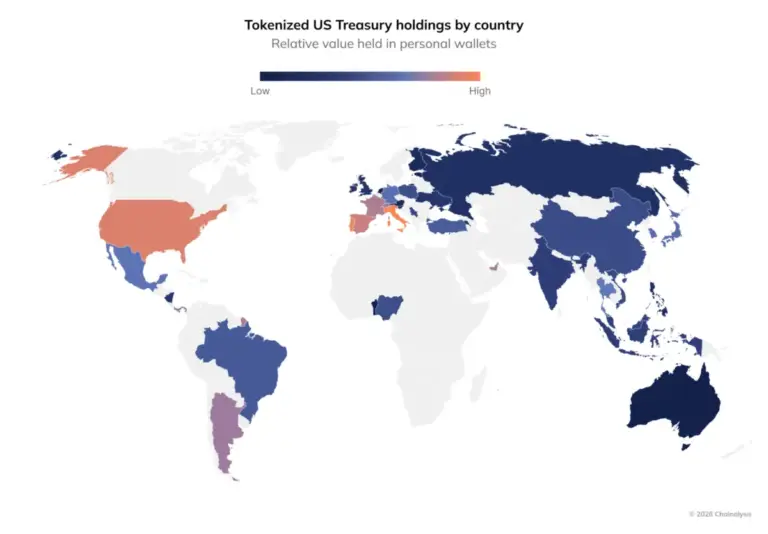
The United States maintained its dominant position within the rapidly expanding real-world asset tokenization sector during the 2026 period. Global tokenized RWA market capitalization finished the second quarter of 2026 at $36.07 billion, representing a 135% period-over-period growth rate. Tokenized U.S. Treasury debt remained the single largest asset class within this ecosystem, commanding $15.42 billion—or 42.8%—of total tokenized RWA value.

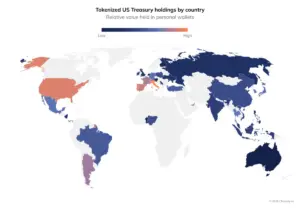
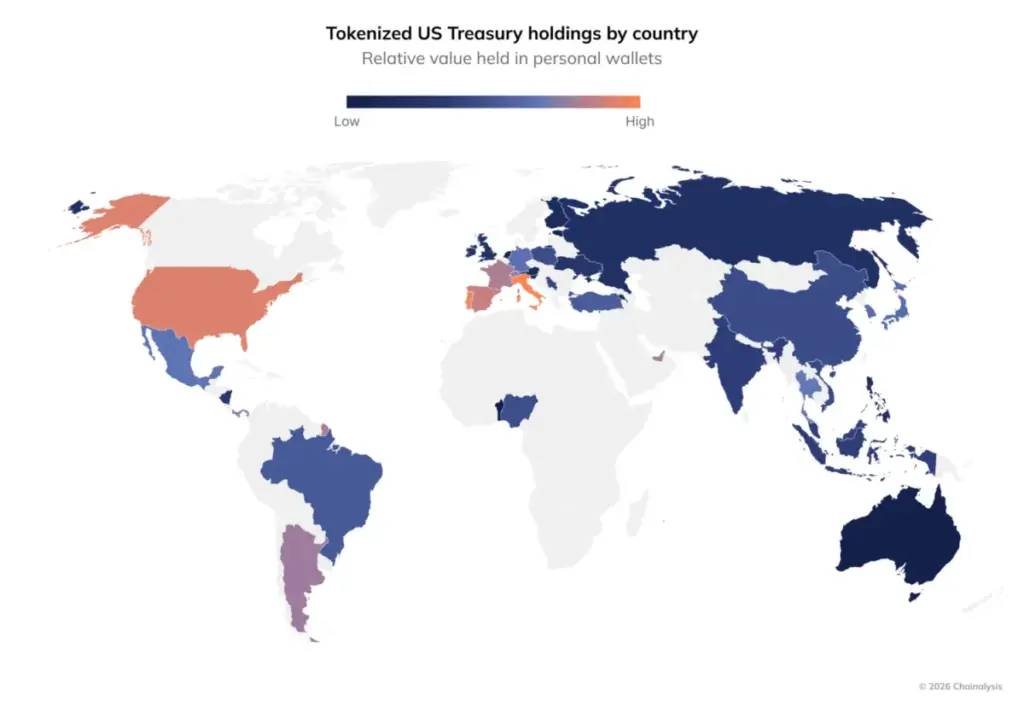
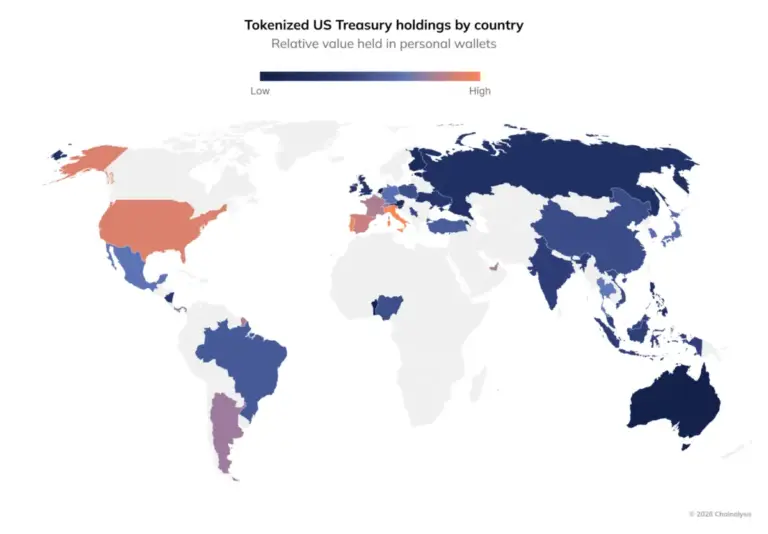
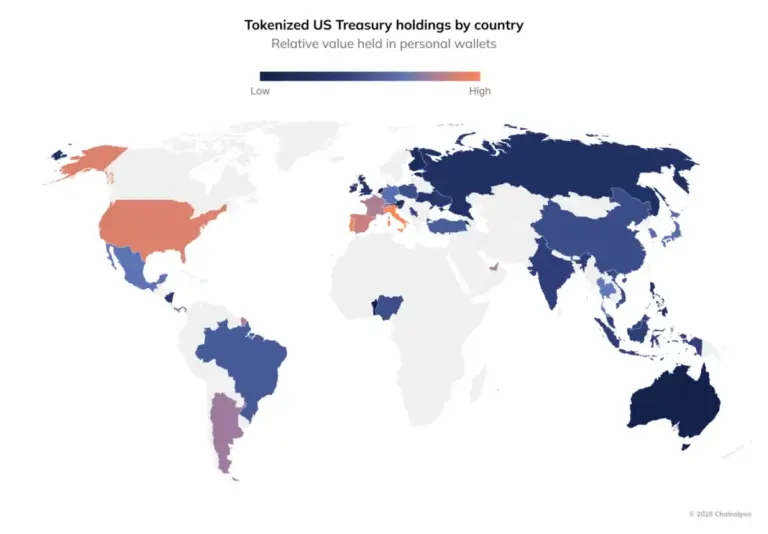
While alternative categories like private credit and corporate credit experienced massive percentage surges from smaller baselines, U.S. Treasury debt expanded by 125%, adding over $8 billion in net value. Interestingly, while U.S. investors account for roughly 11% of the global tokenized RWA holder base, foreign investors drive the vast majority of tokenized Treasury holdings. Jurisdiction-specific data indicates that European and Asian markets, including Italy, Portugal, Singapore, and Japan, account for the lion’s share of tokenized U.S. government debt ownership. By lowering minimum position sizes and eliminating the necessity for traditional U.S. brokerage accounts, tokenization has transformed wholesale institutional instruments into accessible retail assets for foreign participants, thereby generating robust international demand for American sovereign debt.
Canada Emerges as a Global Peer-to-Peer Leader
North of the border, Canada’s crypto economy expanded by 2.3% to reach $247.7 billion during the 2026 period, securing its place as the second-largest market in the regional index and ranking tenth globally in grassroots adoption. Notably, Canada boasts the most robust peer-to-peer crypto economy among all G7 nations, placing seventh worldwide in both domestic and cross-border flows.

Stablecoins dominate Canadian crypto acquisition habits, accounting for 44% of Canadian dollar-based order book volume by June 2026, up significantly from 30% the previous year. USDC captures the vast majority of this activity, while locally denominated Canadian dollar stablecoins command a negligible market share. Industry leaders, including Morva Rohani of the Canadian Web3 Council, have pointed out that this heavy reliance on U.S. dollar-pegged assets funnels potential domestic sovereign debt demand toward the United States. Nevertheless, recent legislative steps, such as Canada’s stablecoin framework, aim to encourage the development of home-grown alternative payment rails.
Canada’s remarkable cross-border strength is heavily reinforced by its diverse demographic profile. With approximately 23% of its population born abroad—the highest proportion within the G7—Canada serves as a vital remittance corridor connecting residents to India, China, the Philippines, Nigeria, and Pakistan. Stablecoin and Bitcoin remittances directed from Canada to India, China, and the Philippines alone reached $2.36 billion across 3.56 million transactions during the reporting period, driven by average transfer sizes of $663. By bypassing traditional remittance providers that charge average fees exceeding 6%, Canadian senders utilized blockchain rails to achieve substantial cost savings.
Furthermore, statistical analysis reveals a strong positive correlation between Canada’s domestic peer-to-peer crypto transaction volumes and the fluctuating size of its temporary visa and study permit populations. As immigrant and temporary resident populations expanded and contracted over recent years, domestic P2P volumes tracked those movements in tandem, illustrating how communities with active cross-border financial commitments naturally gravitate toward efficient, low-cost digital settlement alternatives.

As North America’s crypto ecosystem matures, the structural division of labor becomes increasingly clear: American institutions, developers, and financial issuers provide the underlying infrastructure—spanning tokenized Treasuries, algorithmic payment rails, and digital dollars—while a global user base supplies the enduring demand. Whether emerging regulatory frameworks across international jurisdictions can successfully foster viable local alternatives or whether the digital economy will continue to default to North American infrastructure remains the defining question for the next era of digital finance.
 Crypto Wallets & Security
 Crypto Wallets & Security
 Crypto Wallets & Security