
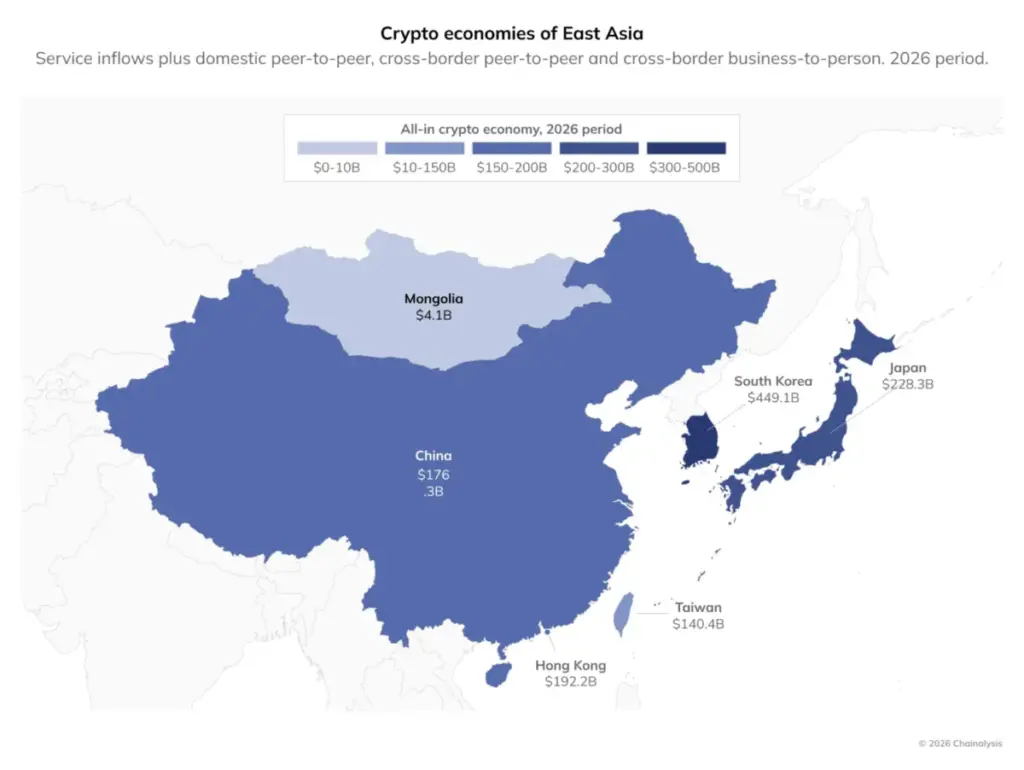
The cryptocurrency economy across Eastern Asia stands as one of the most diverse and fragmented financial landscapes in the world. Ranging from strict, supervised access frameworks to outright prohibitions, individual regulatory environments, risk appetites, and business objectives heavily shape how users and institutions interact with digital assets. While the region’s overall crypto economy contracted modestly between July 2025 and June 2026, aligning with a broader global bear market, this downturn was far from uniform. Growth hotspots emerged in distinct pockets, highlighted by institutional platforms in Hong Kong receiving 87% more capital than the year prior—representing the fastest institutional growth in East Asia—while Japanese users increasingly gravitated toward decentralized exchanges, pushing local inflows up by 36%.
Despite the regional contraction, the period underscored the resilience and scale of East Asia’s largest standalone crypto hubs. South Korea retained its position as the region’s powerhouse and fifth overall in grassroots adoption, boasting a $449 billion crypto economy that expanded 12.3% period-over-period. This expansion was powered by a 16.3% rise in the South Korean exchange ecosystem and an intense retail pivot toward artificial intelligence-driven cryptocurrency assets. According to Daniel Kim, CEO of Tiger Research, "Asia is that rare region with both grassroots retail depth and institutional firepower."

South Korea Leads the Region as Retail Traders Pivot to AI Cryptocurrencies
South Korea’s $449 billion all-in crypto economy grew steadily alongside an additional $51.1 billion in exchange-related flows. Francis Kang, executive director of Korea Blockchain Week, notes that this activity is fueled by the market’s famously retail-driven nature, which has found a natural parallel in the broader global "AI trade."
Much of this growth has transpired without the immediate participation of major domestic financial institutions. Legislative roadblocks have historically slowed institutional entry into large-scale payments or investing, though the government initiated a shift in February 2026 by easing a longstanding ban on corporate crypto trading. Kang describes institutional engagement in the country as being in "preparatory mode." Every major bank and securities firm now maintains a digital asset team, running pilots in stablecoins, tokenization, and custody.

Another major catalyst for South Korea’s retail dominance has been the absence of crypto taxes throughout the 2026 period. Although a delayed 22% tax on crypto profits is slated to take effect at the start of 2027, previous legislative delays leave its exact timeline uncertain. This potential tax shift coincides with the gradual arrival of institutional participation following a February 2025 announcement by the Financial Services Commission outlining a roadmap to open the market to nonprofits, exchanges, listed companies, and registered professional investment corporations. Jinhyeong Jo, a senior examiner at Korea’s Financial Intelligence Unit, notes that the National Assembly’s ongoing discussions will likely have a meaningful impact on retail investor demand and future market participation.
Within South Korea’s retail market, trading has heavily favored high-risk, high-reward opportunities, most prominently manifested in the AI cryptocurrency trade. Mirroring the dominance of memory chip manufacturer SK Hynix on the mainstream stock market, AI-crypto trading surged in parallel. By June 2026, AI cryptocurrencies—including digital assets of AI-focused projects and related infrastructure—became the single most popular thematically-defined investment category by share of won-denominated trading volume, eclipsing payment tokens like XRP.

South Korean won-denominated activity in AI crypto reached levels 19.5 times higher than the Japanese yen rate, completely dwarfing the modest volumes seen in other major global currencies such as the euro, the British pound, or the Brazilian real. Traders heavily bid on assets like Worldcoin, which led the category with $7.41 billion in volumes, alongside newcomer tokens such as SAHARA, VIRTUAL, BIO, and NEAR.
Japan’s Consumer-Crypto Economy and Evolving Institutional Approach
Japan’s $228 billion crypto economy is frequently characterized by its heavy institutional focus, driven primarily by banks and financial firms rather than retail consumers. However, the country’s 122 million citizens maintain a robust and active grassroots footprint. Approximately one in four individuals who withdraw funds from domestic exchanges subsequently deposit them into decentralized finance protocols, and decentralized exchanges captured nearly 35% market share of Japan’s services industry during the 2026 period—the highest share in the region. Since 2022, Japanese engagement with DEXs has climbed over 200%, while centralized exchange activity has remained flat.

Taishi Sato, CEO of DeFimans, attributes the high visibility of perpetual futures in Japan to the sophistication of a trader population well-versed in foreign exchange markets. Local traders utilize platforms like Hyperliquid alongside traditional equity portfolios to manage directional and macroeconomic exposure. In terms of direct token investments, store-of-value assets like Bitcoin maintained a 73.8% share of yen trading volume, though smart contract tokens like Ethereum and Solana emerged as the fastest-growing asset class, rising 17.7% in absolute volume.
Historically, high taxes—such as a maximum marginal rate of up to 55%—have suppressed consumer crypto adoption. However, a series of tax reforms advanced in July 2026 could catalyze broader market growth, potentially shifting eligible gains to a separate 20% taxation rate. Simultaneously, financial institutions are beginning to recognize digital assets as a legitimate new business line. Analysts are closely watching the introduction of local stablecoins like JPYC and the SBI Group’s JPYSC to facilitate international remittances, OTC trading, and real-world asset settlement.

Hong Kong Emerges as Eastern Asia’s Premier Institutional Hub
Hong Kong’s $192 billion crypto economy is defined less by raw scale and more by the institutional nature of its participants. Government policy has placed digital assets at the center of the city’s financial strategy, with regulatory clarity serving as the primary driver of participation. The introduction of Hong Kong’s first Five-Year Plan and stablecoin licensing regime has favored larger, well-controlled operators while strengthening overall market credibility.
Institutional platforms, including over-the-counter desks, custody providers, and market makers, captured 16% of Hong Kong’s service inflows during the 2026 period—nearly triple the share of any regional neighbor. Inbound business-to-business crypto flows reached nearly $24 billion, reflecting the city’s role as a primary two-way corridor for institutional capital moving across Asia. Cumulative net B2B inflows climbed steadily to $17.4 billion, demonstrating that institutional capital is settling firmly within the city’s regulated perimeter.

China’s Surge in Peer-to-Peer Stablecoin Adoption
Despite an official, longstanding government ban on crypto services, China’s crypto economy remains substantial, with estimated volumes reaching at least $176 billion during the 2026 period. Lacking formal exchanges, the market is overwhelmingly driven by peer-to-peer transactions, which accounted for 59.1% of China’s all-in crypto economy.
A dramatic acceleration in China’s P2P market began around March 2025, coinciding with the expansion of the government’s social credit system into finance and the internet. This expansion created strong incentives for individuals restricted by behavioral scoring or banking compliance blacklists to seek censorship-resistant alternatives like stablecoins for domestic payments.

Data highlights a remarkable velocity of money in China, where self-custodied stablecoin holdings turnover at a rate of 33.2 times per year—more than three times the global average. Moving $104.1 billion across 18.1 million transfers, Chinese users increasingly treat stablecoins as working capital for everyday economic activity rather than long-term stores of value.
As East Asia continues to navigate the complexities of regulatory oversight, the region offers a clear contrast between supervised access models and outright prohibitions, setting the stage for further structural evolution in the global digital asset landscape.
 Crypto Wallets & Security
 Crypto Wallets & Security
 Crypto Wallets & Security







