North America retained its position as the most influential region for global cryptocurrency markets during the 12-year reporting period ending July 1, 2026. Backed by the United States’ deep investor base providing substantial capital, progressive updates to legislative frameworks, widespread stablecoin utility, and an accelerating convergence between traditional finance and decentralized assets, the region continues to dictate global industry trends. What occurs within North America’s digital asset ecosystem is increasingly exported to the rest of the world.
According to the latest data, the United States and Canada claimed the top spots on the unweighted "big-money index," which measures the sheer economic power of national crypto markets. Combined, their respective digital asset economies totaled $3.02 trillion during the 2026 period. This represented a modest 1.9% contraction compared to the previous year, a decline largely driven by a broader slowdown inside the United States amidst a challenging bear market.

The U.S. crypto economy dipped 2.2% to $2.78 trillion. However, industry analysts note that this minor pullback is unsurprising given broader macroeconomic headwinds and follows the near-doubling of market value recorded during the 2025 period. Major institutional forces—such as the rapid expansion of spot exchange-traded funds (ETFs), accelerating tokenization of real-world assets, and the ubiquitous spread of stablecoins—helped the U.S. market retain the vast majority of those previous gains.
Industry leaders point to a maturing marketplace as the primary driver behind these shifting dynamics. The foundational building blocks established in prior years are successfully translating into products with active users, sustainable liquidity, and functioning global markets. Three distinct U.S.-developed product categories are capturing major activity both domestically and internationally: AI commerce, stablecoins, and tokenized financial assets. Meanwhile, Canada’s crypto economy bucked the regional downtrend, expanding by 2.3% to reach a milestone of approximately $250 billion, supported heavily by vibrant peer-to-peer activity among immigrant populations.
The U.S. Leads the Emerging AI On-Chain Economy

The United States’ dominant position in the global artificial intelligence development race is rapidly reshaping adjacent sectors, most notably cryptocurrency. Researchers tracking x402—one of the most widely adopted digital payment rails enabling AI agents to autonomously spend money—have gained fresh insight into how this machine-driven economy is materializing.
Autonomous software is increasingly executing transactions on-chain, and the United States has emerged as the epicentre of this development. Foundational American crypto firms, including USDC issuer Circle and x402 developer Coinbase, are providing the essential financial and technical infrastructure supporting this growth. Traditional financial institutions are also taking notice. Will Su, Head of Digital Assets Research at BlackRock, noted that the firm is monitoring agentic commerce closely, highlighting that autonomous AI agents have the potential to generate meaningful demand for frequent, low-value payments operating around the clock.
By the conclusion of the 2026 reporting period, cumulative x402 transactions on Base, the leading blockchain network for agentic commerce, surpassed 138 million. On-chain payment infrastructure facilitates economic activity that remains economically unfeasible on legacy payment rails. Micro-payments valued at fractions of a dollar—and particularly fractions of a cent—cannot be profitably processed by traditional credit card networks. Conversely, stablecoin transactions that settle for less than a cent make it financially viable for autonomous agents to dispense tiny sums of money. This capability unlocks entirely new business models centered around pay-as-you-go goods and services, such as real-time data retrieval via application programming interfaces.

Executives at Circle have highlighted a clean division of labor emerging within the payments ecosystem, noting that traditional card rails are optimized for consumer-prompted payments, while stablecoin rails are ideally suited for machine-to-machine settlements that fall below the economic thresholds of card networks. Empirical data reflects this shift: over the 16 months leading to September 2026, the vast majority of x402 activity registered as micropayments, with more than 87% of transactions falling between a hundredth of a cent and a dime.
AI Payments Display Growing Stickiness and Purposeful Adoption
Although agentic commerce remains in an experimental phase, behavioral metrics indicate a rapid maturation of the user base. Tracking wallets by the quarter in which they were initially funded reveals that user commitment is strengthening over time. The share of wallets receiving a secondary funding event within 30 days climbed from 70.6% for those initiated in the third quarter of 2025 to 89.3% for wallets funded in the second quarter of 2026. This regular topping-up behavior mirrors subscription renewals in traditional software markets, confirming that users are finding sustained utility in x402.

Furthermore, the operational purpose of these wallets has sharpened. The median time gap between a wallet receiving initial seed funding and executing its first x402 transaction compressed dramatically, dropping from 73 days in late 2025 to just 18 minutes by the third quarter of 2026. This temporal contraction demonstrates that newer wallets are being intentionally provisioned to immediately execute agentic transactions rather than sitting idle. By Q3 2026, roughly two in three newly funded wallets executed a payment within their first hour of operation.
An analysis of transaction destinations reveals that AI agents are heavily investing in machine-readable information. Millions of transactions flow from AI wallets into specialized services such as code review, financial intelligence, and search APIs. Additionally, agents are actively funding model inference, paying for gaming and gambling protocols, token issuance platforms, and agentic developer toolkits.
Geographic breakdowns indicate that American-funded AI agents account for roughly 30% of all geolocated agent-to-service transactions globally. U.S. wallets represent 88.1% of all AI model inference payments on the protocol, 41.8% of expenditures on agent frameworks and tooling catalogs, and 23.2% of payments directed toward data and search APIs. Conversely, Chinese-linked wallets demonstrated high concentration in specific niches, driving 90% of security and code analysis transactions—largely through smart contract auditing tools like AgentLISA—while maintaining a minimal footprint in paid model inference, a trend analysts attribute to the widespread availability of free, open-weight domestic models in China.

The U.S. Exports Digital Dollars While Importing Digital Gold
The formalization of regulatory clarity surrounding digital assets has reinforced the United States’ role as the primary global exporter of digital dollars. Stablecoins have effectively transformed U.S. sovereign debt into the preferred currency of choice for cross-border merchants and peer-to-peer economies alike. Throughout the 2026 reporting period, stablecoin adoption accelerated internationally, channeling billions of dollars in economic activity back toward U.S. issuers and the broader American economy.
Simultaneously, the United States has experienced a steady rise in bitcoin accumulation. Since the landmark introduction of spot bitcoin ETFs in early 2024, the U.S. share of global bitcoin activity has increased during every consecutive reporting period. Conversely, stablecoins command a smaller percentage of overall crypto activity domestically than they do abroad, reflecting a fundamental divergence: international markets lean heavily on dollar-denominated stablecoins to bypass local banking limitations, whereas domestic American participants increasingly utilize bitcoin as an institutional store of value against persistent global government debt and spending highs.

Cross-border data indicates that the United States became a net importer of bitcoin in 2026 for the first time in four years. While smaller retail transfers under $10,000 remained net outbound, large-denomination institutional transfers reversed the flow, with institutional brackets above $10 million driving substantial net inflows. Major stablecoin issuers like Circle reported tens of billions of dollars in circulation alongside trillions in on-chain volume, cementing stablecoins as the preferred routing layer for moving liquidity between traditional fiat, local digital currencies, and global dollar reserves.
Tokenization Expands as U.S. Treasuries Dominate Real-World Assets
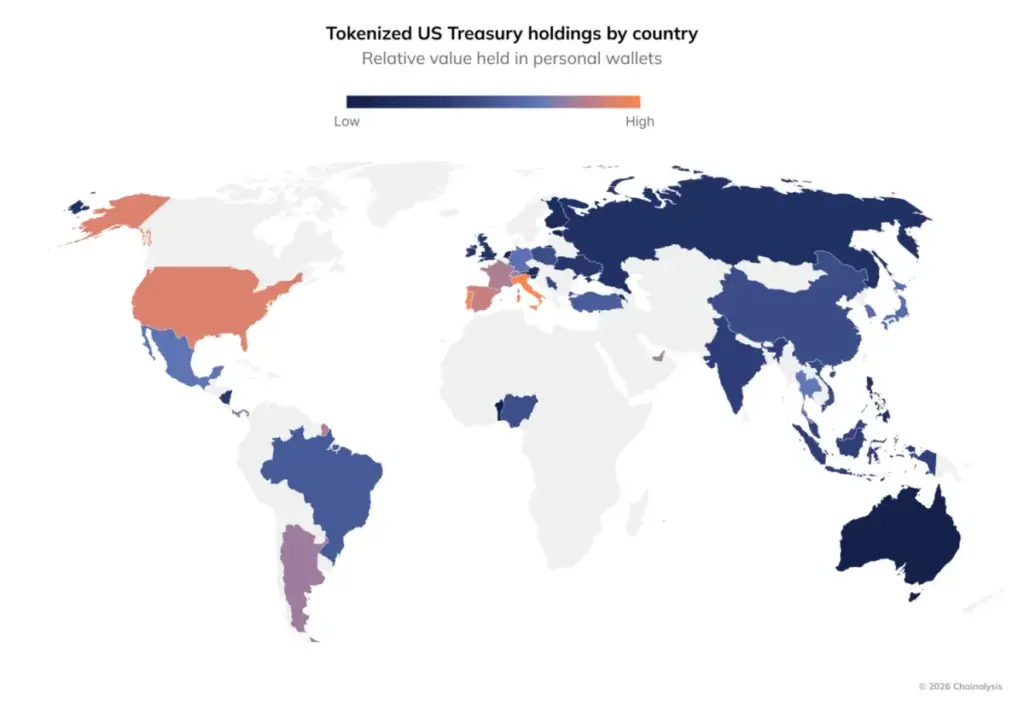
The tokenization of real-world assets experienced explosive growth, with the global market expanding 135% year-over-year to reach $36.07 billion by the close of the second quarter of 2026. U.S. Treasury debt remained the single largest tokenized asset class, accounting for $15.42 billion—or 42.8%—of all tokenized real-world asset value.

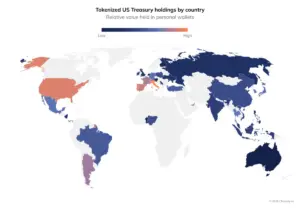
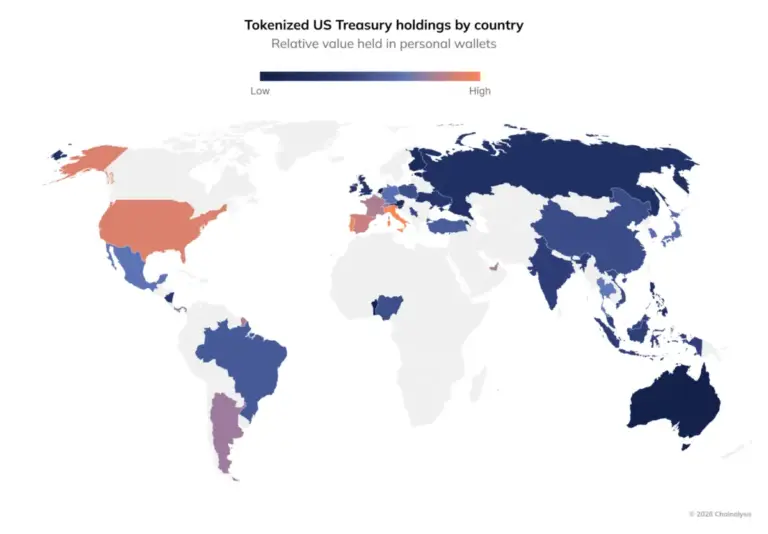
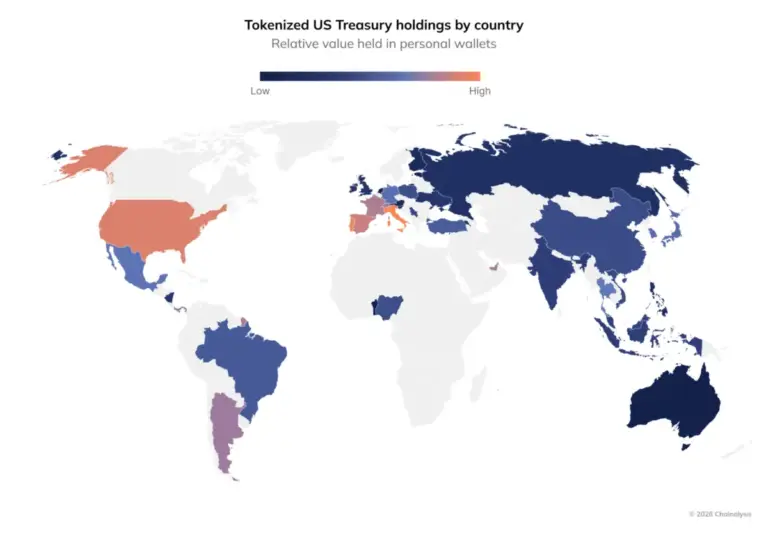
While U.S.-based investors represent a balanced share of tokenized asset holders, the distribution of tokenized Treasuries reveals heavy foreign demand. Institutional investors and retail participants in jurisdictions such as Italy, Portugal, Singapore, and Japan are actively utilizing tokenized U.S. government debt to secure yield without requiring direct access to traditional American brokerage accounts. This mechanism effectively broadens global demand for U.S. sovereign debt while granting international users the speed, programmability, and interoperability inherent to blockchain infrastructure.
Canada Leads G7 in Peer-to-Peer and Remittance Adoption
While the United States dominates institutional and infrastructural development, Canada continues to carve out a unique position in grassroots adoption. Canada’s digital asset economy grew 2.3% during the 2026 reporting period to reach $247.7 billion, securing its place as the second-largest market in North America and ranking tenth globally in grassroots adoption.

Notably, Canada boasts the most robust peer-to-peer crypto economy among G7 nations, placing seventh worldwide in domestic and cross-border flows. Stablecoins account for 44% of Canadian dollar-based order book volume, with USDC capturing the vast majority of market share. Industry experts observe that this heavy reliance on U.S. dollar-denominated stablecoins presents a policy challenge, as domestic capital flows into foreign debt instruments rather than Canadian sovereign alternatives.
Furthermore, Canada maintains the highest foreign-born population share in the G7, serving as a primary driver for its thriving cross-border remittance economy. Stablecoin and bitcoin transfers originating from Canada and moving into high-growth corridors like India, China, and the Philippines surged 141% year-over-year to hit $2.36 billion across millions of individual transactions. Driven by the stark cost efficiencies of blockchain settlement compared to traditional remittance providers—which often charge fees exceeding 6%—immigrant populations and temporary residents are increasingly integrating digital assets into their daily financial lives to manage cross-border obligations efficiently.
As regulatory bodies across North America and international jurisdictions continue to implement frameworks governing stablecoins, tokenized assets, and autonomous AI transactions, the foundational infrastructure of modern finance is undergoing a permanent, technology-driven evolution.
 Crypto Wallets & Security
 Crypto Wallets & Security
 Crypto Wallets & Security