North America stood as the most influential region for global cryptocurrency markets during the 12 months leading up to July 1, 2026, according to comprehensive reporting data. Powered by a deep U.S. investor base, evolving regulatory frameworks, the proliferation of digital currencies, and corporate integration bridging decentralized assets with traditional finance, the region continues to export its financial innovations worldwide.
In the 2026 reporting period, the combined crypto economies of the United States and Canada reached $3.02 trillion, marking a modest 1.9% contraction compared to the previous period. This slight downturn was primarily driven by a slowdown in the United States, where the world’s largest national crypto economy fell by 2.2% to $2.78 trillion amid a severe bear market. Despite this cooling phase, the U.S. market successfully preserved the near-doubling of value it achieved during the 2025 period, bolstered by institutional catalysts such as exchange-traded funds (ETFs), accelerating asset tokenization, and the widespread adoption of stablecoins.

Industry leaders point to market maturation as the underlying force behind these trends. Foundations established in 2025 transformed into operational products with active users, deep liquidity, and thriving markets throughout 2026. While the United States anchored massive institutional flows and cutting-edge innovations like autonomous AI commerce, Canada charted an independent course, exhibiting surprising resilience and robust peer-to-peer adoption.
The United States Leads the AI On-Chain Economy
The global development race in artificial intelligence has increasingly intersected with blockchain infrastructure, with the United States emerging as the primary engine for autonomous agentic commerce. Researchers examining digital payment rails designed for AI agents—specifically the popular x402 protocol—found that autonomous software is rapidly executing on-chain transactions, supported by foundational American firms such as Circle and Coinbase.

Traditional financial institutions are monitoring these developments closely. Major stakeholders recognize that AI agents generate continuous demand for frequent, low-value transactions around the clock. By the end of the 2026 tracking period, more than 138 million x402 transactions had been processed on Base, cementing its position as the leading blockchain for machine-to-machine commerce.
On-chain infrastructure enables economic activity that remains impractical on legacy payment rails. While traditional credit card networks cannot profitably process transactions worth fractions of a cent due to fixed processing overheads, stablecoins settle for less than a cent. This economic efficiency opens entirely new markets for pay-as-you-go digital goods, such as automated API data retrievals.

Industry analysts describe a clear division of labor emerging between traditional and blockchain rails: credit card networks handle consumer-prompted payments, while stablecoins facilitate machine-to-machine settlements that require micro-transaction economics. The vast majority of x402 activity reflects this reality, with over 87% of payments falling between a hundredth of a cent and ten cents.
AI Payments Grow Increasingly Sticky and Purposeful
While agentic commerce remains in an experimental phase, behavioral metrics indicate rapid maturation. Early iterations of the x402 protocol were characterized by transient users executing single trades before abandoning their wallets. However, participation data reveals that successive cohorts of wallet users display significantly higher retention and commitment.

When grouping wallets by the quarter in which they were first funded, the share of accounts receiving a second funding injection within 30 days rose steadily from 70.6% in the third quarter of 2025 to 89.3% in the second quarter of 2026. This replenishment behavior mirrors subscription renewals in traditional software markets, demonstrating tangible utility that prompts users to top up depleted balances.
Furthermore, the operational tempo of these wallets has accelerated dramatically. In late 2025, wallets initiated their first x402 payment at a median age of 73 days. By the third quarter of 2026, that interval compressed to just 18 minutes. Concurrently, the proportion of wallets executing a payment within their first hour of funding climbed from 4% to 67%. These metrics suggest that newer wallets are purpose-built for immediate agentic commerce rather than speculative value parking.

As autonomous agents evolve into distinct economic actors, their purchasing habits have shifted from short-lived speculative memecoins toward functional knowledge services. Millions of transactions now flow into information-heavy sectors, including code review, financial intelligence, and search APIs. Model inference remains one of the largest expenditure categories, highlighting the continuous demand for machine-readable intelligence.
Geographic analysis indicates that American-funded AI agents dominate this landscape, accounting for 30% of geolocated transactions on the protocol. U.S. wallets represent 88.1% of model inference payments, 41.8% of expenditures on agent frameworks, and 23.2% of data API purchases. Conversely, Chinese-linked wallets concentrate heavily on security and code analysis, capturing 90% of spending in that category—primarily through automated Solidity smart contract audits—while maintaining a negligible share in paid model inference, likely influenced by the widespread availability of domestic, open-weight models in China.

The U.S. Imports Digital Gold While Exporting Digital Dollars
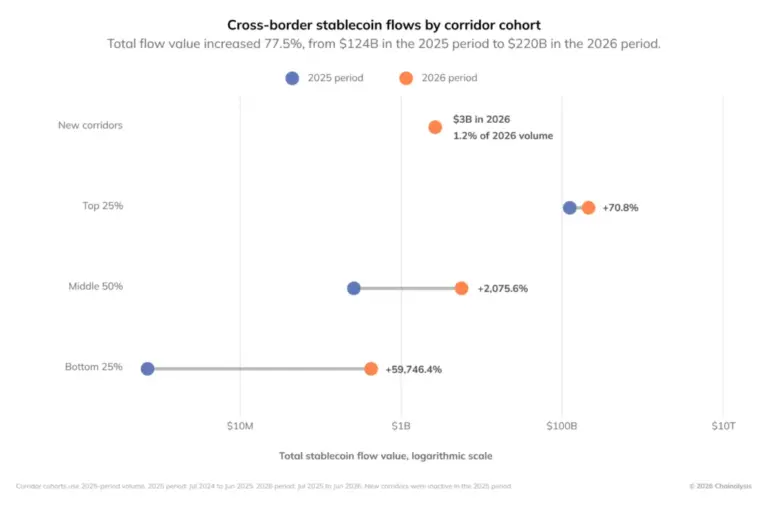
Legislative advancements, such as the passage of the GENIUS Act in mid-2025, have solidified the United States’ role as the preeminent global exporter of digital dollars. Dollar-pegged stablecoins have transformed U.S. sovereign debt into the preferred currency for cross-border businesses and peer-to-peer economies alike, generating billions in global economic activity.
Concurrently, the United States has accelerated its accumulation of bitcoin. Following the introduction of spot bitcoin ETFs in early 2024, the American share of global bitcoin activity has climbed steadily. While stablecoins comprise a smaller relative share of domestic U.S. crypto transactions compared to international markets, the divergence underscores a distinct structural split: international users adopt digital dollars to fulfill foreign currency and settlement needs, whereas American market participants increasingly leverage bitcoin as a scarce store of value amid rising national debt levels.

Cross-border data reveals that the United States transitioned into a net importer of bitcoin during 2026. While retail-sized transfers under $10,000 remained net outbound, institutional-scale transactions—particularly those exceeding $10 million—drove massive inbound liquidity. Meanwhile, stablecoin circulation expanded significantly, with major issuers reporting tens of billions in active tokens supporting trillions of dollars in quarterly on-chain volume. These stablecoins function primarily as routing layers between fiat currencies, local assets, and global liquidity pools, ultimately driving underlying demand for short-dated U.S. government debt.
Tokenization Expands as U.S. Treasuries Anchor Real-World Assets
The tokenization of real-world assets (RWAs) experienced substantial expansion through mid-2026, with the total market capitalization growing 135% year-over-year to reach $36.07 billion. Tokenized U.S. Treasury bonds constituted the single largest asset class, accounting for $15.42 billion or 42.8% of total RWA value.

Asset managers, public corporations, and financial institutions increasingly leverage blockchain infrastructure to enhance the speed, programmability, and interoperability of financial instruments. While niche categories like corporate credit and private equity achieved high percentage growth from small baselines, U.S. Treasury debt expansion dwarfed other sectors in absolute dollar terms.
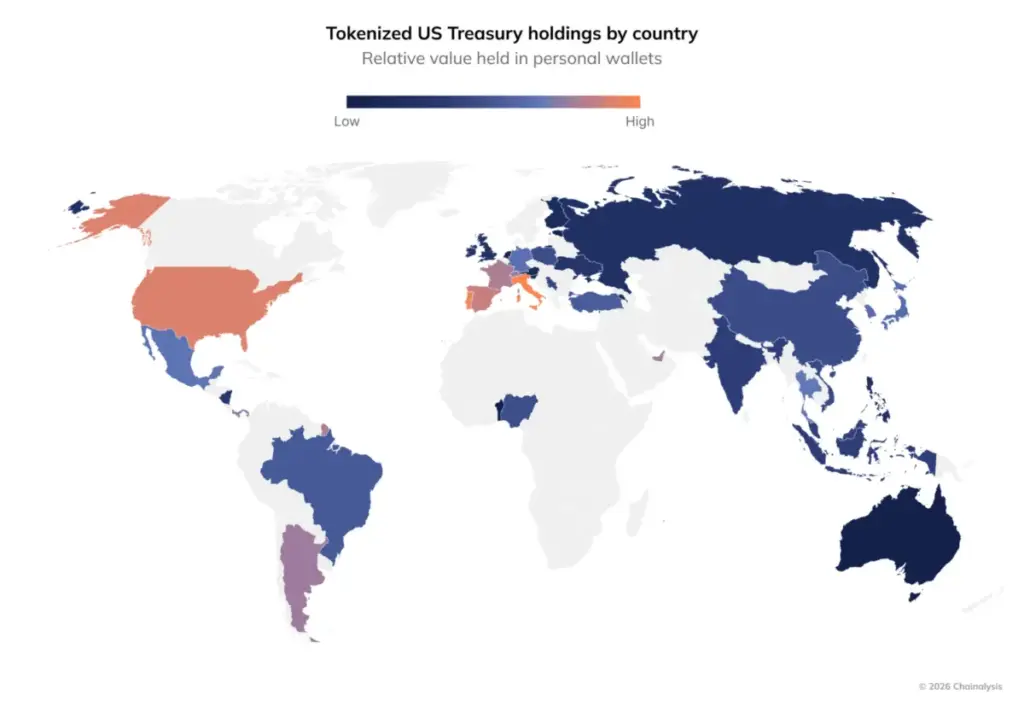
International retail and institutional investors drive a significant share of this demand. While U.S.-based entities hold roughly 11.4% of total RWA value, foreign jurisdictions—including Italy, Portugal, and Singapore—represent substantial holdings in tokenized U.S. government debt. This dynamic highlights how blockchain tokenization removes traditional brokerage barriers, allowing international retail investors to access wholesale U.S. financial instruments directly.

Canada Emerges as a Global Leader in Peer-to-Peer and Remittances
North of the border, Canada’s crypto economy expanded by 2.3% during the 2026 period to reach $247.7 billion. Despite its smaller scale relative to the United States, Canada demonstrated exceptional resilience and recorded the most robust peer-to-peer crypto economy among G7 nations, placing seventh globally in both domestic and cross-border flows.
Stablecoins captured 44% of Canadian dollar-based order book volume by mid-2026, up from 30% the previous year, with USDC dominating the sector. Because these preferred stablecoins are denominated in U.S. dollars, Canadian policymakers have monitored the trend closely, noting that capital flowing into foreign-backed digital assets may dilute potential demand for domestic sovereign debt. To address this, Canada recently enacted a stablecoin framework designed to foster the development of Canadian dollar-backed alternatives for domestic and international payments.

Canada’s prominent cross-border remittance market is heavily influenced by its diverse demographic makeup. With approximately 23% of its population born abroad—the highest proportion in the G7—Canada serves as a major origin point for remittance flows to countries like India, China, the Philippines, Nigeria, and Pakistan.
During the reporting period, stablecoin and bitcoin transfers along remittance corridors to India, China, and the Philippines totaled $2.36 billion across 3.56 million transactions, driven by significantly lower settlement costs compared to traditional banking channels. Furthermore, domestic peer-to-peer transaction volumes in Canada exhibited a strong historical correlation with fluctuations in temporary visa and study permit populations, suggesting that residents with active cross-border financial ties naturally gravitate toward efficient blockchain settlement alternatives.

Infrastructure Rests in American Hands While Usage Spreads Globally
The overarching narrative of North American cryptocurrency markets centers on infrastructure centralization. U.S. institutions, protocol developers, and corporate issuers control the foundational layers of the modern on-chain economy—spanning tokenized sovereign debt, dollar-denominated stablecoins, and autonomous AI payment rails. Meanwhile, the consumer and institutional user base driving transaction demand spans the globe.
As international jurisdictions continue to implement competitive frameworks—such as Europe’s MiCA regulation, Singapore’s stablecoin licensing regimes, and central bank digital currency pilots—market participants will evaluate whether regional alternatives can challenge the entrenched dominance of dollar-based crypto rails. Upcoming regulatory guidance across North America will ultimately determine how institutional adoption and automated on-chain commerce scale in the periods ahead.
 Crypto Wallets & Security
 Crypto Wallets & Security
 Crypto Wallets & Security