
Cryptocurrency has long been recognized as a multifaceted global movement, serving different purposes depending on geography and economic reality. For capital allocators in the Western world, it functions primarily as a technological upgrade, where tokenized assets hold the potential to completely reshape how traditional financial instruments are traded. Meanwhile, for low-wage workers and citizens in the Global South, digital assets represent an essential lifeline, offering stablecoins as a fast, reliable mechanism to move value and hedge against severe political and economic uncertainty. For everyday retail participants worldwide, it remains an alternative investment class.
The latest findings from the annual Geographies report illustrate one of the most extreme and volatile stretches for cryptocurrency markets on record. Spanning the period from July 1, 2025, to June 30, 2026, the market experienced a historic rollercoaster. During this timeframe, Bitcoin surged to a new all-time high before recording its largest-ever dollar-value retreat, shedding an astonishing $67,000 from peak to trough. This massive correction contributed to an overall crypto market capitalization drawdown of 50%, wiping out $2.1 trillion in value and marking the most severe bear market since the cascading collapses and industry-wide scandals of 2022.
Despite the profound contraction in speculative asset prices, the broader global crypto economy proved remarkably resilient. Historically, bear markets invariably stunt economic growth within the sector, but the downturn between 2025 and 2026 achieved this only modestly. According to the report, the world’s aggregate crypto economy—which encompasses service inflows, domestic peer-to-peer activity, and cross-border transfers—shrank by just 1.6% from the prior 12-month period. This comprehensive metric recorded $9.4 trillion in total economic activity for the year ending June 30, 2026, holding nearly steady compared to the $9.5 trillion registered during the previous period.

Market analysts note that the 2026 drawdown could easily have been far more catastrophic. Because a market trading at half its former valuation must work twice as hard to generate the same aggregate economic effect, a purely investment-driven ecosystem would have suffered a devastating collapse in global value flows. In comparison, the 2023 bear market saw a much sharper percentage drop in activity—falling 23% compared to the 1.6% contraction seen in 2026—and a larger pure dollar decline of $1.2 trillion versus just $0.1 trillion, despite a much smaller contraction in overall market capitalization.
The primary factor blunting the recent contraction was the growing diversity of real-world use cases. Across eight distinct chapters, the new report details how these varied identities are shaping crypto adoption on a regional level, utilizing hard data and on-the-ground insights to demonstrate how macroeconomic events directly influence on-chain economies.
Retail-Sized Transfers and Institutional Resilience
A substantial portion of the global crypto economy relies on centralized and decentralized services used to buy, sell, trade, borrow, lend, and transmit digital assets. Tracking these platforms provides clear visibility into the user demographics driving activity. During the 2026 monitoring period, small-dollar inflows into these services experienced notable growth. Transfers of under $100 surged by 78.4%, while transactions ranging from $100 to $1,000 increased by 58.6%.

Although this retail-level participation accounts for a modest share of the overall economic picture—representing $273 billion out of nearly $10 trillion in total activity—it signals that everyday users maintained persistent engagement despite prevailing bear market conditions. Concurrently, institutional-sized transfers of $1 million or more proved remarkably resilient against the broader price pullback. These high-volume transactions dropped by just 7.2% period-over-period. Given that institutional portfolios faced asset values up to 50% lower than previous highs, maintaining this level of transaction volume required moving significantly greater amounts of digital assets, effectively capping the overall depth of the market drawdown.
Boom in Cross-Border Stablecoin Transfers
Emerging regulatory frameworks across major global jurisdictions—including the GENIUS Act in the United States, Markets in Crypto-Assets (MiCA) regulation in the European Union, and legislative actions in Japan, Hong Kong, Singapore, and the United Kingdom—are increasingly providing the regulatory clarity necessary to accelerate stablecoin adoption.
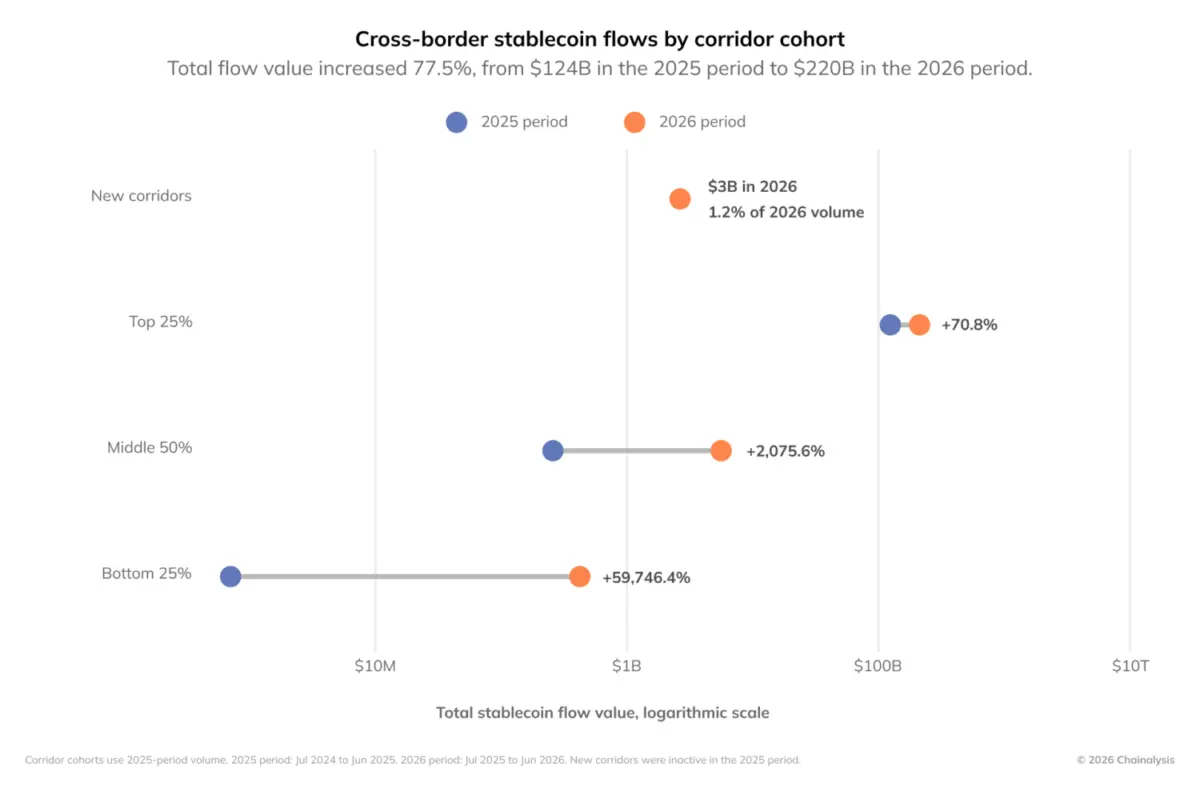
Conservative estimates indicate that monthly cross-border stablecoin value more than doubled, climbing from $11 billion in January 2025 to $24 billion by June 2026, with actual underlying volumes likely substantially higher. Overall, cross-border stablecoin transfers rose 77.5% over the 12-month period, expanding from $124.2 billion to $220.3 billion.

This robust cross-border expansion is largely driven by everyday payments averaging approximately $3,000—a transaction size far too small to reflect institutional treasury operations. Instead, these transfers align with practical, real-world utility: individuals paying international suppliers, remitting funds to family members abroad, or moving personal savings out of domestic currencies facing severe depreciation.
Philip Gradwell, vice president of economics at Tether, observed that crypto activity has evolved into a consistent pattern. Rather than moving in speculative bursts, transactions are now steadily routed through wallets in a regular rhythm, representing the classic signature of trade and commerce rather than market speculation.
As stablecoins become deeply embedded in global commerce, transaction flows have expanded across previously quiet trade corridors. The top quartile of corridors accounts for the vast majority of cross-border stablecoin value, growing by 70.8% during the period. Meanwhile, lower-tier corridors that previously saw minimal activity experienced substantial inflows, as thousands of new corridors opened rapidly, carrying billions in cumulative volume, predominantly utilizing the world’s largest stablecoin, USDT. Gradwell noted that the true power of assets like USDT lies in serving the long tail of the global economy—regions and businesses historically priced out or excluded from traditional financial infrastructure due to excessive costs or restrictive technology, relying instead on instant settlement, minimal transaction fees, and basic mobile access.

Peer-to-Peer Rallies and Stablecoin Anchoring
While traditional crypto services experienced a mild contraction—with value flowing into exchanges, decentralized finance protocols, and other businesses falling 4.3% from $9.30 trillion to $8.90 trillion—peer-to-peer (P2P) activity surged dramatically. Value moving directly between personal wallets within domestic markets skyrocketed by 302.9%, jumping from $56.8 billion to $228.7 billion. Consequently, P2P transactions expanded across every global region, driven almost entirely by stablecoins, which now comprise roughly 96% of all peer-to-peer volume.
This stark divergence highlights the fundamental divide within the digital asset ecosystem. While service inflows heavily reflect trading and on-ramp activity tied directly to asset prices, stablecoin payments remain largely insulated from market sentiment. Denominated in dollars and sized strictly according to user needs, these utility-driven transfers occur independently of whether the broader market is rising or falling.
On-chain balances similarly reflected broader market movements, with global measured balances falling from a peak of $0.86 trillion in September 2025 to $0.44 trillion by June 2026. However, stablecoin balances remained remarkably stable, holding between $98 billion and $109 billion throughout the nine-month drawdown. Because stablecoins are pegged to fiat currencies, their on-chain value does not fluctuate alongside volatile crypto prices. As the broader market contracted by over 55%, stablecoins naturally increased their share of global balances, reaching 22.5% by June 2026 and serving as a vital financial anchor during heightened economic uncertainty.

Brazil Leads Global Grassroots Adoption
Synthesizing these comprehensive metrics, Brazil emerges as the leading nation worldwide for grassroots cryptocurrency adoption. While the country did not necessarily capture the top ranking in any single individual subcategory, its consistent performance across all evaluated areas allowed it to surpass more established markets like the United States during a challenging global bear market. Brazil’s robust $252.5 billion crypto economy underscores a widespread, systemic integration of digital assets into everyday financial life across the region.
The global landscape of grassroots adoption features diverse contributions from major economies worldwide. Following Brazil and the United States in the top tier are nations such as Nigeria, Japan, the Republic of Korea, India, Ukraine, Thailand, South Africa, and Canada. Rounding out the top twenty are Mexico, China, Germany, Indonesia, Australia, the Russian Federation, the United Kingdom, Vietnam, the Philippines, and Türkiye.
The methodology underpinning these rankings evaluates countries across four distinct pillars: service inflows, domestic peer-to-peer activity, cross-border transfers, and on-chain balances. By applying purchasing power parity adjustments and utilizing a geometric mean for overall scoring, the index rewards consistent adoption breadth rather than isolated dominance in a single category. Through the tracking of hundreds of millions of transactions and billions of web visits, combined with insights from local industry operators, the findings offer a clear picture of how cryptocurrency continues to function as an essential economic tool worldwide, even amid historic market volatility.
 Crypto Wallets & Security
 Crypto Wallets & Security
 Crypto Wallets & Security







