The Middle East and North Africa (MENA) spent the reporting period from July 2025 to June 2026 under a heavy regional cloud of uncertainty, reflecting deep geopolitical pressures and evolving market dynamics in its cryptocurrency adoption. The outbreak of the Iran conflict on February 28, 2026, generated cross-border shockwaves that touched every market under study. Compounding these macro tensions were localized pressures, including a prolonged internet shutdown and sweeping crackdown in Iran, alongside a major licensing transition for digital asset providers in Türkiye.
Despite these localized stresses and a global 2026 bear market that cut the total cryptocurrency market capitalization in half, on-chain economic activity worldwide showed remarkable resilience, barely dented by the valuation drop. The MENA region mirrored this global pattern. The region’s aggregate crypto economy slipped only slightly from $449.6 billion to $443.3 billion, marking a minor decline of 1.4% that closely tracked global trends. Out of 24 MENA markets with measurable data, 16 actually experienced growth. The regional total remained essentially flat largely because Türkiye and the United Arab Emirates—which together account for a massive 56% of the regional economy—moved in opposite directions, effectively canceling each other out. Ultimately, the defining characteristic of the MENA crypto landscape during this period was not the bear market itself, but the complex layer of regional disruptions stacked on top of it.
The common thread binding the regional narrative together is the pervasive pressure of geopolitical and economic instability. When institutional capital seeks a durable, regulated hub within the region, it increasingly concentrates in the UAE. Conversely, when Türkiye’s exchange sector pauses to comply with rigorous new licensing mandates, everyday retail users bypass centralized platforms entirely to transact wallet-to-wallet. While each of these behavioral shifts is specific to its local market, they all represent calculated responses to the same overarching regional conditions.

Türkiye’s $144.5 Billion Crypto Economy Shifts Toward Institutional Integration
Türkiye maintained its position as MENA’s largest cryptocurrency economy during the 2026 period, recording $144.5 billion in total value received—roughly one-third of the entire regional volume. This metric captures value across service inflows, domestic peer-to-peer transfers, cross-border peer-to-peer flows, and cross-border business-to-person transactions. While Türkiye’s total volume contracted modestly year over year, industry experts emphasize that this decline reflects a market undergoing a healthy structural transition rather than a retreat. Activity migrated away from unverified services onto direct wallet-to-wallet rails, while institutional engagement from traditional banks and licensed platforms deepened significantly. The net result is a smaller but fundamentally stronger market.
Right at the conclusion of the study period, Türkiye began aggressively enforcing a new regulatory regime requiring all Crypto Asset Service Providers (CASPs) to hold official licenses issued by the country’s financial regulator, the SPK. Functionally, the nation now demands that CASPs adhere to the exact same rigorous compliance protocols as traditional financial institutions. Burcu Küçüknal, CEO of the Turkish exchange Stablex, noted that the new legislation has raised the operational bar for the entire domestic industry. Crypto in Türkiye is rapidly becoming an integrated part of traditional finance rather than operating as a parallel system, she observed.
Compliant exchanges are now vastly better positioned to serve sophisticated institutional demands under the new regulatory framework. Fatih Günaydın, General Manager at Işık Digital Asset Technologies, explained that Turkish licensing criteria, operational rules, and capital requirements now place local crypto businesses directly in line with international standards. This evolution represents a crucial milestone for Türkiye and is expected to bolster long-term growth across regulated services.

Salim Karaman, CEO of BtcTurk, Türkiye’s largest crypto exchange, highlighted the changing mindset of corporate actors. Offering equity and crypto asset services within the same financial group—while maintaining proper regulatory authorizations and the strict separation of activities—is increasingly on the corporate agenda, Karaman noted. He added that the defining change over the past 12 months has been a tangible shift from merely assessing interest and potential toward actively developing institutional services and taking concrete steps to enter the market within a formalized regulatory framework.
Türkiye’s $3.56 Billion Peer-to-Peer Economy and the Stablecoin Constraint
Even as its institutional landscape matures, Türkiye retains a remarkably vibrant grassroots crypto economy. Its peer-to-peer (P2P) market expanded fivefold to reach $3.56 billion during the 2026 period, making it by far the largest in the region. In fact, Türkiye’s P2P crypto economy is nearly three times larger than the rest of the MENA region combined, with nearly all of that dramatic growth driven by stablecoins.
However, unlike P2P markets in other parts of the world, Turkish peer-to-peer activity is heavily restricted from touching the broader real-world economy. Günaydın pointed out that Turkish regulations strictly prohibit the use of crypto assets for purchasing everyday goods and services. Consequently, stablecoins are utilized primarily by individuals as a secure savings instrument, favored for their low spreads and ease of transfer. On the commercial and SME front, they see limited utilization in international trade strictly within the legal limits permitted by the laws of both trading partners.

For average citizens, the appeal of stablecoins is straightforward and driven by necessity. U.S. dollar-pegged stablecoins provide a stable store of value in a country where persistent inflation of the Turkish lira has steadily eroded household wealth for years. Putting dollar stability within reach of anyone with a digital wallet addresses a problem seen in high-inflation economies worldwide. Yet, because the Central Bank of the Republic of Türkiye bans crypto payments for goods and services, none of that $3.56 billion in domestic wallet-to-wallet volume circulates freely between buyers and sellers in the domestic real economy. Instead, it moves between Turkish wallets primarily as a digital, dollar-denominated savings and transfer mechanism. Küçüknal emphasized this persistent policy gap, noting that clear legal frameworks for stablecoin-based payments could unlock domestic demand well beyond simple trading and wealth protection.
Changing Regulations Trigger a Surge in Turkish Tokenized Gold Markets
Despite the soaring popularity of dollar-pegged stablecoins, they do not serve as the ultimate traditional savings instrument for Turkish households. That distinction belongs to physical gold, a deeply ingrained cultural store of value. Centuries-old societal attachments mean residents frequently stash precious metals under their mattresses, with government estimates suggesting that the population hoards an astonishing 5,000 tons of gold.
During the 2026 period, this deeply entrenched cultural preference migrated heavily on-chain, transforming Türkiye into a global leader in tokenized gold adoption. Activity surged from virtually zero in prior reporting periods to nearly $1 billion in 2026. Küçüknal observed a massive spike in tokenized gold trading on Stablex, noting that the trend clearly demonstrates how Turkish investors seek familiar, trusted assets delivered via modern digital rails.

Exchange order book data reveals the true scale of this phenomenon. When examining the popularity of purchasing tokenized gold using the Turkish lira, researchers found it ranked as the second most popular currency globally for such trades, trailing only the U.S. dollar. In fact, a greater share of Turkish lira trading volume flowed directly into tokenized gold than any other fiat currency with an order book exceeding $100 million.
This digital gold rush coincided directly with a major policy shift by Türkiye’s Treasury and Finance Ministry. In January 2026, the government announced a ban on purchasing physical gold—such as jewelry and bullion—using cash. The explicit objective of this framework, known as the Precious Metal Tracking System (KMTS), was to curb the informal economy and combat widespread counterfeit gold circulating in physical markets.
Rather than extinguishing local demand for gold, the cash ban redirected it, establishing a permanent new volume floor for tokenized gold. Trading activity spiked immediately following the announcement, hitting $183.9 million in February alone and representing 2.51% of the entire lira order book as traders front-ran the impending restrictions. When the physical cash restrictions officially went into force a few months later, the initial trading frenzy subsided, but it settled at a significantly higher baseline than before. To formalize this emerging reality, the government issued new directives in July 2026 governing the regulated trade of digital precious metals, a move industry leaders expect will further institutionalize the market.

The UAE Reaps the Rewards of Early Crypto Business Embraces
For years, the United Arab Emirates has actively courted cryptocurrency businesses as a cornerstone of its broader strategy to diversify its historically oil-dependent economy. By pioneering forward-thinking regulatory frameworks for digital assets, the UAE positioned itself at the cutting edge of global financial markets.
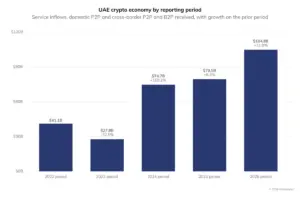
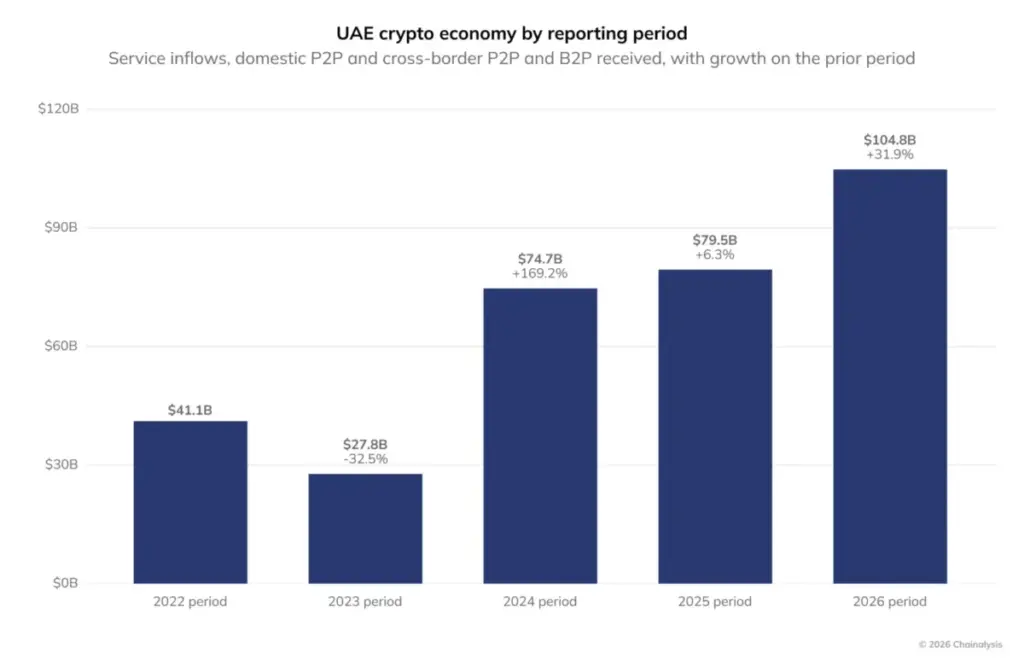
This successful economic diversification campaign enabled the Emirates’ crypto economy to expand robustly during a period of intense regional instability. Even as the conflict involving Iran generated geopolitical shockwaves and temporarily slowed broader economic growth in sectors like tourism and hospitality, the UAE’s crypto economy expanded by 32% to reach $104.8 billion. Highlighting the sheer momentum of the Emirates, excluding the UAE from the calculations means the rest of the MENA region contracted by 8.6% rather than a mild 1.4%. Henri Arslanian, co-founder of Nine Blocks Capital Management and the first crypto hedge fund licensed by Dubai’s virtual assets regulator VARA, noted that while the war impacted traditional pillars of the economy, the digital asset industry experienced minimal disruption.
Arslanian added that outside of the United States, the MENA region—and the UAE in particular—has established itself as the primary global hub for crypto corporate operations. He credits the willingness of UAE financial regulators to issue clear, predictable licenses as a vital catalyst that largely eliminated the career risk for corporate executives engaging with digital assets. Laurent Girouille, Senior Executive Officer at Rain Trading Limited, observed a distinct maturation in market inquiries, shifting from retail access questions a year ago to highly operational concerns regarding regulated counterparties, asset custody, and settlement reconciliation originating from corporate treasuries, family offices, and institutional intermediaries.

Market data strongly validates this institutional pivot. The UAE’s $102.3 billion services sector drove the vast majority of its cryptoeconomic expansion during the 2026 period. Overall, this category grew 29% period-over-period, with centralized exchange inflows rising 22% to $55 billion. Institutional platforms, including dedicated custodians and market-makers, surged 75% to reach $11.7 billion. Decentralized finance (DeFi) exchanges also captured more than $31 billion in total inflows, representing a 31% increase over the prior period.
Simultaneously, the UAE’s much smaller peer-to-peer and business payment segments experienced explosive growth. Domestic P2P payments skyrocketed 786% period-over-period, while cross-border peer-to-peer inflows multiplied 18-fold. Cross-border business payments likewise surged nearly 400%, fueled by an influx of major stablecoin transfers valued at $1 million or more. Arslanian emphasized that many international observers underestimate the scale of stablecoin adoption in B2B transactions within the UAE, noting that the country has evolved into a global clearinghouse for such settlements, supported by regulated OTC brokers offering robust fiat off-ramps.
These rapid growth trajectories are rapidly propelling the UAE toward the apex of the regional market. The UAE ended the 2026 reporting period at nearly three-quarters the size of Türkiye, MENA’s longstanding market leader. On its current trajectory, the UAE’s crypto economy is on a clear path to surpass Türkiye in 2027.

Conflict and Safe Havens: How the Iran War Influenced UAE and Turkish Crypto Choices
While the Iran conflict did not stunt the growth of the UAE’s institutional crypto services sector, it did coincide with a notable shift in retail investment behavior within the Emirates: a distinct rise in holders of tokenized gold paired with a comparative decline in holders of bitcoin. Much like Türkiye, where the KMTS cash ban redirected gold demand onto digital ledgers, the catalyst in the UAE differed, but the underlying behavioral pattern remained identical. Periods of acute geopolitical uncertainty consistently push investors toward deeply familiar assets operating on modern financial rails.
Bitcoin and tokenized gold both function as cultural safe-haven assets during times of crisis. However, gold represents a savings habit backed by centuries of tradition, as Girouille pointed out. When the UAE first began experiencing the impact of regional hostilities in March 2026, the local ranks of both bitcoin and tokenized gold holders climbed in tandem. However, these twin trends diverged sharply during subsequent periods of relative calm. Following a broken ceasefire, the relative share of tokenized gold holders in the UAE continued to steadily climb, whereas the number of bitcoin holders contracted. Investors who had accumulated bitcoin during the height of uncertainty liquidated their positions once tensions eased, while gold accumulators held firm.
This stickiness stems from the unique cultural perspective surrounding gold in the region—it functions less as a speculative trading instrument and more as a long-term savings vehicle to be accumulated and preserved. While bitcoin serves a comparable function in other global markets, local data suggests it played a more transient role in the UAE during this period, functioning as a short-term hedge that investors exited once pressure subsided.

Blackouts, Protests, and Resilience: Everyday Crypto Adoption in Iran
Iran presents a complex dual reality within the regional crypto ecosystem: it hosts one of the most robust grassroots crypto economies in the world, yet its state apparatus simultaneously utilizes digital assets to evade international sanctions and fund military operations. Because the Iranian regime relies on the domestic crypto sector to bypass restrictions imposed by bodies like OFAC, analyses of grassroots adoption intentionally isolate everyday civilian activity from state-sponsored illicit behavior.
Throughout 2026, regular Iranians relied heavily on bitcoin and stablecoins to hedge against persistent domestic inflation and manage their daily lives, despite severe disruptions caused by rolling government internet blackouts. The regime twice severed civilian digital connectivity to the outside world: first for 20 days in January following the suppression of economic protests, and second for 88 days immediately following the outbreak of the war. In both instances, these blackouts severely crippled the ability of ordinary citizens to execute crypto transactions.
Transaction metrics demonstrate the immediate chilling effect of these digital blockades. Iranian personal bitcoin wallets recorded nearly 90% fewer transactions during the first week of the January blackout compared to baseline periods. Activity rebounded swiftly, exceeding baseline levels the moment connectivity was restored. A month later, the onset of the war and the second extended blackout triggered another steep drop of approximately 80% in Iranian bitcoin transactions.

Crucially, bitcoin activity inside Iran never dropped entirely to zero. During the prolonged second blackout, transaction volumes gradually crept upward, illustrating the remarkable resilience and ingenuity of the local population in bypassing severe digital censorship through tools like Starlink satellite connections. By the conclusion of the second blackout, activity had recovered to more than 75% of baseline levels. When restrictions were finally lifted in late May, transaction volumes surged to nearly double the baseline, proving that the blackouts had merely bottled up immense underlying demand rather than destroying it.
Internet blackouts restrict outbound spending within an isolated country, but they cannot prevent the influx of incoming funds. Analysis of cross-border stablecoin flows revealed that foreign senders adapted quickly to the volatile conditions. Initial stablecoin transfers jumped to nearly 150% of baseline levels ahead of restrictions, dropped by roughly 80% while blackouts took full effect, and rebounded instantly the moment networks reopened and foreign wallets confirmed that Iranian recipients could access their funds. The geopolitical conflict with the United States initially prompted a similar 50% drop in cross-border stablecoin activity, but inflows quickly rebounded and surpassed baseline levels following the April 7 ceasefire.
Israel’s Crypto Economy Holds Steady Amid Regional Turbulence
Israel’s cryptocurrency economy demonstrated remarkable stability amid 12 months of intense regional turbulence, expanding by a modest 0.7% period-over-period. It stood out as one of the few markets globally that successfully avoided both contraction and expansion during the wider bear market downturn.

Trading activity drives this $37.9 billion market, with the vast majority of tracked volume consisting of inflows into centralized exchanges and digital asset services. This dynamic aligns with observations from local industry experts, who note that Israel exhibits extremely limited peer-to-peer activity and negligible domestic cross-border flows compared to its MENA neighbors. Noam Kaplan, a partner at KPMG Israel, noted that while trading and investment remain the primary use cases, local participants are increasingly exploring decentralized finance and blockchain-based financial services.
An expanding regulatory framework governs these emerging sectors. In the months following the study period, Israeli financial watchdogs introduced new rules concerning stablecoins, token offerings, and heightened capital requirements for virtual asset service providers. Ilan Sterk, CEO of Horizon—the crypto wing of Israeli investment firm Altshuler Shaham—emphasized that the local market remains predominantly retail-driven, having not yet reached the institutional depth seen in larger international jurisdictions.
Transfer-size data corroborates this retail dominance. During the 2026 period, 98.4% of Israeli transfers into services were valued under $10,000, though they accounted for just 11% of total value. Conversely, large transfers of $1 million or more carried 57% of the total value, totaling $21.3 billion. Institutional platforms captured 10.8% of service inflows, down slightly from a 2025 peak of 13.6% but remaining well above the 5.6% recorded in 2024.

Stablecoins steadily increased their share of Israeli service inflows over three consecutive reporting periods, rising from 48.1% in 2024 to 51.6% in 2025, and reaching 57.0% in 2026. Sterk explained that this growth reflects a strong tendency among Israeli retail users to acquire stablecoins locally and transfer them to offshore venues in search of trading opportunities unavailable on domestic platforms. With the single Israel-domiciled exchange tracked in the data capturing just 0.06% of local stablecoin inflows—with the remainder flowing abroad—Israel’s crypto economy remains functionally hosted outside its own physical borders.
Notably, Israel diverged from other MENA markets in its reaction to the 2026 military conflicts. The early 2026 conflict saw Israeli service inflows fall by 18.9%, slightly below the global average drop of 23.6%, while the June 2025 conflict saw a 29.2% decline. Neither event produced the massive, immediate surge that followed the October 7, 2023 attacks, which had permanently elevated Israel’s share of global service inflows. Because Israeli market participants were already operating within a crypto environment that had absorbed those earlier structural adjustments, subsequent rounds of conflict failed to trigger the dramatic behavioral swings observed in the UAE and Türkiye.
As the MENA region looks toward 2027, the central question remains which of these diverse national shifts will harden into permanent fixtures of the global financial architecture. The UAE’s aggressive institutional buildout runs far ahead of its peers, Türkiye’s retail population has durably embraced peer-to-peer and tokenized assets under formal licensing regimes, and Israel has settled into a resilient steady state. The rapid evolution of these distinct regional markets continues to provide a vital window into the intersection of geopolitics, regulation, and digital asset adoption.
 Crypto Wallets & Security
 Crypto Wallets & Security
 Crypto Wallets & Security