North America cemented its status as the most influential region for global cryptocurrency markets during the 12 months leading up to July 1, 2026. Driven by a deep U.S. investor base providing vital capital, lawmakers updating regulatory frameworks, stablecoins functioning as a widespread currency, and businesses bridging the gap between crypto and traditional finance, the region continues to export its financial innovations to the rest of the world.
According to recent reporting, the United States and Canada topped the unweighted "big-money index," which measures the sheer crypto-economic power of covered countries. Combined, their respective crypto economies totaled $3.02 trillion during the 2026 reporting period, representing a modest 1.9% contraction compared to the previous year.
This regional dip was primarily rooted in a minor slowdown within the United States. The U.S. crypto economy valued at $2.78 trillion fell by 2.2% period-over-period—an outcome that industry experts viewed as unsurprising amid a harsh bear market. Nevertheless, the world’s single-largest crypto economy largely preserved the near-doubling of value it achieved during the 2025 period. Foundational institutional forces, such as the rapid growth of crypto exchange-traded funds (ETFs), accelerating asset tokenization, and the widespread proliferation of stablecoins, played a pivotal role in retaining those gains.

Hoolie Tejwani, Head of Coinbase Ventures, noted that much of the market behavior observed compared to 2025 comes down to industry maturation. The structural building blocks established in 2025 successfully transitioned into commercial products boasting real users, healthy liquidity, and active markets in 2026.
The primary drivers of this activity center around three U.S.-developed crypto products that attracted massive domestic and international engagement: AI commerce, stablecoins, and tokenized assets. Meanwhile, the Canadian market resisted the broader continental downtrend, expanding by 2.3% to reach a $250 billion crypto economy, fueled in part by robust peer-to-peer activity among its immigrant populations.
The US Leads the AI On-Chain Economy
The United States’ leading role in the global artificial intelligence development race is visibly reshaping every corner of the economy, including digital assets. Analysts researched x402, one of the most prominent digital payment rails enabling AI agents to autonomously spend money, to map how this new machine-driven economy is taking shape.

As autonomous software increasingly initiates on-chain payments, the United States has emerged as the dominant builder of this infrastructure. Core American crypto companies—including Circle, the issuer of the leading agent currency USDC, and Coinbase, the creator of the x402 system—are actively supporting this technological evolution. Major financial institutions are also taking notice. Will Su, Head of Digital Assets Research at BlackRock, noted that the firm is closely monitoring agentic commerce because AI agents hold the potential to generate meaningful, round-the-clock demand for frequent, low-value payments.
By the close of the 2026 period, more than 138 million x402 transactions had been executed on Base, establishing it as the most popular blockchain for agentic commerce.
On-chain payments facilitate economic activity that remains entirely infeasible on traditional legacy payment rails, most notably micro-payments. Transactions worth fractions of a dollar, and especially those under a single penny, simply do not make fiscal sense for credit card networks to process due to overhead costs. However, stablecoin settlements costing less than a cent make it economically viable for machines to spend tiny amounts of money. This breakthrough opens up an entirely new market for pay-as-you-go digital goods and services, such as purchasing a data retrieval via an API call.

Circle described a clean division of labor taking shape across the broader payments landscape: traditional card rails handle consumer-prompted agent payments, while stablecoin rails manage machine-to-machine settlements that are far too small for traditional card economics.
AI Payments Become Stickier and More Purposeful
During the 16 months leading up to September 2026—a timeframe extended to account for the infancy of the technology—the vast majority of x402 activity registered as micropayments. Over 87% of all payments ranged between a hundredth of a cent and a dime, with the most frequent transaction size falling between one and ten cents.
While agentic commerce remains largely in an experimental phase, distinct signs of maturation are emerging. Early adoption was frequently characterized by one-off users trying out basic crypto trades before abandoning the protocol once their initial funds depleted. That dynamic has changed dramatically.

When grouping wallets by the quarter they were first funded, the share that received a second funding injection within 30 days climbed from 70.6% for wallets funded in the third quarter of 2025 to 89.3% for those funded in the second quarter of 2026. This regular topping-up functions as the on-chain equivalent of renewing a subscription. Furthermore, the time gap between a wallet’s initial funding and its first x402 spend compressed significantly. In late 2025, wallets had a median age of 73 days before initiating a payment; by the third quarter of 2026, that window shrank to just 18 minutes. Roughly two in three new wallets now spend almost immediately after being topped up, signaling intentional and purposeful adoption rather than idle experimentation.
The U.S. Dominates AI-to-AI Commerce
American-funded AI agents currently transact more with x402 services than agents backed by any other nation. The United States commands a 30% share of geolocated agent-to-services transactions globally. American wallets account for 88.1% of all geolocated AI model inference transactions on the protocol, alongside 41.2% of payments directed toward agent frameworks and tool catalogs, and 23.2% of payments for data and search APIs.
In contrast, Chinese-attributed wallets displayed a different usage pattern, heavily concentrating in the security space. Approximately nine out of every ten transactions directed toward security and code analysis originated from Chinese-linked wallets, flowing predominantly into AgentLISA, an AI service that audits Solidity smart contracts. Chinese-funded agents also showed strong participation in market and financial intelligence and settlement rails, but remained largely absent from model inference payments, accounting for just 0.1% of that category. Industry observers attribute this split to a combination of AI nationalism and economic reality, noting that China’s open-weight models are often free to use, whereas U.S.-developed metered models carry ongoing costs.

The US Imports Digital Gold and Exports Digital Dollars
Following the congressional passage of the GENIUS Act in mid-2025, the United States solidified its status as the world’s leading exporter of digital dollars. Stablecoins transformed U.S. debt into a preferred currency for peer-to-peer economies and cross-border business transactions alike, generating billions of dollars in economic activity that benefits both U.S. corporations and the federal government.
While the U.S. actively exports stablecoins, it concurrently imports bitcoin. Since the launch of spot bitcoin ETFs in January 2024, the U.S. share of global bitcoin activity has risen steadily. Conversely, stablecoins comprise a smaller share of domestic American crypto activity than they do internationally, with that gap widening over successive reporting periods. This divergence highlights a distinct market split: users abroad pivot to digital dollars to satisfy foreign financial needs, while American users lean heavily into bitcoin as an institutional store of value.
Cross-border bitcoin flows into and out of the U.S. turned net positive in 2026 for the first time since 2022. Transfers under $10,000 consistently recorded net outflows, whereas institutional-scale transfers above $10 million drove substantial net inflows, accounting for over 53,200 coins arriving during the period. Meanwhile, stablecoin circulation expanded significantly, with issuers like Circle reporting billions in token supply backed primarily by short-dated U.S. government debt.

The U.S. Impact on Tokenization
The United States also maintained its dominance in the rapidly expanding tokenization sector throughout 2026. U.S. Treasury bonds served as the single largest real-world asset (RWA) category, capturing $15.42 billion on-chain—representing 42.8% of all tokenized RWA value. The broader tokenization market finished the second quarter of 2026 at $36.07 billion, marking a 135% growth rate period-over-period.
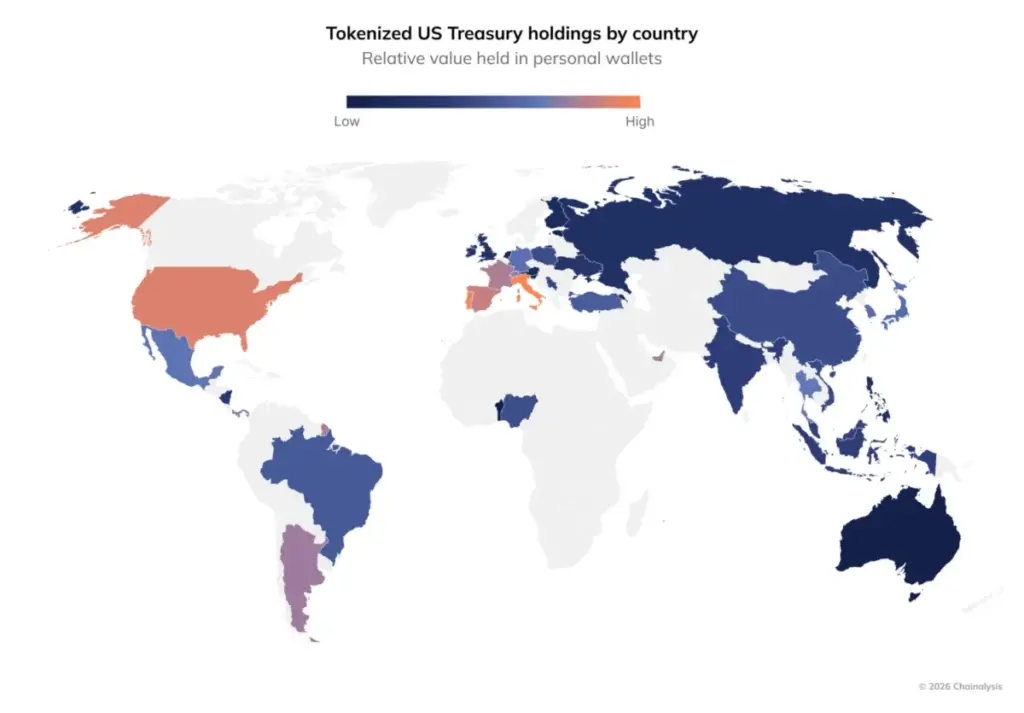
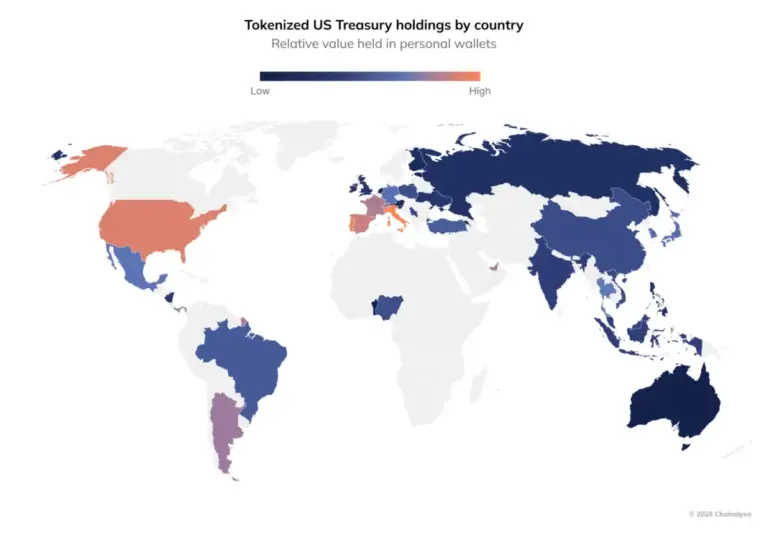
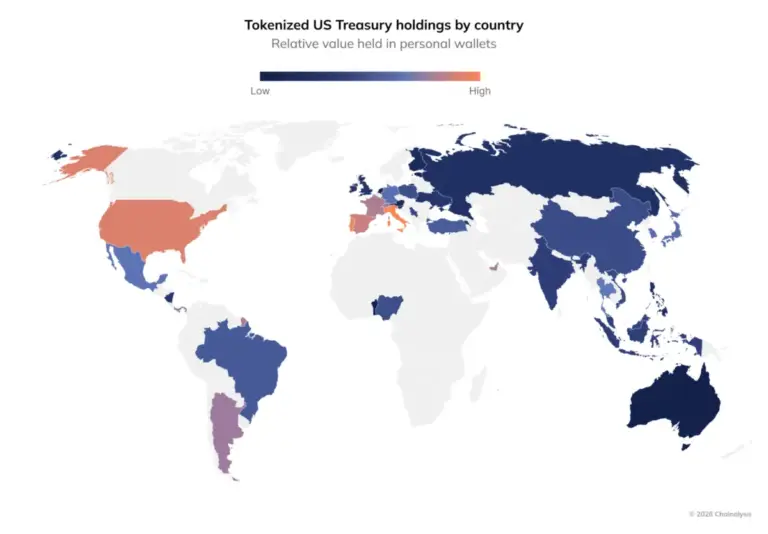
Although U.S. residents account for roughly 11% of the global tokenized RWA holder base and value, tokenized U.S. Treasuries exhibit a different geographic distribution. Foreign investors—led by Italy, Portugal, and Singapore—drive a significant portion of tokenized Treasury holdings, effectively utilizing blockchain rails to bypass traditional brokerage hurdles and purchase fractionalized U.S. sovereign debt directly.
Lending patterns further demonstrate that tokenized Treasuries are primarily bought and held rather than utilized as active collateral. While private credit and commodity lending against tokenized assets surged dramatically, Treasury lending contracted by 23%, reflecting their already high liquidity in traditional financial markets.

Canada Excels as a Global Peer-to-Peer Leader
Canada, ranking as the second-largest country in the North American crypto economy, saw its market grow by 2.3% between July 2025 and June 2026 to reach $247.7 billion. Beneath this steady expansion lies heavy everyday usage by Canadian residents, placing the country seventh globally in domestic and cross-border flows and making it the most robust peer-to-peer crypto economy among G7 nations.
Stablecoins power a massive share of Canadian crypto activity, accounting for 44% of Canadian dollar-based order book volume by June 2026, led primarily by USDC. Executive Director Morva Rohani of the Canadian Web3 Council noted that policymakers are monitoring this trend closely, as heavy reliance on U.S. dollar-denominated stablecoins funnels potential sovereign debt demand toward the United States rather than Canada.
To address this, Canada recently adopted a stablecoin act intended to pave the way for domestic Canadian dollar-backed stablecoin issuers. However, their current market capitalization remains minimal compared to their U.S. dollar counterparts.

Canada’s vibrant cross-border remittance market heavily utilizes stablecoins. With the G7’s highest foreign-born population share at roughly 23%, Canada maintains massive remittance corridors linking residents to India, China, and the Philippines. Stablecoin and bitcoin transfers across these specific corridors totaled $2.36 billion during the reporting period, representing a 141% year-over-year increase spread across millions of transactions.
Domestic peer-to-peer transaction volumes in Canada also tracked closely with fluctuations in temporary visa and study permit populations, illustrating that residents with active cross-border financial ties naturally gravitate toward faster and cheaper blockchain-based settlement options.
Ultimately, North America’s defining narrative centers less on retail token holding and more on foundational infrastructure. American institutions, developers, and issuers occupy the center of tokenized Treasuries, stablecoin liquidity, and agentic AI commerce. As international jurisdictions pursue their own regulatory frameworks and digital currency pilots, the future adoption curve will determine whether regional alternatives can challenge the dominant role of American digital infrastructure.
 Crypto Wallets & Security
 Crypto Wallets & Security
 Crypto Wallets & Security