
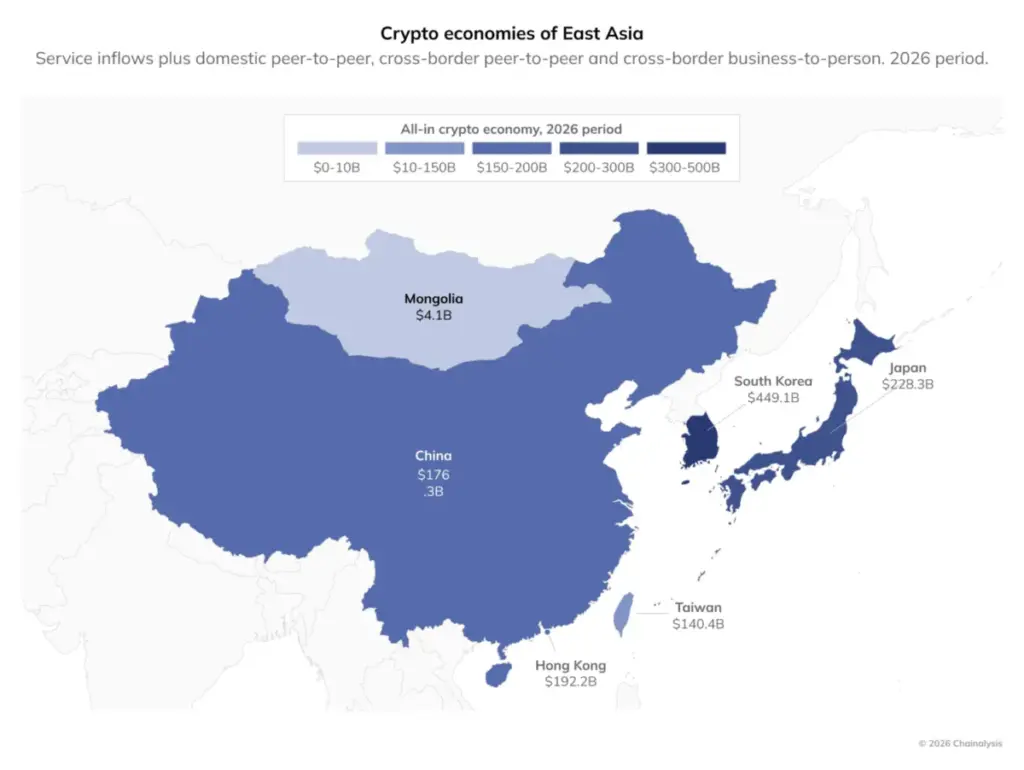
Eastern Asia’s cryptocurrency economy stands as one of the most economically diverse and strategically fractured landscapes in the global digital asset ecosystem. Across the region, sharply contrasting regulatory frameworks, distinct risk appetites, and varied business objectives continue to drive users toward vastly different operational use cases. Data compiled for the period between July 2025 and June 2026 reveals that while the broader regional crypto economy contracted modestly in alignment with a global bear market, this downturn was far from uniform. Growth hotspots flourished in specific sectors, propelled by institutional adoption in financial hubs like Hong Kong and a massive surge toward decentralized platforms and alternative asset classes in neighboring jurisdictions.
Regional market dynamics highlight the unique duality of the Asian market. Industry leaders note that Asia remains a rare geographic territory housing both deep grassroots retail participation and formidable institutional infrastructure. South Korea maintained its position as the region’s largest standalone market, anchoring a $449 billion crypto economy driven primarily by retail demand and a high-stakes rotation into artificial intelligence-linked digital assets. Meanwhile, Hong Kong cemented its status as the premier institutional gateway through clear regulatory pathways, whereas Mainland China witnessed a dramatic shift toward peer-to-peer stablecoin usage amid broader shifts in financial oversight.

South Korea Leads the Region Amid Retail-Driven Expansion
South Korea’s expansive $449.1 billion all-in crypto economy grew 12.3% period-over-period, supported by an additional $51.1 billion in direct exchange-related flows. This robust activity remains heavily anchored by the country’s famously retail-driven market dynamics. Observers note that this consumer enthusiasm operates largely without the immediate, large-scale participation of major domestic financial institutions, which have historically faced legislative hurdles regarding direct crypto operations and asset management.
Although traditional financial players have been slow to deploy capital at scale for retail crypto investing or payments, institutional preparation is well underway. Following government initiatives to gradually ease longstanding corporate crypto trading bans, major domestic banks and securities firms have established dedicated digital asset teams. Most of these traditional institutions are actively running pilots focused on stablecoins, asset tokenization, and secure custody solutions, indicating that institutional engagement is shifting from exploratory conceptualization toward practical execution.

The impending implementation of a 22% tax on crypto profits, scheduled to take effect at the beginning of 2027 following previous legislative delays, serves as a significant catalyst for market expectations. The potential convergence of stricter retail tax policies and broadened corporate access could reshape South Korea’s landscape, introducing institutional capital as a meaningful counterweight to retail demand for the first time. Regulatory authorities continue to monitor these legislative deliberations closely, noting their potential to fundamentally alter retail investor participation patterns.
The AI Cryptocurrency Trade Dominates South Korea
South Korean retail traders have consistently favored high-risk, high-reward opportunities, a tendency manifested most prominently within the artificial intelligence cryptocurrency sector. This trend has developed in parallel with the nation’s traditional equity market, which is heavily influenced by domestic semiconductor giants producing memory chips for global data center expansion.

By June 2026, AI-focused cryptocurrencies emerged as the single most popular thematically defined investment category by share of Korean won-denominated trading volume, eclipsing established payment tokens like XRP. This level of engagement sets South Korea apart as an outlier on both a regional and global scale. Won-denominated trading activity in AI assets vastly outpaced equivalent metrics in other major currency markets, demonstrating a turnover velocity and intensity unmatched across other measured jurisdictions.
The specific tokens capturing trader interest within this thematic category experienced rapid turnover. Leading assets from previous periods gave way to newer market participants, including Worldcoin, SAHARA, VIRTUAL, BIO, and NEAR. Market data underscores that South Korean retail participants navigate this high-beta asset class at a velocity and trading volume that distinguishes the domestic market from any other monitored region.

Japan’s Evolving Consumer and Institutional Crypto Economy
Japan’s $228.3 billion crypto economy often commands attention for its growing institutional footprint, led by banks and traditional financial institutions seeking new revenue lines in digital assets. Despite this institutional focus, the nation of 122 million residents maintains a remarkably active consumer base whose on-chain footprint continues to expand.
Data from the 2026 study period reveals significant consumer engagement with decentralized finance protocols. Approximately one in four individuals withdrawing funds from Japan-domiciled centralized exchanges subsequently deposit capital into DeFi applications. Furthermore, decentralized exchanges captured nearly 35% market share of Japan’s services industry volume, marking the highest share of any mature centralized exchange market in the region. Japanese engagement with DEXs has more than tripled since 2022 while centralized exchange volumes remained relatively flat, challenging assumptions regarding limited consumer participation.

The popularity of perpetual futures among Japanese retail traders reflects a population well-versed in traditional foreign exchange markets. Currency power traders utilize on-chain derivatives venues to manage directional and macroeconomic exposure, blending crypto-native tools with traditional equity portfolios. Regarding direct token investments, store-of-value assets such as Bitcoin remained the most popular category, though their volume share dipped amid rising interest in smart contract platforms like Ethereum and Solana.
High historical tax burdens, which previously imposed maximum marginal rates of up to 55% on crypto gains, have long constrained consumer adoption in Japan. However, prospective tax reforms advancing toward a flat 20% separate taxation rate could significantly alleviate friction, potentially revitalizing retail trading volumes and accelerating institutional product development in the coming year. Financial institutions are simultaneously exploring domestically useful tools, including yen-denominated stablecoins designed to facilitate international remittances, over-the-counter trading, and real-world asset settlement.

Hong Kong Emerges as Eastern Asia’s Institutional Hub
Hong Kong’s $192.2 billion crypto economy is defined primarily by the sophisticated nature of its participants rather than sheer transaction volume. Strategic government policy has positioned digital assets at the core of the city’s financial development, with regulatory clarity serving as the primary catalyst for institutional engagement.
Recent policy addresses and strategic plans have identified stablecoins, tokenized finance, and central bank digital currencies as regional priorities. The rollout of official stablecoin licensing frameworks and virtual asset trading platform rules has raised operational standards, favoring well-controlled, licensed operators and enhancing overall market credibility.

Institutional platforms—encompassing over-the-counter desks, prime brokerages, custody providers, and market-making desks—captured 16% of Hong Kong’s service-related inflows, representing nearly triple the concentration of any regional neighbor. Inbound business-to-business crypto flows reached nearly $24 billion, indicating that Hong Kong functions as a primary two-way corridor for institutional capital traversing Asia. Cumulative net B2B inflows accelerated steadily through mid-2026, demonstrating that institutional capital is settling securely within the city’s regulated perimeter rather than merely transiting through unregulated channels.
China’s Stablecoin Usage Surges Amid Evolving Financial Oversight
China’s crypto economy remains complex to measure due to the government’s longstanding official ban on domestic cryptocurrency services. Nevertheless, available data indicates an all-in crypto economy of at least $176.3 billion, driven primarily by an extensive peer-to-peer exchange network rather than institutional platforms. P2P transactions accounted for nearly 59% of China’s total estimated crypto volume during the period.

A notable acceleration in domestic stablecoin usage began around March 2025, coinciding with the expansion of the government’s social credit system into internet and financial sectors. This systemic integration potentially incentivized individuals restricted by financial blacklists or seeking privacy from traditional banking monitoring systems to utilize censorship-resistant digital assets for domestic transactions.
Analysis of transactional velocity reveals that Chinese self-custodied stablecoin holdings turn over at an exceptionally high rate of 33.2 times per year, vastly exceeding global averages and regional peers. This high velocity suggests that users treat stablecoins primarily as operational working capital and functional domestic payment rails rather than long-term stores of value.

Regulatory Divergence Shapes the Future of Eastern Asia
The contrasting trajectories of Eastern Asia’s individual markets provide a clear macroeconomic test of how regulatory intervention alters cryptocurrency adoption. While comprehensive prohibitions in Mainland China drove participants toward decentralized peer-to-peer channels, supervised-access frameworks in Hong Kong, Japan, and South Korea channeled activity through distinct institutional and retail pathways. As regulatory environments continue to evolve and impending tax reforms take shape across the region, upcoming market data will clarify whether supervised access successfully captures all forms of economic activity or if alternative capital flows continue to seek out offshore venues.
 Crypto Wallets & Security
 Crypto Wallets & Security
 Crypto Wallets & Security







