North America stood firmly as the most influential region for global cryptocurrency markets during the 12 months leading up to July 1, 2026. Backed by the deep investor base of the United States, evolving regulatory frameworks, the proliferation of stablecoins, and the bridging of crypto with traditional financial institutions, the region continues to export its crypto industry trends to the rest of the world.
According to recent data measuring the sheer economic power of covered countries, the United States and Canada topped the regional indexes. Together, their crypto economies totaled a massive $3.02 trillion during the 2026 reporting period, representing a modest 1.9% contraction compared to the previous cycle. This slight regional cooling primarily stemmed from a slowdown in the United States, where the $2.78 trillion crypto economy dipped by 2.2% period-over-period. While unsurprising given the context of a brutal bear market, the world’s single-biggest crypto economy largely retained the near-doubling of value it achieved during the 2025 reporting period, supported by institutional developments such as exchange-traded funds (ETFs), tokenization initiatives, and the widespread adoption of stablecoins.

Hoolie Tejwani, Head of Coinbase Ventures, noted that much of the activity observed compared to 2025 comes down to industry maturation. The foundational building blocks established in previous years have successfully transitioned into live products supporting real users, liquidity, and active markets. Industry leaders are focusing on three primary U.S.-developed crypto products driving massive activity both domestically and internationally: AI commerce, stablecoins, and tokenized assets. Simultaneously, the Canadian market resisted the broader continental downtrend, expanding by 2.3% to reach a $250 billion crypto economy fueled heavily by robust peer-to-peer activity among immigrant populations.
The U.S. Leads the AI On-Chain Economy
The United States’ dominant position in the global artificial intelligence development race is rapidly reshaping traditional economic sectors, including digital assets. Researchers studying x402—one of the most popular digital payment rails enabling AI agents to transact autonomously—have gained deep insights into how this machine-to-machine economy is taking shape.

Autonomous software has begun executing micro-payments entirely on-chain, with cornerstone American crypto enterprises supporting the infrastructure. Circle, the issuer of the leading agent currency USDC, and Coinbase, the developer of the x402 protocol itself, have played instrumental roles in powering this expansion. Financial institutions are also taking notice. Will Su, Head of Digital Assets Research at BlackRock, noted that the firm is monitoring agentic commerce closely, highlighting that AI agents could generate significant demand for frequent, low-value transactions operating around the clock.
By the end of the 2026 reporting period, over 138 million x402 transactions had been processed on Base, cementing it as the leading blockchain for agentic commerce. Traditional credit card networks struggle to process sub-dollar transactions profitably, but stablecoin transactions costing less than a cent to settle make tiny, pay-as-you-go purchases economically viable. Circle describes a clean division of labor emerging, where traditional card rails serve consumer-prompted agent payments, while stablecoin rails handle machine-to-machine settlements that are far too small for card economics.

Data from a 16-month review ending in September 2026 highlights the dominance of micropayments within the x402 ecosystem. Over 87% of payments ranged between a hundredth of a cent and a dime, with transaction sizes between one and ten cents proving most common. While agentic commerce remains largely experimental, behavioral shifts indicate rapid maturation. Early usage was characterized by transient participants making isolated trades before abandoning the protocol, but retention figures have since improved dramatically.
AI Payments Gain Stickiness and Purposeful Adoption
Wallets funded in successive quarters show a rising commitment to the ecosystem. Grouping wallets by the quarter they received initial funding reveals that the share securing a second funding round within 30 days climbed from 70.6% for wallets funded in the third quarter of 2025 to 89.3% for those funded in the second quarter of 2026. This regular top-up behavior mirrors traditional software subscription renewals. Focusing exclusively on wallets that sent transactions across two or more separate days eliminates transient experimenters, confirming that users increasingly find sustained utility in agentic payments.

Furthermore, the time gap between initial wallet funding and the first x402 transaction has compressed drastically. In late 2025, newly funded wallets had a median age of 73 days before initiating a payment. By the third quarter of 2026, that interval plummeted to just 18 minutes. Nearly two-thirds of newly funded wallets now execute payments within their first hour, signaling that users are provisioning wallets for immediate, specific tasks rather than parking speculative capital.
Data tracking what AI models purchase on-chain reveals an evolution away from fleeting memecoin fads toward sustainable information services. Millions of transactions now flow from AI wallets into code review services, financial intelligence tools, and data or search APIs. AI agents are also paying for gaming infrastructure, token issuance, gambling services, agent frameworks, and crucially, model inference—effectively paying other AI models for cognitive outputs.

The U.S. Dominates AI-to-AI Commerce
American-funded AI agents transact on x402 services more frequently than agents from any other nation, capturing a 30% share of geolocated agent-to-service transactions globally. U.S. wallets account for an overwhelming 88.1% of geolocated AI model inference transactions, 41.8% of payments to agent frameworks and tools, and 23.2% of data and search API expenditures.
In contrast, Chinese-attributed wallets concentrate heavily on security and code analysis, accounting for nine out of ten transactions directed toward smart contract auditing services like AgentLISA. Chinese operators also show significant activity in financial intelligence and payment rails, yet they represent a negligible 0.1% share of model inference spending. Industry analysts attribute this disparity to AI nationalism and economic factors, noting that China’s open-weight models are freely accessible, whereas U.S.-developed models like ChatGPT and Claude are metered and commercialized.

This rapid integration of automated financial flows presents unique compliance challenges. Because individual transactions occur too quickly and frequently for traditional manual screening, regulatory and compliance frameworks must evolve. Oversight logic is shifting away from per-transaction reviews toward screening the initial funding event, validating the human-approved budget authorization, and monitoring behavioral patterns against known counterparties at machine speed.
The U.S. Imports Digital Gold and Exports Digital Dollars
Following legislative actions such as the GENIUS Act in mid-2025, the United States has solidified its role as the world’s primary exporter of digital dollars. Stablecoins backed by U.S. debt have increasingly become the preferred currency for peer-to-peer transactions and cross-border trade in developing regions. Consequently, U.S. entities and government debt benefit from billions of dollars in international economic activity.

While exporting stablecoins globally, the United States has simultaneously imported substantial amounts of bitcoin. Following the introduction of spot bitcoin ETFs in early 2024, the U.S. share of global bitcoin activity has grown steadily. Conversely, stablecoins comprise a smaller percentage of overall crypto activity within the U.S. than abroad, with the divergence widening across successive reporting periods. International users rely heavily on dollar-denominated stablecoins to access stable liquidity that local banking systems may lack, whereas American investors increasingly treat bitcoin as a scarce monetary alternative amidst rising global debt levels.
Cross-border bitcoin flows into the U.S. shifted to net imports during 2026. While small-denomination transfers under $10,000 remained net outbound, institutional-scale transactions—particularly brackets exceeding $10 million—drove substantial net inflows. Order book data underscores the entrenched dominance of the U.S. dollar, with over 99% of traded stablecoin volume pegged to the dollar. Despite regulatory frameworks like Europe’s MiCA or licensing regimes in Singapore and Hong Kong designed to foster local stablecoin alternatives, alternative fiat-pegged tokens struggle to capture meaningful market share.

The U.S. Impact on the Growing Tokenization Sector
The United States continues to anchor the expanding tokenization market. U.S. Treasury bonds represented the largest real-world asset category during the period, reaching $15.42 billion on-chain and capturing 42.8% of all tokenized RWA value. The broader tokenization market finished the second quarter of 2026 with $36.07 billion in value, marking a 135% year-over-year increase.
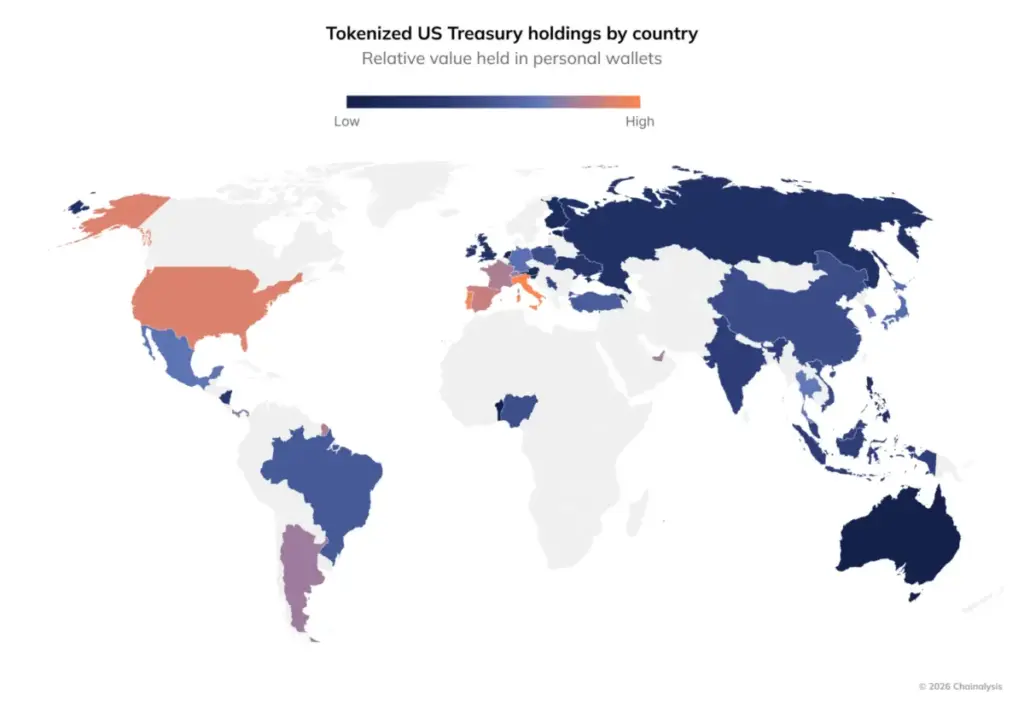
Asset managers, public corporations, and financial institutions are increasingly placing equities, corporate credit, and private equity on-chain. While corporate credit and private equity experienced explosive percentage growth from smaller bases, Treasury debt expansion in absolute dollar terms surpassed the next three categories combined. Interestingly, while U.S. investors make up roughly 11% of tokenized real-world asset holders, tokenized Treasuries see heavy international demand, with investors in jurisdictions like Italy, Portugal, and Singapore holding significant portions of the market value. This dynamic allows retail investors abroad to bypass traditional brokerage hurdles and directly acquire fractionalized exposure to U.S. sovereign debt.

Canada Emerges as a Global Peer-to-Peer Leader
Canada maintained its position as the second-largest crypto economy in North America, growing 2.3% during the 2026 period to reach $247.7 billion. Despite its developed economy, Canada exhibits exceptionally robust peer-to-peer adoption, ranking seventh globally in both domestic and cross-border flows and leading G7 nations in grassroots activity.
Stablecoins captured 44% of Canadian dollar-based order book volume by June 2026, up from 30% the previous year, with USDC representing the dominant asset. Canadian policymakers are monitoring this trend closely, as heavy reliance on U.S. dollar stablecoins directs domestic savings into foreign sovereign debt rather than local alternatives. To address this, Canada recently enacted a stablecoin framework to pave the way for domestic, Canadian dollar-denominated stablecoin offerings, though their adoption remains minuscule compared to USD counterparts.

Canada’s cross-border remittance economy thrives largely due to its diverse demographic makeup. With approximately 23% of its population born abroad—the highest proportion in the G7—Canada serves as a major remittance sender to countries like India, China, and the Philippines. Remittance-sized stablecoin and bitcoin transfers to these three nations totaled $2.36 billion over the reporting period across millions of transactions, as senders increasingly bypass traditional banking remittance fees that often exceed 6%. Furthermore, domestic peer-to-peer crypto volumes closely track fluctuations in temporary resident permit populations, demonstrating that individuals with active cross-border financial lives readily adopt efficient, low-cost blockchain rails.
 Crypto Wallets & Security
 Crypto Wallets & Security
 Crypto Wallets & Security