North America solidified its position as the most influential region for the global cryptocurrency markets during the 12 months leading up to July 1, 2026. Driven by a deep domestic investor base supplying vital capital, shifting regulatory frameworks, widespread stablecoin utilization, and a concerted push by businesses to bridge cryptocurrency with traditional finance, the region remains the primary exporter of crypto trends to the rest of the world. According to the latest reporting period metrics, the United States and Canada comfortably topped the unweighted "big-money index," which measures the sheer economic power of covered nations. Together, their respective crypto economies totaled an impressive $3.02 trillion, representing a modest 1.9% dip compared to the previous period.
This slight regional contraction was largely driven by a slowdown in the United States. The U.S. crypto economy, valued at $2.78 trillion, contracted by 2.2% period-over-period—an unsurprising development within the context of a challenging bear market. Nevertheless, the world’s single largest crypto market managed to retain nearly all of the near-doubling it achieved during the preceding 2025 period. Key institutional forces, including the burgeoning popularity of spot crypto exchange-traded funds (ETFs), accelerating tokenization initiatives, and the widespread proliferation of stablecoins, proved instrumental in cementing those prior gains.

Industry leaders note that the market’s trajectory reflects a fundamental evolution. Hoolie Tejwani, Head of Coinbase Ventures, observed that much of the observed activity compared to 2025 comes down to industry maturation, where foundational building blocks established previously are translating into functional products boasting real users, liquidity, and active markets.
A significant driver of this maturation involves a trio of U.S.-developed crypto innovations capturing massive domestic and international attention: AI-driven commerce, stablecoins, and tokenized real-world assets. Meanwhile, the Canadian market demonstrated remarkable resilience against the broader downtrend, expanding its crypto economy by 2.3% to reach approximately $250 billion, supported heavily by vibrant peer-to-peer activity and a dynamic immigrant population.
The United States is Leading the AI On-Chain Economy

The United States’ commanding lead in the global artificial intelligence development race is rapidly reshaping adjacent sectors, most notably cryptocurrency. Researchers tracking x402, a prominent digital payments rail enabling AI agents to autonomously execute financial transactions, have found a fascinating new economic paradigm taking shape.
Autonomous software is increasingly paying for digital services on-chain, and the United States has quickly emerged as the epicenter of this activity. Cornerstone American cryptocurrency enterprises, such as Circle—the issuer of the leading agent currency USDC—and Coinbase, the developer of the x402 protocol, are actively supporting this burgeoning ecosystem. Major traditional financial institutions are also taking notice. Will Su, Head of Digital Assets Research at BlackRock, noted that the firm is monitoring agentic commerce closely, highlighting that AI agents possess the potential to generate meaningful demand for frequent, low-value payments operating around the clock.
By the end of the 2026 reporting period, cumulative x402 transactions on Base, the leading blockchain network for agentic commerce, surpassed 138 million. Traditional payment rails like credit card networks struggle to process transactions worth fractions of a cent due to prohibitive processing fees. However, stablecoin settlements costing less than a fraction of a cent make micro-payments economically viable, unlocking entirely new markets for pay-as-you-go digital goods and services, such as automated API data retrievals.

Circle executives describe a clean division of labor emerging within the payments landscape, utilizing traditional card rails for consumer-prompted agent payments and stablecoin rails for machine-to-machine settlements that fall well below standard card economics. Transaction data indicates that over 87% of x402 payments range between a hundredth of a cent and a dime, with the most common transaction size falling between one and ten cents.
AI Payments are Becoming Stickier
While agentic commerce remains largely in an experimental phase, quantitative metrics signal rapid maturation. Early adoption was characterized by transient users testing the waters with a single trade before abandoning the protocol. However, recent cohort analysis reveals that consecutive groups of wallet owners exhibit significantly higher commitment.

When grouping wallets by the quarter they were first funded, the proportion securing a second funding injection within 30 days rose dramatically from 70.6% for wallets funded in the third quarter of 2025 to 89.3% for those funded in the second quarter of 2026. This behavior mirrors traditional software subscription renewals. Furthermore, the duration between initial wallet funding and the first x402 expenditure plummeted from a median of 73 days in late 2025 to just 18 minutes by the third quarter of 2026. This temporal compression underscores that newer wallets are purpose-built for immediate agentic commerce rather than passive value storage.
What AI Agents are Buying with x402
As AI agents firmly establish themselves as autonomous economic actors, the nature of their on-chain purchases has shifted away from early speculative fads like memecoins toward practical information services. Millions of transactions now flow from AI-controlled wallets into knowledge-based services, including automated code review, financial intelligence, and search APIs.

Additionally, AI agents are actively purchasing model inference capabilities, effectively paying other AI models for computational output. Geolocated data indicates that American-funded AI agents dominate this space, accounting for 30% of total agent-to-services transactions globally. U.S.-based wallets represent an overwhelming 88.1% of all geolocated AI model inference transactions, alongside substantial shares in agent frameworks and data search APIs.
Conversely, Chinese-attributed wallets displayed a different usage pattern, concentrating heavily on security and code analysis—specifically auditing smart contracts via language models—as well as market intelligence and payment rails, while remaining largely absent from purchasing model inference due to the prevalence of domestic, open-weight models in China.
The US is Importing Digital Gold and Exporting Digital Dollars

The formalization of the digital asset landscape via legislative actions like the GENIUS Act in mid-2025 cemented the United States’ role as the primary exporter of digital dollars. Stablecoins have effectively transformed U.S. sovereign debt into the preferred currency for peer-to-peer economies and cross-border commercial transactions worldwide.
Concurrently, the U.S. has experienced a marked surge in bitcoin imports. Since the introduction of spot bitcoin ETFs in early 2024, the U.S. share of global bitcoin activity has climbed steadily. While stablecoins comprise a relatively smaller share of domestic U.S. crypto activity compared to foreign jurisdictions, the rest of the world increasingly relies on dollar-denominated stablecoins to satisfy monetary needs that local banking systems fail to meet.
Institutional adoption of bitcoin as an alternative monetary store of value has similarly intensified amid persistent global government debt expansion. Institutional inflows into bitcoin accelerated significantly as broader market conditions shifted throughout 2026, positioning the U.S. as a net importer of bitcoin through large-scale cross-border transfers exceeding $10 million.

The US Impact on Tokenization
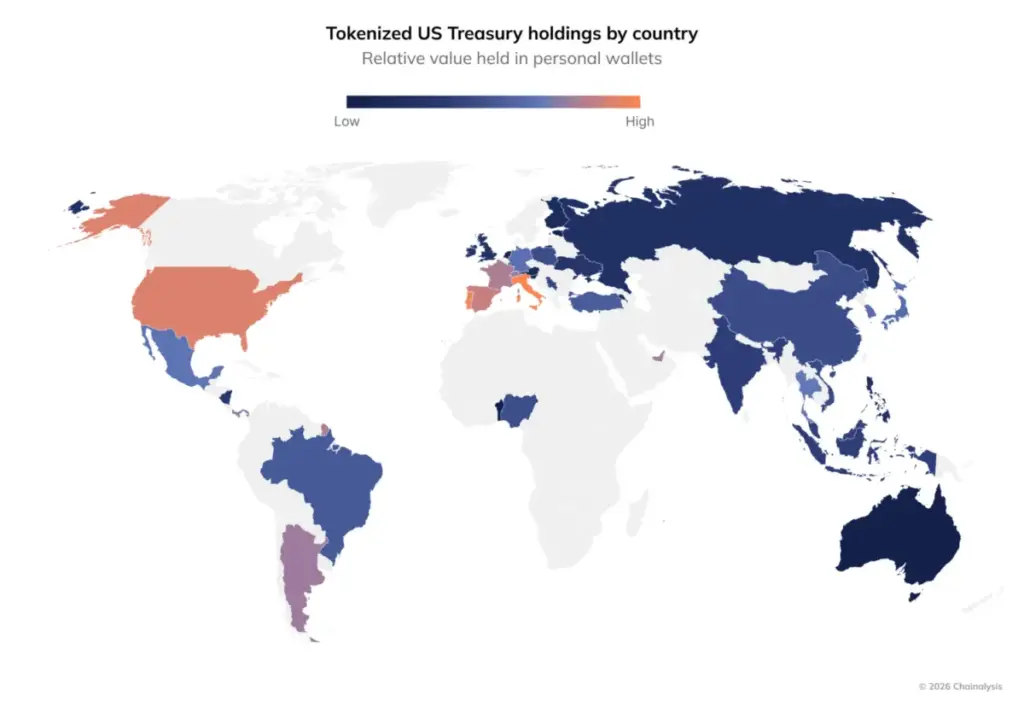
The United States continues to anchor the rapidly expanding tokenized real-world asset sector. By the close of the second quarter of 2026, the global tokenized RWA market reached $36.07 billion, marking a 135% period-over-period growth rate. Tokenized U.S. Treasury bonds represented the single largest asset class, commanding $15.42 billion on-chain, or roughly 42.8% of all tokenized RWA value.
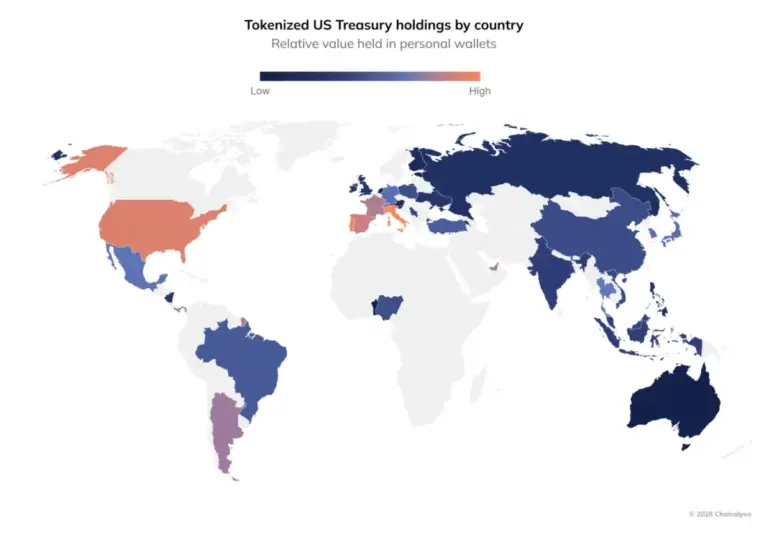
While U.S. investors account for roughly 11% of the global tokenized RWA holder base, foreign institutional and retail investors—particularly in regions like Italy, Portugal, and Singapore—drive a substantial portion of tokenized Treasury holdings. This dynamic effectively allows international investors to access U.S. sovereign debt yields directly via blockchain infrastructure, circumventing traditional brokerage barriers.

Canada is a Global Leader in Peer-to-Peer Adoption
Canada’s crypto economy expanded by 2.3% during the 2026 reporting period, reaching a total valuation of $247.7 billion. Despite its modest overall growth, the country stands out among G7 nations for maintaining a remarkably robust peer-to-peer crypto ecosystem, ranking seventh globally in both domestic and cross-border flows.
Stablecoins, particularly USDC, capture a dominant share of Canadian order book volume, rising to 44%. This heavy reliance on USD-denominated stablecoins has drawn attention from domestic policymakers concerned about potential displacement of Canadian sovereign debt demand.

Furthermore, Canada’s thriving immigrant population—representing approximately 23% of the total population, the highest proportion in the G7—has fueled an expansive cross-border remittance market. Remittance-sized stablecoin and bitcoin transfers to top corridors such as India, China, and the Philippines reached $2.36 billion across millions of transactions, driven by the significant cost advantages of blockchain settlement over traditional remittance channels charging average fees exceeding 6%.
As the infrastructure layer of the global crypto economy remains heavily concentrated in North America, the broader international user base continues to leverage American-built rails for stablecoins, tokenized assets, and automated commerce. While international jurisdictions pursue regulatory frameworks to establish local digital assets, the enduring demand for U.S.-anchored financial infrastructure highlights the region’s central role in shaping the future of global finance.
 Crypto Wallets & Security
 Crypto Wallets & Security
 Crypto Wallets & Security