North America has solidified its position as the most influential region for cryptocurrency markets globally, driving a massive export of financial innovation, infrastructure, and digital assets. According to comprehensive market reporting for the 12 months ending July 1, 2026, the region’s crypto economies totaled an impressive $3.02 trillion. While this represents a modest 1.9% contraction compared to the previous reporting period, the dip stems primarily from a slight slowdown in the United States amidst a challenging bear market. Despite a 2.2% drop in its domestic crypto economy to $2.78 trillion, the U.S. largely retained the near-doubling of value it achieved during the 2025 period, bolstered by vital institutional forces such as crypto exchange-traded funds (ETFs), accelerating asset tokenization, and the rapid proliferation of stablecoins.
Industry leaders point out that the slight regional cooling reflects a natural maturation phase for the market. Building blocks and foundational products established throughout 2025 have successfully transformed into operational tools with active users, deep liquidity, and thriving markets by 2026. What happens within North America’s digital asset ecosystem continues to ripple outward, effectively exporting financial technology, stablecoin liquidity, and blockchain standards to the rest of the world.

The U.S. Leads the Emerging AI On-Chain Economy
The United States’ commanding lead in global artificial intelligence development is rapidly reshaping adjacent sectors, most notably cryptocurrency. Autonomous software agents have increasingly begun executing transactions and spending funds entirely on-chain, with the U.S. serving as the epicenter of this technological convergence. Key American infrastructure providers, including Circle—the issuer of the leading agent currency USDC—and Coinbase, which developed the widespread x402 payment protocol, are actively supporting this emergent sector.
Financial institutions are also taking note. Major asset managers are monitoring agentic commerce closely, anticipating that autonomous software agents will generate significant, round-the-clock demand for frequent, low-value payments. By the conclusion of the 2026 reporting period, cumulative activity on Base, the leading blockchain for agentic commerce, had surpassed 138 million transactions using the x402 protocol.

Traditional payment rails such as credit card networks cannot economically process micro-payments worth a fraction of a cent due to fixed processing overhead. However, stablecoin infrastructure enables settlements for less than a cent, opening an entirely new marketplace for pay-as-you-go digital goods and services, including real-time API data requests. Industry observers note a clean division of labor taking shape, where traditional card networks handle consumer-prompted payments, while stablecoin rails manage machine-to-machine settlements.
Data tracking demonstrates that AI-driven payments are rapidly becoming stickier. Wallets funded in successive quarters show increasing commitment, with the share receiving secondary funding within 30 days rising significantly over time. Furthermore, the duration between initial wallet funding and the first x402 expenditure has compressed drastically, shifting from an average of over two months down to mere minutes. This temporal compression indicates that newer wallets are intentionally provisioned for immediate, recurring agentic commerce rather than speculative experimentation or dormant storage.

AI agents are primarily utilizing these on-chain micro-payments to acquire machine-readable knowledge and computational resources, such as code reviews, financial intelligence, search APIs, and model inference services. Geographically, American-funded AI agents dominate this space, capturing the vast majority of model inference transactions and developer tooling payments. Conversely, international participants show distinct patterns; for instance, Chinese-linked wallets predominantly allocate funds toward security smart-contract audits and financial intelligence services while largely utilizing open-weight, locally developed models rather than metered American alternatives.
The U.S. Imports Digital Gold While Exporting Digital Dollars
The legislative passage of the GENIUS Act in mid-2025 formalized the United States’ role as the world’s leading exporter of digital dollars. Stablecoins have increasingly established U.S. debt as the currency of choice for cross-border commerce and peer-to-peer economies abroad. Concurrently, the U.S. has experienced significant inflows of digital gold through institutional accumulation. Since the landmark introduction of spot Bitcoin ETFs in early 2024, the U.S. share of global Bitcoin activity has climbed steadily.

While international markets increasingly pivot toward dollar-denominated stablecoins to satisfy foreign currency demands not met by local banking systems, American investors lean heavily on Bitcoin as an unyielding store of value against rising global government debt and public spending. Cross-border data indicates that smaller retail Bitcoin transfers run net outbound from the U.S., whereas institutional-scale transfers—particularly transactions exceeding $10 million—drive substantial net inflows.
Meanwhile, stablecoin issuance continues to scale dramatically, with circulating supplies expanding significantly year-over-year while facilitating trillions of dollars in on-chain settlement volume. Because these tokens represent direct claims on short-term U.S. government debt held in reserve, the global proliferation of dollar stablecoins indirectly reinforces American economic strength. International competitors, including euro-backed stablecoin initiatives under Europe’s MiCA framework and regulatory frameworks in Singapore and Hong Kong, continue to face substantial hurdles in unseating the global dominance of the dollar due to entrenched user preference and network effects.

The U.S. Impact on Real-World Asset Tokenization
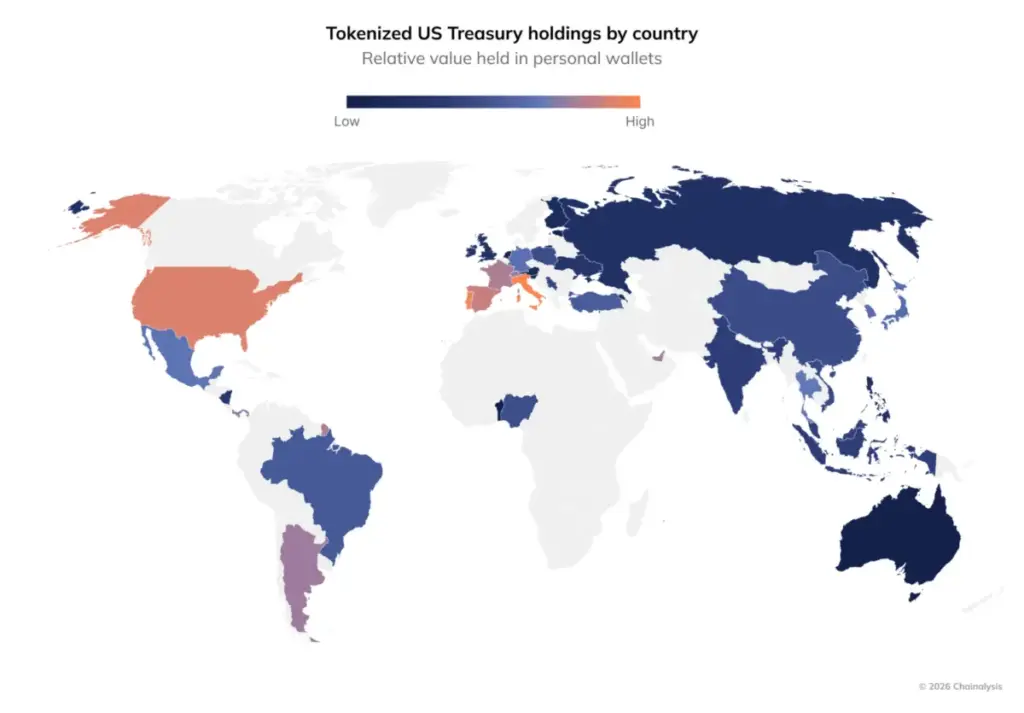
The United States has maintained its dominance in the fast-growing real-world asset (RWA) tokenization sector. The global tokenized RWA market expanded significantly year-over-year, finishing a strong quarter with tens of billions in total value. Tokenized U.S. Treasury bonds represent the single largest category within this sector, accounting for a massive share of all tokenized RWA value.
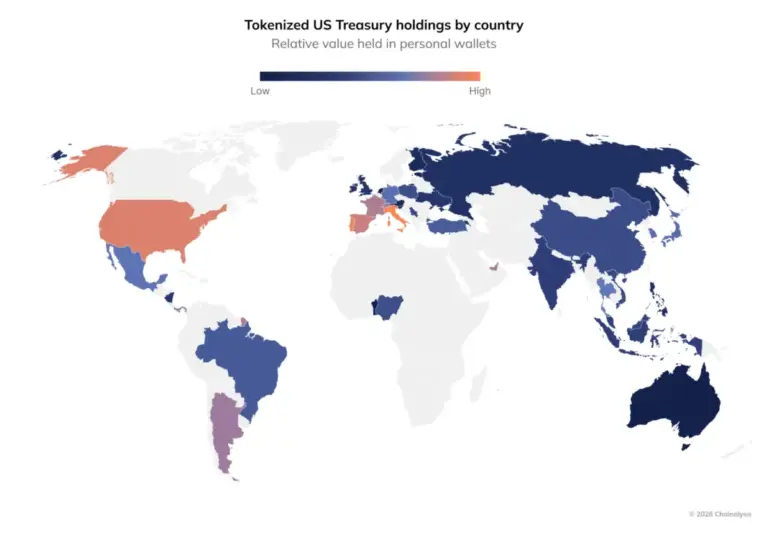
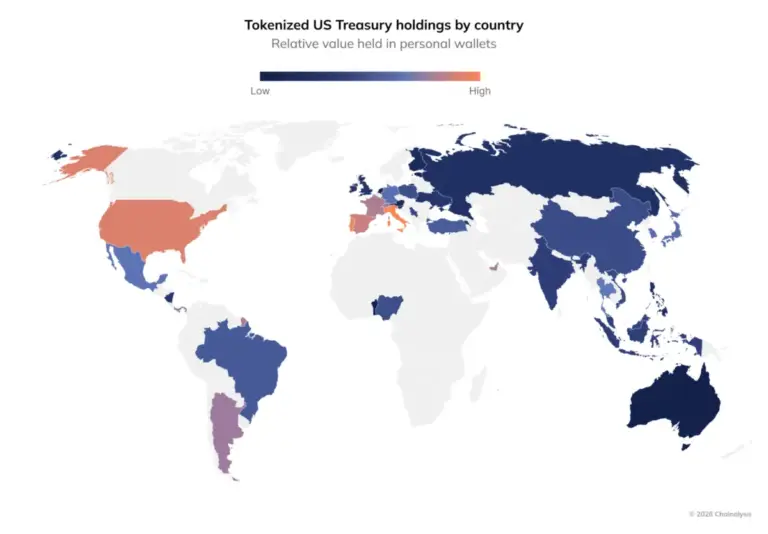
While asset managers continue expanding into tokenized corporate credit and private equity, government debt remains the preferred asset class for institutional and retail participants seeking the speed, programmability, and global interoperability of blockchain rails. Intriguingly, geographic breakdowns reveal that a significant proportion of the value in tokenized U.S. Treasuries is held by international investors based in jurisdictions such as Europe and Asia. By lowering minimum position sizes and eliminating the necessity for direct U.S. brokerage accounts, tokenization transforms wholesale sovereign debt instruments into retail-accessible assets for international users.

Canada Ranks as a Global Leader in Peer-to-Peer Crypto and Remittances
While dwarfed by its southern neighbor’s massive financial footprint, Canada’s crypto economy demonstrated resilience, growing 2.3% to reach nearly $250 billion. Within G7 nations, Canada boasts a remarkably robust peer-to-peer crypto economy, ranking high globally in both domestic and cross-border transaction flows.
Stablecoins capture nearly half of all Canadian dollar-based order book volume, with USDC serving as the dominant vehicle. This heavy reliance on USD-denominated stablecoins has drawn scrutiny from domestic policymakers concerned about potential displacement of Canadian sovereign debt demand.

Canada’s remarkable cross-border remittance activity is heavily influenced by its diverse, foreign-born population—the highest share within the G7. Remittance corridors connecting Canada to countries such as India, China, and the Philippines have seen explosive growth on crypto rails, handling billions in transfers. Users increasingly bypass traditional remittance providers charging high fees, opting instead for stablecoin and Bitcoin transfers that settle instantly for a fraction of a cent. Furthermore, domestic peer-to-peer crypto volumes have historically tracked parallel trends in temporary visa and study permit populations, highlighting how individuals with active cross-border financial lives naturally gravitate toward efficient digital settlement solutions.
As North America continues to refine its regulatory landscape—from Canada’s implementation of its stablecoin legislation to unfolding U.S. guidance on asset tokenization and agentic payments—the region remains the definitive engine of global cryptocurrency evolution.
 Crypto Wallets & Security
 Crypto Wallets & Security
 Crypto Wallets & Security