North America solidified its position as the most influential region for global cryptocurrency markets during the 12-year reporting period ending July 1, 2026. Backed by the deep investor base of the United States, evolving regulatory frameworks, the widespread integration of stablecoins, and traditional financial institutions bridging the gap into blockchain technology, the region continues to export its crypto innovations to the rest of the world. According to data from the annual market assessment, the United States and Canada topped the unweighted "big-money index," measuring the sheer crypto-economic power of covered nations. Together, their respective crypto economies totaled $3.02 trillion, marking a modest 1.9% contraction from the preceding period.
This minor regional decline was primarily driven by a slowdown in the United States, the world’s single-biggest crypto economy. The U.S. crypto economy stood at $2.78 trillion, falling by 2.2% period-over-period amid a brutal broader market downturn. Despite this contraction, the American market largely retained the near-doubling of value it achieved during the previous reporting cycle. Institutional forces—such as the expansion of crypto exchange-traded funds (ETFs), accelerating tokenization initiatives, and the ongoing proliferation of stablecoins—helped cushion the blow and preserve those foundational gains.

Industry leaders point to structural maturation rather than regression. Hoolie Tejwani, Head of Coinbase Ventures, noted that much of the activity observed compared to the prior year reflects the maturing of the ecosystem. The fundamental building blocks established previously are successfully transforming into commercial products boasting real-world users, deep liquidity, and active markets.
The United States Leads the AI On-Chain Economy
The United States’ commanding lead in global artificial intelligence development is actively reshaping every sector of the economy, including digital assets. Researchers focused heavily on x402, a premier digital payments rail designed to enable AI agents to execute transactions autonomously, to understand how this emerging machine-to-machine economy is taking shape.

Autonomous software has officially begun conducting financial settlements on-chain, with the United States driving the vast majority of this development. Foundational American crypto enterprises, including stablecoin issuer Circle and x402 creator Coinbase, are providing the essential infrastructure to support this growth. Traditional financial powerhouses are also taking notice. Will Su, Head of Digital Assets Research at BlackRock, indicated that the firm is closely monitoring agentic commerce, highlighting the potential for AI agents to generate substantial, round-the-clock demand for frequent, low-value payments.
By the conclusion of the reporting period, cumulative x402 transactions on Base, the leading blockchain network for agentic commerce, surpassed 138 million. On-chain payment systems unlock financial capabilities that remain economically unfeasible on legacy payment rails. Traditional credit card networks cannot profitably process transactions worth fractions of a cent due to fixed processing overhead. Conversely, stablecoin infrastructure—where settlements cost a fraction of a cent—enables autonomous agents to execute micro-transactions efficiently, opening new commercial avenues for pay-as-you-go digital goods, such as real-time API data requests.

Circle characterizes this evolution as a clean division of labor: traditional card rails remain optimized for consumer-prompted payments, while stablecoin rails power machine-to-machine settlements that are fundamentally too small for legacy card economics. Transaction data confirms this trend, showing that over 87% of x402 payments fall between one-hundredth of a cent and ten cents, with the most frequent volume concentrated between one and ten cents.
While agentic commerce remains in an exploratory phase, indicators of maturation are multiplying. Early usage was characterized by episodic participants executing one-off trades before abandoning the protocol. More recent cohorts exhibit far greater commitment. Grouping wallets by their initial funding quarter reveals that the share receiving secondary funding within 30 days rose from 70.6% in the third quarter of 2025 to 89.3% in the second quarter of 2026. This regular recapitalization functions as the on-chain equivalent of renewing a subscription. Furthermore, the duration between initial wallet funding and the first x402 transaction compressed dramatically, dropping from a median of 73 days in late 2025 to just 18 minutes by the third quarter of 2026. This temporal compression demonstrates that newer wallets are purpose-built for immediate agentic engagement.

AI Payments and the Dominance of U.S. Agentic Commerce
What autonomous agents purchase on-chain has similarly evolved beyond short-lived speculative fads like early memecoins into practical, information-driven services. Millions of transactions now flow from AI-controlled wallets into code review, financial intelligence, and data search APIs. Furthermore, AI agents are actively paying for foundational tooling, gaming, token issuance, and even model inference—effectively purchasing the computational intelligence required to operate other AI agents.
Geolocated data underscores U.S. dominance in this arena. American-funded AI agents account for approximately 30% of all global agent-to-service transactions. More specifically, U.S. wallets represent 88.1% of geolocated AI model inference transactions, 41.8% of payments directed toward agent frameworks and tool catalogs, and 23.2% of expenditures on data and search APIs.

In contrast, Chinese-attributed wallets exhibited a different specialization, concentrating heavily on security and code analysis. Approximately 90% of transactions directed toward security and smart contract auditing—primarily flowing into automated auditing tools like AgentLISA—originated from Chinese-linked wallets. Chinese operators also maintained a strong presence in market intelligence and payment rails, yet they accounted for a negligible 0.1% of model inference transactions. Industry observers attribute this disparity to AI nationalism and economic realities, noting that China’s open-weight models are freely accessible, whereas Western metered models require direct payment settlements.
This rapid integration of autonomous transactions introduces novel compliance challenges. Traditional compliance checks cannot screen individual transactions operating at machine speeds, frequency, and scale. Instead, the paradigm shifts toward screening the initial funding event, validating human-approved budget authorizations, monitoring known counterparty destinations, and utilizing behavioral pattern recognition to flag anomalies. Regulatory frameworks that fail to adapt risk either stifling innovation or missing the activity entirely.

The U.S. Imports Digital Gold While Exporting Digital Dollars
The formalization of digital asset policy, highlighted by legislative milestones like the GENIUS Act in mid-2025, codified the United States’ role as the primary global exporter of digital dollars. Stablecoins backed by U.S. sovereign debt have become the currency of choice for cross-border businesses and peer-to-peer economies alike, generating billions in economic activity and extending the reach of the U.S. dollar.
Concurrently, the United States has emerged as a major importer of bitcoin. Following the introduction of spot bitcoin exchange-traded funds in early 2024, the U.S. share of global bitcoin activity expanded steadily. Conversely, stablecoins represent a comparatively smaller share of domestic American crypto activity, reflecting a wider global divergence. While international markets utilize dollar-denominated stablecoins to bridge local banking deficiencies, American investors increasingly lean toward bitcoin as an alternative monetary store of value amid rising global sovereign debt.

Cross-border bitcoin flows illustrate this institutional accumulation. In 2026, the United States transitioned into a net importer of bitcoin for the first time since 2022. While retail-sized transfers under $10,000 remained net outbound, multi-million-dollar institutional transfers dominated inflows, with transactions exceeding $10 million accounting for more than 53,000 incoming coins. This private institutional accumulation is further reinforced by implicit sovereign demand strategies.
Stablecoins circulate globally without touching traditional correspondent banking networks, yet they generate sustained demand for short-dated U.S. government debt held as reserves. Issuers like Circle report massive circulating supplies and staggering quarterly on-chain volumes, cementing stablecoins as the primary routing layer for international liquidity. Meanwhile, competing sovereign alternatives—such as euro-denominated stablecoins operating under the European Union’s MiCA framework—have captured only a fraction of order book volume, demonstrating that regulatory readiness currently outpaces global market adoption.

The U.S. Impact on Real-World Asset Tokenization
The tokenization of real-world assets (RWAs) experienced explosive growth, finishing the second quarter of 2026 at $36.07 billion globally, representing a 135% period-over-period increase. The United States heavily influenced this sector, with tokenized U.S. Treasury bonds serving as the single largest real-world asset class, reaching $15.42 billion and accounting for 42.8% of all tokenized RWA value.
Asset managers, public corporations, and financial institutions are increasingly migrating traditional assets on-chain to leverage settlement speed, programmability, and global interoperability. While private credit and private equity experienced triple-digit percentage expansions from smaller initial baselines, U.S. government debt dominated in absolute dollar growth.

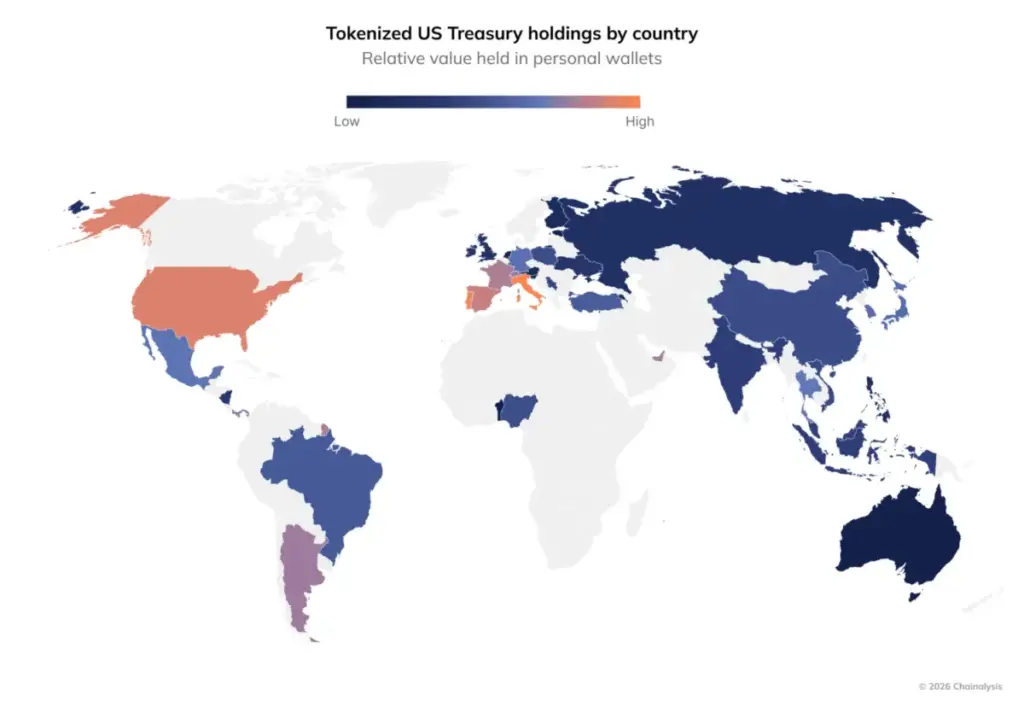
Geolocated holder data reveals an interesting international distribution for tokenized Treasuries. European nations such as Italy and Portugal, alongside Singapore, account for the vast majority of tokenized Treasury value, while retail holders in countries like Japan represent a large share of individual accounts holding smaller positions. By lowering investment minimums and eliminating traditional brokerage barriers, tokenization allows international retail participants to acquire exposure to U.S. sovereign debt directly.
Lending patterns indicate that tokenized Treasuries are primarily acquired as long-term holdings rather than utilized as collateral. While private credit and commodity-backed lending expanded rapidly on-chain, tokenized Treasury lending contracted. Because traditional Treasuries already function as highly liquid collateral within conventional finance, holders seeking liquidity utilize established traditional avenues rather than decentralized protocols.

Canada Emerges as a Global Peer-to-Peer Leader
Canada maintained its position as the second-largest crypto economy in North America and a top-tier participant in grassroots adoption, expanding its crypto economy by 2.3% to reach $247.7 billion during the 2026 reporting period. Notably, Canada demonstrated the most robust peer-to-peer crypto economy among G7 nations, placing seventh globally in both domestic and cross-border flows.
Stablecoins command a substantial portion of Canadian crypto interest, rising to represent 44% of Canadian dollar-based order book volume. USDC dominates this sector, while domestic Canadian dollar-backed stablecoins maintain negligible market capitalization. Executive Director of the Canadian Web3 Council Morva Rohani noted that this dynamic creates a policy challenge, as local adoption of U.S. dollar-denominated stablecoins implicitly generates demand for foreign sovereign debt rather than Canadian alternatives. Although Canada recently enacted legislative frameworks to authorize domestic stablecoin issuers, market adoption remains heavily skewed toward USD-pegged assets.

Canada’s cross-border remittance economy also displays unique characteristics. With approximately 23% of its population born abroad—the highest proportion in the G7—Canada serves as a major origin point for remittances directed toward India, China, and the Philippines. Stablecoin and bitcoin transfers across these specific corridors totaled $2.36 billion during the reporting period, distributed across millions of transactions with an average transfer size of $663. By circumventing traditional remittance fees that often exceed 6%, digital assets provide a cost-effective alternative for expatriates managing ongoing financial obligations abroad.
Furthermore, domestic peer-to-peer transaction volumes in Canada correlate closely with fluctuations in temporary immigrant and study permit populations. As temporary visa numbers expanded and contracted over recent years, domestic crypto volumes mirrored those directional shifts, highlighting how populations with active cross-border financial requirements naturally gravitate toward efficient decentralized settlement rails.

The Infrastructure Layer Remains American While User Bases Expand Globally
The overarching narrative of North America’s crypto market is defined by an infrastructural asymmetry: the foundational protocols, tokenized debt instruments, dollar-denominated stablecoins, and AI payment rails are engineered and managed within the United States, while the end-user demand is increasingly distributed worldwide.
While international jurisdictions continue developing regulatory frameworks and domestic digital currency pilots to challenge dollar dominance, the speed of actual user adoption will ultimately dictate market equilibrium. As pending regulatory guidance regarding tokenized assets and autonomous agentic payments takes effect in the United States and Canada, these frameworks will establish the parameters for how institutional and automated on-chain economies scale in the future.
 Crypto Wallets & Security
 Crypto Wallets & Security
 Crypto Wallets & Security