Sub-Saharan Africa has cemented its status as the world’s fastest-growing cryptocurrency economy, expanding by 13.4% to reach a total volume of $101 billion between July 1, 2025, and June 30, 2026. While the region remains the smallest crypto market by overall economic scale, its rapid upward trajectory highlights a profound shift in how everyday individuals and enterprises manage money. South Africa and Nigeria continue to serve as the dominant engines driving this expansion, though smaller markets are also posting remarkable gains as digital assets cement their role in the daily economic fabric of the continent.
The widespread embrace of cryptocurrency across the region is fundamentally rooted in a practical reality: millions of people and businesses continue to face steep hurdles when attempting to access affordable, reliable traditional financial services. For individual consumers, digital assets offer an alternative mechanism to manage personal finances, protect savings against local currency depreciation, and execute seamless money transfers. For commercial entities, blockchain-based networks enable faster, significantly more cost-effective cross-border payments and settlements, bypassing the notorious friction points of legacy banking infrastructure.

Industry leaders emphasize that the region’s crypto adoption is driven less by speculative investment trends and more by the necessity of solving tangible, everyday economic challenges. Mercy Emmanuel, Stablecoin and Blockchain Commercial Lead at the Nigerian fintech company Flutterwave, highlights this pragmatic approach. For African markets, she notes, the most commercially viable innovations are those that reduce friction in existing financial activities rather than introducing unnecessary technological complexity simply for the sake of utilizing blockchain.
South Africa and Nigeria Dominate Regional Activity as Growth Diverges Across Smaller Markets
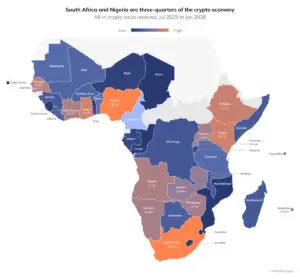
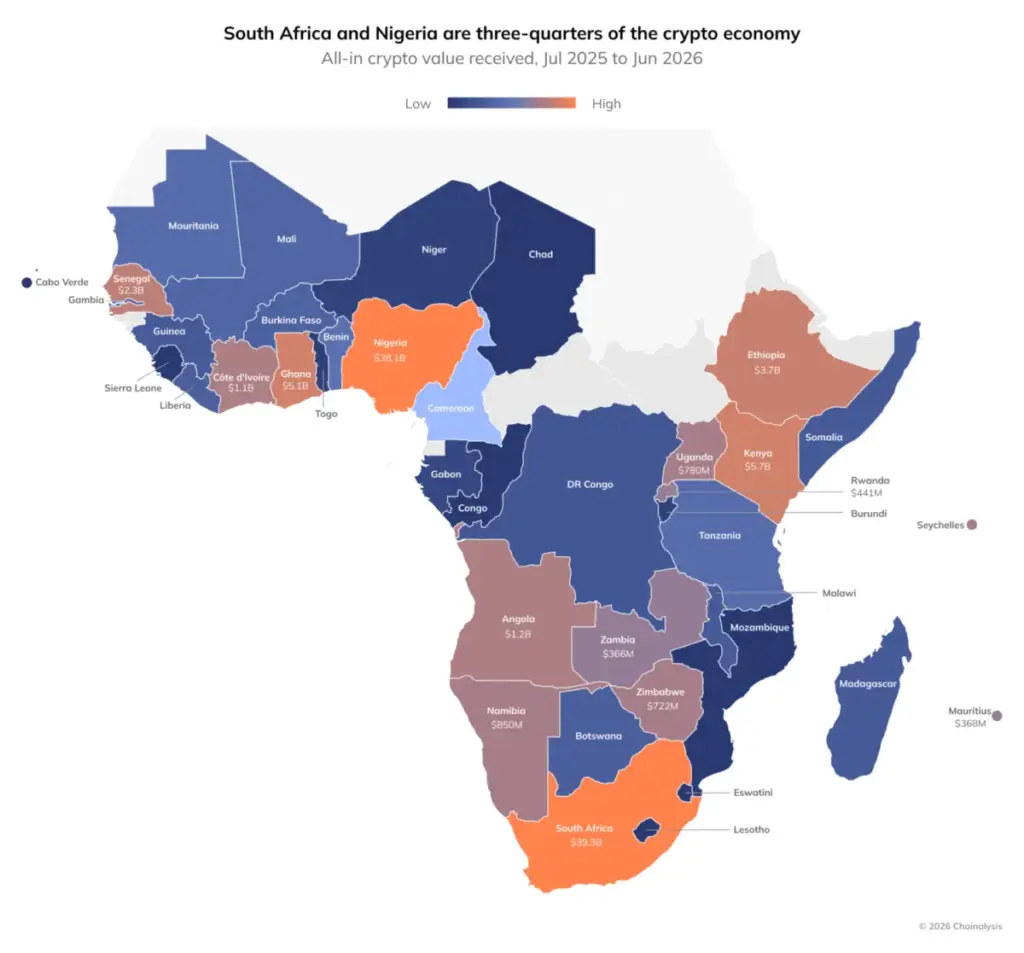
South Africa and Nigeria tower over the rest of the regional landscape, collectively accounting for more than three-quarters of all cryptocurrency activity across Sub-Saharan Africa. However, despite their shared dominance, the two economic powerhouses are tracing divergent paths.

South Africa’s crypto economy surged to $39.3 billion during the report period, expanding by an impressive 52% year-over-year despite broader global market headwinds. This growth was notably broad-based, registering increases across every measured category, spearheaded by cross-border peer-to-peer stablecoin flows and professional service transactions.
In contrast, Nigeria’s crypto market reached $38.1 billion, representing a slight 3% decline year-over-year. While overall centralized exchange and professional service activity remained resilient, the contraction was pulled down by a 45% drop in decentralized exchange volume and a 17% reduction in cross-border peer-to-peer flows. Nevertheless, Nigeria maintained its strong footing, placing third globally in grassroots adoption metrics.

Beyond the two giants, smaller regional markets showcased explosive, albeit volatile, growth. Ghana’s crypto economy jumped 80% to $5.1 billion, spurred by gains in both centralized and decentralized exchange activity. Senegal experienced an astonishing 215% surge to $2.3 billion, heavily fueled by centralized exchange adoption. Conversely, Ethiopia contracted by 8% to $3.7 billion, largely reflecting a downturn in decentralized exchange volumes. These contrasting trajectories underscore a dynamic ecosystem where smaller markets possess immense room for expansion, though they remain sensitive to regulatory shifts and broader market sentiment.
A Third of Sub-Saharan Africa’s Crypto Economy Lands in Personal Wallets
A defining characteristic of Sub-Saharan Africa’s crypto market is the outsized role played by personal wallets. Self-custody accounts accounted for 32.3% of the total value received across the region during the 2026 reporting period, marking the highest share recorded globally. This pattern illustrates that adoption is driven primarily by users taking direct control of their funds rather than routing them through established exchanges or third-party intermediaries.

Cross-border peer-to-peer transfers make up the vast majority of this self-custody activity, representing 70.9% of total value received. Domestic peer-to-peer transactions accounted for 18.5%, while service-to-personal-wallet transfers comprised the remaining 10.7%.
This heavy reliance on self-custody is heavily influenced by limited access to reliable custodial services and persistent regulatory uncertainty. In Nigeria, for instance, a sequence of government restrictions on traditional banks serving crypto exchanges between 2021 and 2023, coupled with subsequent legal and regulatory tensions involving major international trading platforms, has fostered a cautious environment. Users increasingly lean toward self-custody to insulate their assets from potential regulatory interventions and sudden operational disruptions.

Stablecoin Activity Surged More Than Sixfold Across the Region
Stablecoins have rapidly emerged as the foundational asset class shaping Sub-Saharan Africa’s crypto market. Between 2022 and 2026, the value of stablecoins received through peer-to-peer channels multiplied more than sixfold, climbing from $2.3 billion to $14.6 billion. Over the same timeframe, Bitcoin receipts dropped by 60%, falling from $36 billion to $14.6 billion.
This pivot highlights an essential utility: stablecoins enable individuals and businesses to store value in U.S. dollars and other stable currencies without needing to open traditional foreign-currency bank accounts. In an economic climate characterized by local currency volatility, restricted access to foreign exchange, and expensive legacy cross-border payment rails, stablecoins offer a reliable mechanism to receive payments, preserve purchasing power, and move capital.

Regulatory frameworks are beginning to adapt to this reality. Nations such as Ghana and Kenya introduced comprehensive virtual asset service provider laws to bring clarity to the surging stablecoin market. Central banks are also exploring innovative architectures, such as cedi-backed stablecoin models studied by the Bank of Ghana, which would allow digital assets to handle instant wholesale settlements while end-users receive traditional local currency via bank accounts or mobile money wallets without ever touching cryptocurrency directly.
Furthermore, industry experts point out that stablecoins provide a crucial advantage over traditional banking infrastructure: 24/7 availability. While conventional bank transfers stall during weekends, holidays, and outside standard business hours, blockchain transactions process continuously, providing an invaluable tool for international trade, commerce, and remittance settlement.

Crypto Corridors Expand Across Region as Businesses Seek Cheaper Cross-Border Payments
Intra-regional business payments expanded markedly during the report period, demonstrating that digital assets are becoming vital to commercial trade within Africa. Traditional cross-border business payments on the continent have long been hampered by severe structural friction, with only a tiny fraction of intra-African financial flows clearing directly within the continent, resulting in steep annual losses and regulatory bottlenecks.
Against this backdrop, crypto-powered payment corridors have flourished. Active intra-regional payment corridors nearly doubled from 80 to 152, with 95 of those routes recording active two-way flows. Total transaction volume more than tripled, surging from $34.3 million to $116.5 million, while average volume per corridor grew from $429,000 to $766,000. These figures indicate not only broader network connectivity but also deeper, more sustained commercial usage between African markets that conventional financial institutions have historically underserved.

North America Leads Crypto Remittance Inflows into Sub-Saharan Africa
Remittances remain a vital economic lifeline for Sub-Saharan Africa, accounting for upwards of one-fifth of the gross domestic product in nations like The Gambia and Lesotho, and totaling $41 billion in inflows across the region in 2025. However, sending money to the continent remains exceptionally costly. The World Bank reported an average fee of 7.9% for a $200 transfer, making it the most expensive remittance corridor in the world.
Crypto has stepped in to drastically reduce these fees, eliminate administrative barriers, and accelerate settlement times. Western nations drove the bulk of crypto-remittance inflows into Sub-Saharan Africa, reaching $888 million—a 36% year-over-year increase—while the absolute number of individual transactions climbed 43% to surpass one million.

North America led all sending regions with $645 million in inflows, supported by large diaspora communities originating from Nigeria, Ghana, and Ethiopia. Meanwhile, inflows from Australia and New Zealand registered the fastest growth, nearly tripling from $48 million in 2024 to $143 million in 2026. Western Europe recorded more modest growth, rising from $79 million to $100 million.
An analysis of diaspora populations reveals fascinating patterns in how remittances are dispatched. North America and Australia punched well above their weight, sending significantly higher volumes of crypto remittances than their population sizes alone would predict. In contrast, Western Europe—which hosts roughly 64% of Sub-Saharan Africa-born residents in analyzed Western nations—accounted for a mere 10% of total crypto remittances. On a per-capita basis, Canada led all sending countries with outflows rising to $736 per resident born in Sub-Saharan Africa, followed by the U.S. at $143, while Western Europe trailed far behind at just $17.90 per resident. These discrepancies highlight how local economic conditions, financial regulations, and the maturity of domestic crypto markets in host countries heavily influence diaspora remittance behaviors.

How South Africa’s Businesses Are Accepting Crypto
South Africa has cultivated a robust real-world crypto economy where consumers and local merchants routinely settle transactions using digital assets. Measuring domestic business-like transfers—capped at $50,000 to filter out institutional outliers—researchers found that South Africa recorded $8.34 billion in such transactions during the 2026 period. Every successive quarter outpaced the previous one, with the final quarter of the study period exceeding the initial quarter by more than $1 billion.
This retail and commercial activity expanded even faster than South Africa’s flourishing institutional crypto sector, which pulled in $1.29 billion over the same timeframe. The growth was heavily supported by expanding retail infrastructure. Partnerships between major QR-code payment platforms like Scan to Pay and crypto infrastructure providers such as MoneyBadger integrated Bitcoin spending across a retail footprint approaching 700,000 store locations by August 2026. Data from payment providers indicates that everyday usage is thriving, with nearly half of transactions falling below $13 and the vast majority under $60, proving that digital assets are firmly embedding themselves into consumer spending and e-commerce habits.

South Africa Is the Region’s Crypto Hub
Historically serving as the primary financial gateway for international and intra-continental investment, South Africa functions as the central conduit for international crypto flows into the wider region. A comparative analysis of cross-border crypto payments and traditional foreign direct investment reveals notable overlaps in markets like Nigeria, Kenya, the Democratic Republic of the Congo, Tanzania, Namibia, and Zimbabwe, suggesting that crypto flows frequently follow established trade corridors and historical business ties.
However, South Africa’s regulatory landscape faces potential transformation. The National Treasury and the South African Reserve Bank published a draft Crypto Asset Manual for Cross-Border Activities aimed at integrating digital assets into the nation’s capital flow management framework. While initial proposals sought to restrict cross-border crypto movements by companies and mandate rigid pre-approvals for individuals, strong industry backlash prompted monetary authorities to reconsider and revise the framework. The final implementation of these rules will undoubtedly shape South Africa’s ongoing role as a regional financial hub.

Nigeria Outpaces the Region on Service Adoption, Driven by Domestic Exchanges
Nigeria’s crypto economy exhibits a profoundly service-oriented structure, with users routing $25.2 billion through cryptocurrency platforms and digital services during the report period—a striking 172% increase compared to four years prior. Domestic exchanges fueled nearly all of this expansion, capturing $6.22 billion, which accounts for half of all centralized exchange inflows in Nigeria and represents a dramatic market share leap from just 7% in 2022.
This pivot toward domestic platforms was catalyzed by prior regulatory frictions and temporary restrictions placed on major international exchanges by Nigerian authorities amid concerns over currency depreciation. The establishment of a Presidential Executive Order on Virtual Asset Coordination in July 2026, alongside upcoming regulatory requirements from the Securities and Exchange Commission, aims to create a harmonized and controlled operating environment. While these higher capital requirements and compliance mandates promise greater long-term clarity, they may also consolidate market share among well-capitalized local operators.

At the same time, peer-to-peer activity remains a cornerstone of the Nigerian market, characterized by a unique reliance on Bitcoin for smaller transfers. Bitcoin accounted for 92% of Nigeria’s small domestic wallet transfers under $10,000—totaling $923 million out of $1 billion—standing in sharp contrast to the rest of Sub-Saharan Africa, where stablecoins overwhelmingly dominate smaller transactions. This distinct preference underscores a market where users maintain a strong demand for decentralized, direct value transfers alongside an expanding formal service ecosystem.
Ultimately, the future trajectory of Sub-Saharan Africa’s crypto economy will hinge on the interplay between grassroots economic demand, institutional integration, and regulatory evolution. As regulatory clarity takes root across key jurisdictions, the fundamental question remains whether this wave of digital asset adoption will successfully translate into permanent, deeply integrated financial connectivity for millions of businesses and individuals across the continent.
 Crypto Wallets & Security
 Crypto Wallets & Security
 Crypto Wallets & Security