North America has solidified its standing as the most influential region in the global cryptocurrency market, according to data covering the 12-month period ending July 1, 2026. Powered by deep institutional capital bases in the United States, evolving regulatory frameworks, and expanding utility for stablecoins and tokenized assets, the region continues to export its financial innovations to the rest of the world.
Together, the United States and Canada topped the global "big-money index"—an unweighted measurement of sheer crypto-economic power—with their combined crypto economies reaching $3.02 trillion during the 2026 reporting period. This represents a modest 1.9% contraction from the preceding year, a minor shift largely driven by a slight slowdown in the United States amid broader market conditions.

The U.S. crypto economy stood at $2.78 trillion, reflecting a 2.2% period-over-period decline. Industry experts view this minor cooling as an unsurprising outcome within the context of a challenging market cycle, noting that the world’s single-largest crypto market successfully retained nearly all of the explosive gains it posted during the previous year. Institutional foundations—such as the expansion of crypto exchange-traded funds, accelerating asset tokenization, and the widespread adoption of stablecoins—helped anchor those gains.
Hoolie Tejwani, Head of Coinbase Ventures, pointed to market maturation as the primary driver behind these shifting dynamics. "A lot of what we’re seeing versus 2025 comes down to the maturation of the industry," Tejwani said, explaining that the foundational building blocks established previously are steadily translating into real-world products with active users, deep liquidity, and stable markets.

The United States Leads the Emerging AI On-Chain Economy
The United States has emerged as the dominant global builder and consumer in the intersection of artificial intelligence and blockchain technology. Researchers exploring x402—one of the most popular digital payment rails enabling autonomous software agents to execute financial transactions—have uncovered how this machine-to-machine economy is rapidly taking shape.
Autonomous software agents are increasingly utilizing on-chain rails to pay for goods, services, and data. Cornerstone American enterprises are actively supporting this infrastructure, including Circle, the issuer of the leading agent currency USDC, and Coinbase, the developer of the x402 payment protocol itself. Financial institutions are also taking notice. Will Su, Head of Digital Assets Research at BlackRock, noted that the firm is monitoring agentic commerce closely, highlighting the potential for AI agents to generate meaningful demand for frequent, low-value payments around the clock.

By the end of the 2026 reporting period, cumulative x402 transactions on Base—the leading blockchain for agentic commerce—surpassed 138 million. Traditional payment rails like credit card networks cannot economically process transactions worth fractions of a cent due to fixed processing overhead. However, stablecoin settlements costing less than a fraction of a cent make micro-payments economically viable, unlocking entirely new pay-as-you-go business models, such as instantaneous data retrievals via application programming interfaces.
Circle described a clean division of labor emerging within the digital economy, contrasting card rails designed for consumer-prompted agent payments with stablecoin rails optimized for machine-to-machine settlements that fall below traditional card economic thresholds.

Data from the 16-month period ending in September 2026 indicates that the vast majority of x402 activity operates as micro-payments. Over 87% of all recorded payments fall between a hundredth of a cent and a dime, with the most frequent transaction sizes hovering between one and ten cents.
AI Payments Transition from Experimentation to Stickiness
While agentic commerce began as an experimental frontier characterized by one-off users testing network functions, recent data demonstrates clear signs of operational maturation. Subsequent cohorts of active wallets show significantly higher retention and commitment than their predecessors.

When grouping wallets by the quarter in which they were initially funded, the share receiving secondary funding within 30 days rose steadily. For wallets funded in the third quarter of 2025, approximately 70.6% received additional funding within a month. That metric climbed to 89.3% for wallets funded in the second quarter of 2026, signaling that users are finding persistent utility and regularly replenishing their digital balances.
Furthermore, the temporal gap between initial wallet funding and its first x402 expenditure has compressed drastically. In late 2025, wallets were a median of 73 days old before executing their first x402 transaction. By the third quarter of 2026, that median duration dropped to just 18 minutes. Concurrently, the share of wallets executing a payment within their first hour of funding surged from 4% to 67%, indicating that users are establishing wallets for specific, immediate transactions rather than speculative holding.

AI models and autonomous software are primarily utilizing these payment rails to acquire machine-readable information, including code reviews, financial intelligence, search APIs, and model inference services. Geolocation data indicates that American-funded AI agents dominate this sector, accounting for 30% of all geolocated agent-to-service transactions globally, including over 88% of AI model inference payments. Meanwhile, Chinese-linked wallets have concentrated heavily on specialized security and smart contract auditing services through platforms like AgentLISA.
The U.S. Imports Digital Gold While Exporting Digital Dollars
The United States continues to act as the primary global exporter of digital dollars through stablecoins, which have increasingly become the preferred peer-to-peer and cross-border currency for international economies. Following the passage of the GENIUS Act in mid-2025, the institutional role of stablecoins in formalizing U.S. debt as a global medium of exchange has expanded significantly. Circle reported $73.3 billion of USDC in circulation at the close of the quarter, representing a 19% year-on-year increase underpinned by $14.8 trillion in quarterly on-chain volume.

Conversely, the United States has increasingly imported digital gold through sustained institutional accumulation of Bitcoin. Since the regulatory approval and launch of spot Bitcoin exchange-traded funds in January 2024, the U.S. share of global Bitcoin activity has risen steadily. While stablecoins make up a relatively smaller share of domestic American crypto activity compared to foreign markets, American investors have leaned heavily into Bitcoin as a decentralized store of value.
Cross-border data reveals that the United States transitioned into a net importer of Bitcoin in 2026 for the first time since 2022. While retail transfers under $10,000 generally registered as net outbound, high-value institutional transactions—particularly those exceeding $10 million—drove substantial net inflows into the country, complemented by implicit sovereign demand discussions surrounding strategic reserve frameworks.

Tokenization Expands as U.S. Treasuries Anchor Real-World Assets
The tokenization of real-world assets experienced rapid expansion during the 2026 period, with the global market reaching $36.07 billion by the end of the second quarter, marking a 135% year-over-year increase. U.S. Treasury debt served as the single largest real-world asset category, accounting for $15.42 billion, or 42.8% of all tokenized asset value.
Tom Murphy, head of communications for Securitize, noted that asset managers, public corporations, and financial institutions are increasingly integrating tokenized funds and stablecoin infrastructure into traditional trading, lending, and collateral markets. While tokenized corporate credit and private equity grew rapidly from smaller baselines, Treasury debt expanded by 125%, adding more absolute dollar value than the next three categories combined.

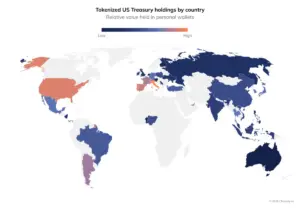
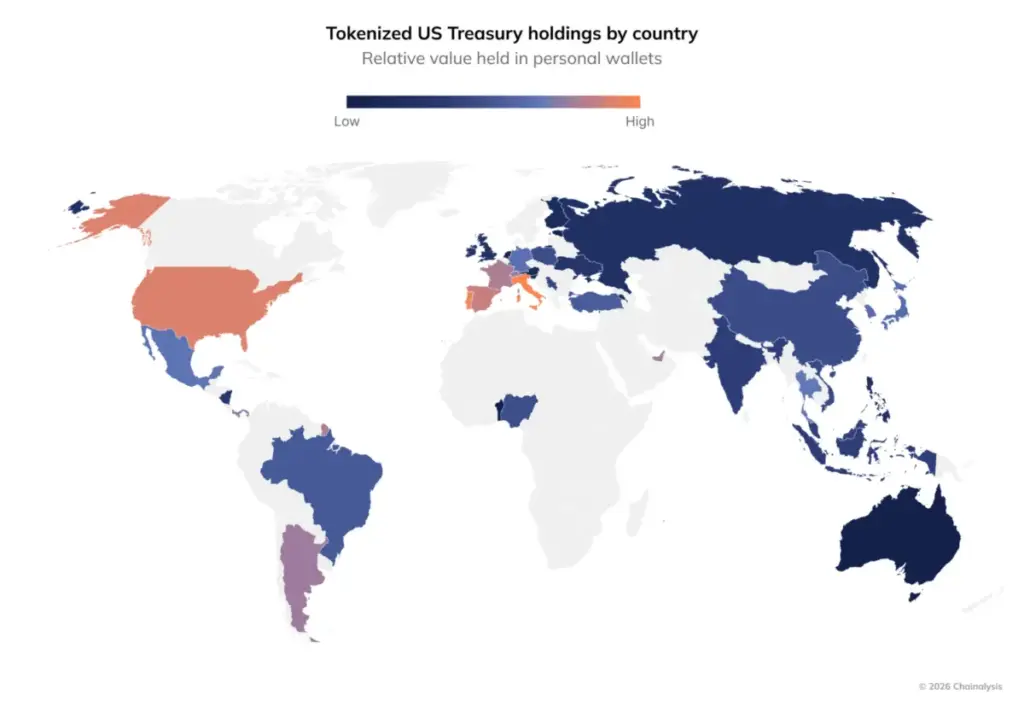
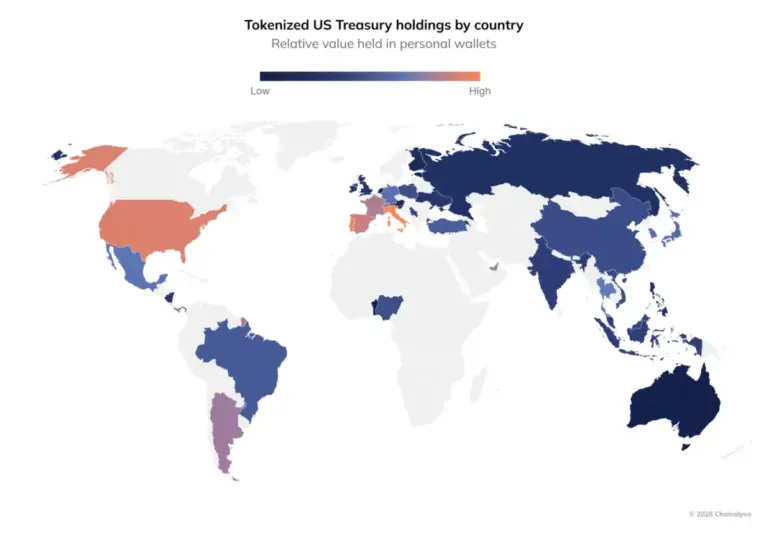
Geographic distribution data reveals a distinct structural pattern: while U.S. investors make up roughly 11% of the global tokenized holder base, foreign institutional investors in jurisdictions such as Italy, Portugal, and Singapore drive a significant majority of the held Treasury value. This dynamic extends U.S. sovereign debt demand directly to international retail and institutional participants who bypass traditional brokerage barriers through blockchain infrastructure.
Canada Emerges as a Global Leader in Peer-to-Peer Transactions
Canada recorded a resilient performance within the regional crypto economy, expanding by 2.3% during the 2026 reporting period to reach $247.7 billion overall. Notably, Canada demonstrated the most robust peer-to-peer crypto economy among G7 nations, placing seventh globally in both domestic and cross-border flows.

Stablecoins captured 44% of Canadian dollar-based order book volume by June 2026, up from 30% the previous year, with USDC representing the dominant asset. Morva Rohani, Executive Director of the Canadian Web3 Council, noted that policymakers are closely monitoring the reliance on foreign, U.S. dollar-denominated stablecoins, which naturally generate indirect demand for U.S. sovereign debt rather than domestic alternatives. Although Canada recently enacted legislation to establish regulatory frameworks for Canadian dollar-backed stablecoins, adoption levels for domestic alternatives remain minimal compared to their U.S. dollar counterparts.
Canada’s cross-border crypto flows are heavily influenced by its large immigrant population, which accounts for roughly 23% of the country’s total residents—the highest share within the G7. Remittance corridors connecting Canada to nations such as India, China, and the Philippines expanded markedly, with stablecoin and Bitcoin transfers across these specific corridors totaling $2.36 billion through 3.56 million transactions during the period. The average transfer size of $663 reflects significant cost savings for migrant workers bypassing traditional remittance channels that traditionally charge significantly higher fees.

Domestic peer-to-peer transaction volumes within Canada have also demonstrated a strong parallel correlation with temporary visa and immigrant permit populations since 2021, illustrating how individuals with active cross-border financial lives naturally gravitate toward efficient on-chain settlement options for everyday utility.
As North American infrastructure providers continue to build the foundational layers for tokenized assets, stablecoins, and autonomous AI commerce, regulatory bodies across Canada, the United States, and international jurisdictions face ongoing policy decisions that will define the integration of blockchain technology into traditional global finance.
 Crypto Wallets & Security
 Crypto Wallets & Security
 Crypto Wallets & Security