SpaceX came out swinging on Tuesday, October 20, delivering a third-quarter earnings report that thoroughly outperformed Wall Street expectations and underscored the company’s dramatic evolution far beyond its traditional rocket-building origins. Driven by explosive growth in artificial intelligence and robust connectivity operations, Elon Musk’s aerospace and technology enterprise reported a blockbuster quarter characterized by surging revenues, massive profitability, and substantial liquid reserves, all while maintaining its long-term digital asset treasury.
According to financial statements released by the newly publicly traded company, SpaceX generated $14.6 billion in revenue during the third quarter, representing a staggering 161% increase year-over-year. More dramatically, the enterprise successfully transformed a $1.1 billion loss from the same period a year earlier into $4.4 billion in net income. Operating income reached $2.8 billion, while adjusted earnings before interest, taxes, depreciation, and amortization (EBITDA) hit $8.8 billion, marking a phenomenal 306% surge compared to the previous year.
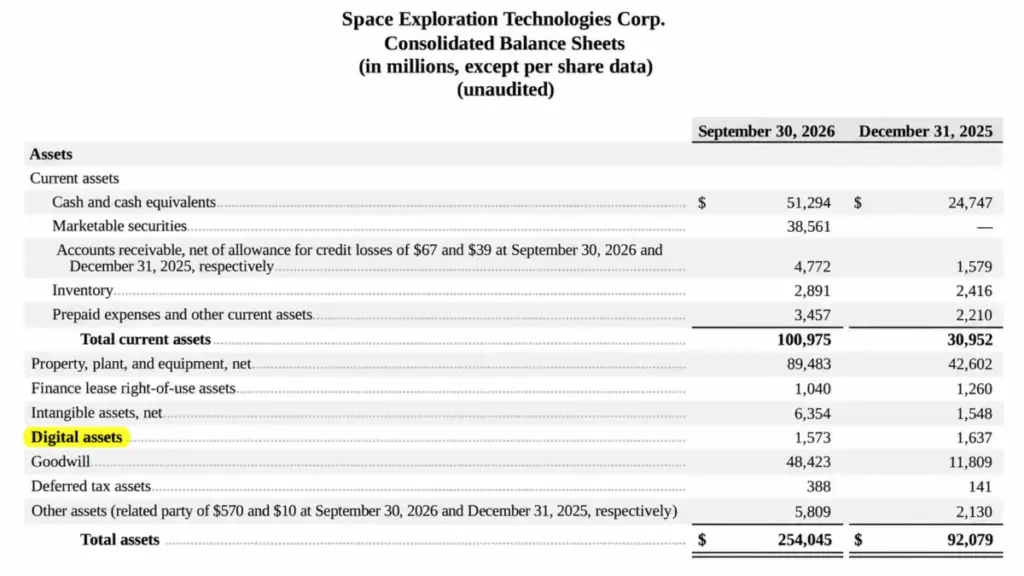
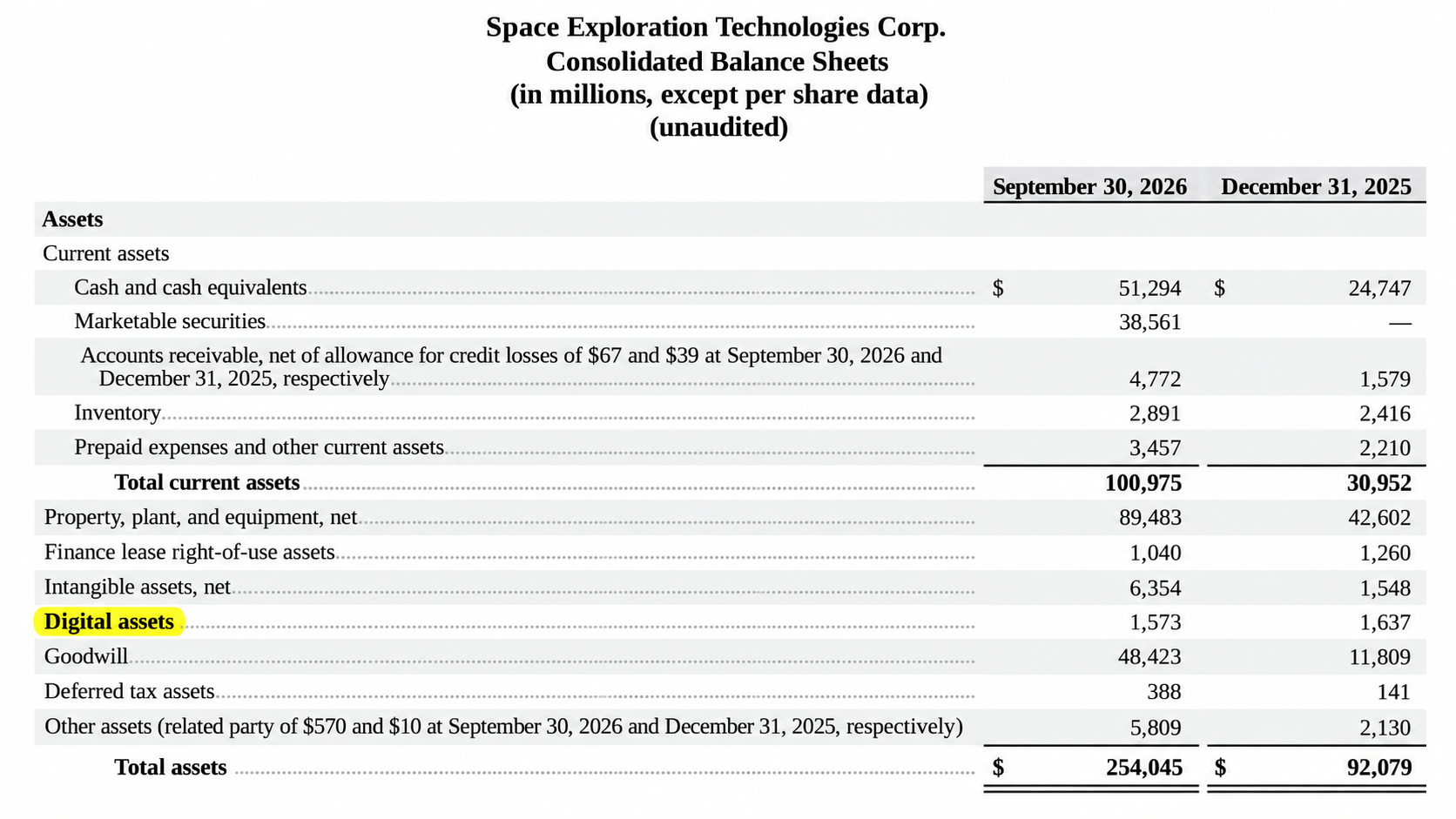
Diluted earnings came in at 35 cents per share, comfortably outstripping consensus analyst estimates that had ranged between 13 and 16 cents. Meanwhile, the top-line revenue figure easily surpassed Wall Street forecasts, which had anticipated figures between $12.7 billion and $12.9 billion. Tucked deeper into the financial disclosures, the company also reported $1.573 billion in digital assets, consistent with its previously established bitcoin treasury of 18,712 BTC. For Elon Musk, whose sprawling business empire stretches from orbital launch sites to advanced artificial intelligence infrastructure, the latest financial results demonstrate how thoroughly SpaceX has transitioned into a multifaceted technology conglomerate.
SpaceX Earnings Crush Expectations as AI Becomes the Main Attraction
The real showstopper in the quarterly report was SpaceX’s Super Intelligence division. The burgeoning business segment raked in $7.56 billion in revenue during the quarter, representing an astonishing 830% increase compared to the previous year. Encompassing advanced language models like Grok, robust cloud infrastructure, and the recently acquired Cursor operation, the Super Intelligence division officially overtook Starlink as SpaceX’s single largest revenue contributor.
The financial turnaround for the AI unit was equally striking. Operating income for the division reached $431 million, successfully reversing a steep $1.72 billion loss recorded during the comparable quarter in 2025. This rapid scaling highlights the aggressive strategic pivot the company has executed toward capturing market share in the rapidly expanding artificial intelligence and cloud computing sectors.
Despite losing its crown as the company’s top revenue driver, Starlink was far from idle during the quarter. The satellite connectivity division generated $5.25 billion in revenue, marking a healthy 69% year-over-year increase. This expansion was underpinned by a growing base of 13.6 million consumer subscribers worldwide. Traditional space operations contributed an additional $1.77 billion to the top line, bolstered notably by the company’s first revenue-generating Starship mission, which successfully deployed 26 next-generation Starlink satellites into orbit.
SpaceX’s 18,712 Bitcoin Remain a Billion-Dollar Fixture
While artificial intelligence spearheaded the revenue machine, the company’s balance sheet revealed a continuation of its quiet, long-term commitment to cryptocurrency. Tucked away on page 10 of the consolidated balance sheet, SpaceX reported $1.573 billion under the category of digital assets as of September 30, 2026. This compares with $1.637 billion recorded at the end of December 2025, reflecting a nominal $64 million decline in reported value over the nine-month period.
Although the quarterly earnings release did not explicitly use the word "bitcoin" or disclose the exact quantity of coins held, previous financial disclosures established SpaceX’s position at precisely 18,712 BTC. Those holdings were originally acquired at an approximate cost basis of $661 million. Prominent blockchain intelligence platform Arkham Intelligence independently tracks the company’s holdings at the exact same figure of 18,712 BTC, noting that the treasury is primarily managed through Coinbase Prime custody services.
Financial analysts noted that the $64 million reduction in the reported value of digital assets does not represent a liquidation or sale of the cryptocurrency. In fact, SpaceX’s accompanying cash flow statement records a corresponding $64 million unrealized loss on digital assets during the first nine months of 2026. This adjustment is entirely consistent with standard accounting practices reflecting fluctuations in market valuation rather than a confirmed disposal of corporate assets.
For a corporate giant increasingly dominated by the staggering financial gravity of its artificial intelligence operations, bitcoin remains a sizable, albeit relatively quiet, financial fixture. The latest earnings materials provided no indication of any additional purchases or sales, leaving the previously established treasury position entirely intact based on all available information.
Musk’s $925 Billion Fortune Inches Toward Trillionaire Territory
SpaceX’s extraordinary financial growth and technological ambitions are not coming without significant capital expenditure. The company reported total capital expenditures of $19.6 billion during the third quarter alone, with a massive $16.4 billion directed specifically toward the ongoing expansion of its Super Intelligence division and associated infrastructure. Despite these heavy investments, SpaceX finished the month of September sitting on approximately $89.9 billion in cash and marketable securities, providing the firm with immense financial ammunition to fund its long-term roadmap.
Meanwhile, the stellar financial performance across his corporate portfolio allowed Elon Musk to maintain his commanding position at the absolute summit of global wealth rankings. According to the Forbes Real-Time Billionaires list, Musk’s personal fortune was valued at approximately $925 billion, reflecting a daily increase of $1.4 billion as markets responded to the earnings news.
Because a substantial portion of that wealth remains tied directly to his equity ownership stakes in SpaceX and Tesla, Musk’s net worth regularly fluctuates in tandem with shifting market valuations and private funding rounds. Still, with SpaceX posting multibillion-dollar profits, cementing an expanding artificial intelligence empire, and holding a bitcoin treasury worth well over $1.5 billion, the world’s richest individual now finds himself within striking distance of a financial milestone once confined strictly to theoretical fiction: a personal fortune approaching the $1 trillion mark.
 Bitcoin & Major Altcoins
 Bitcoin & Major Altcoins
 Bitcoin & Major Altcoins