
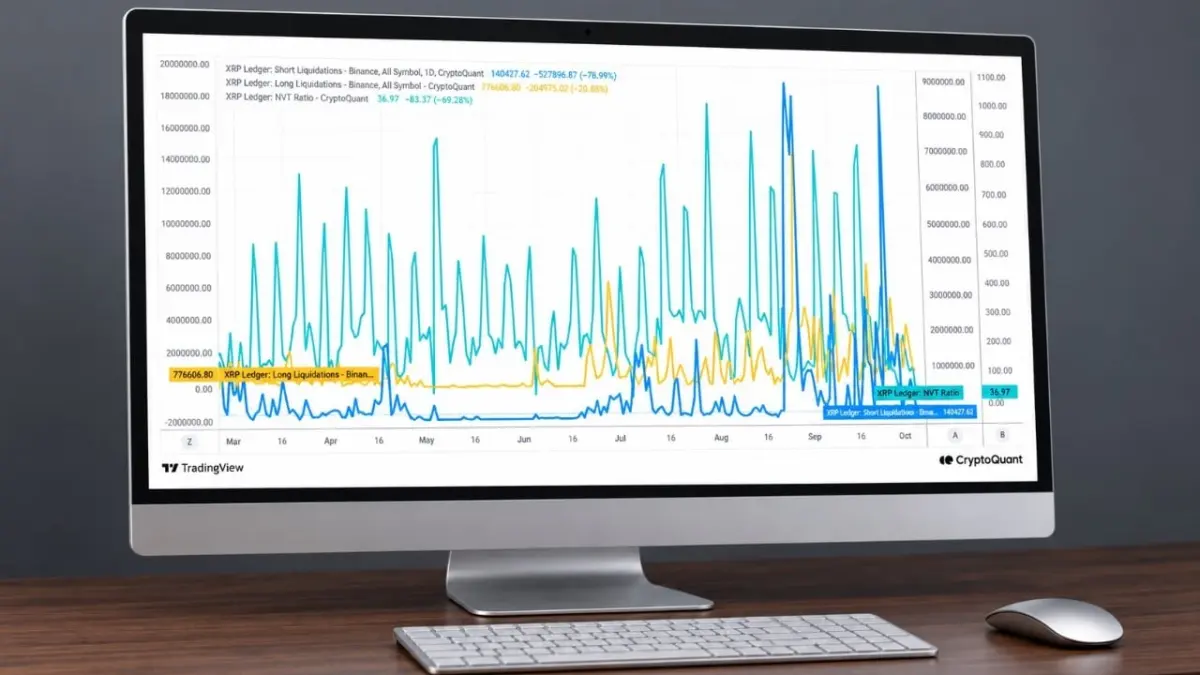
XRP liquidation pressure on Binance is showing notable signs of easing after enduring months of sharp, volatile spikes, according to a newly published market analysis. This cooling off in forced liquidations suggests that the intense strain previously exerted by leveraged trading has begun to subside. However, analysts emphasize that any sustainable, long-term price gains for the digital asset will still fundamentally depend on robust spot buying, healthy overall trading volume, and favorable broader price trends rather than leveraged speculation alone.
The recent evolution in the cryptocurrency’s market dynamics highlights a significant shift in trader behavior. According to data and insights shared by Cryptoquant on October 2, XRP traders on Binance are experiencing significantly fewer forced position closures. This comes as a welcome relief following a turbulent period characterized by repeated liquidation spikes that stretched from late July through September. Cryptoquant contributor PelinayPA examined this easing liquidation pressure by analyzing a comprehensive chart that pairs exchange liquidations with a key network valuation measure, offering a clearer picture of the underlying market health.
This broader market shift follows a notable contraction within the derivatives sector—a segment of the crypto economy defined by financial contracts tied to an asset’s price rather than the direct ownership of the underlying token itself. Market data reveals that Binance’s outstanding XRP derivatives positions experienced a sharp contraction of approximately 32 percent between August 22 and September 17. During this multi-week window, open interest—a metric that tracks the total number of derivative contracts, such as futures and options, that remain active and unclosed—plunged from roughly $323 million down to $219 million.
To understand the significance of this contraction, it helps to examine the mechanics of leverage. Leverage allows investors and speculators to control trading positions significantly larger than the initial collateral they deposit with an exchange. While this mechanism can dramatically magnify potential profits when the market moves in a trader’s favor, it equally magnifies potential losses during adverse price movements. When the market moves against a leveraged position and the trader’s deposited funds can no longer meet mandatory margin requirements—the minimum equity needed to keep a trade open—exchanges automatically trigger forced closures, known as liquidations. In the derivatives ecosystem, long positions profit when asset prices rise, while short positions profit when prices decline.
Despite the overall reduction in forced liquidations, the latest market readings still reveal underlying vulnerabilities, particularly among market participants betting on upward momentum. The Cryptoquant analyst pointed out an ongoing imbalance in the current data that leaves certain traders exposed: in the current data, long liquidations appear to be noticeably higher than short liquidations. This trend suggests that long positions have been disproportionately affected by recent downward price movements, leaving bullish speculators more susceptible to sudden market dips even as overall leverage cools down.
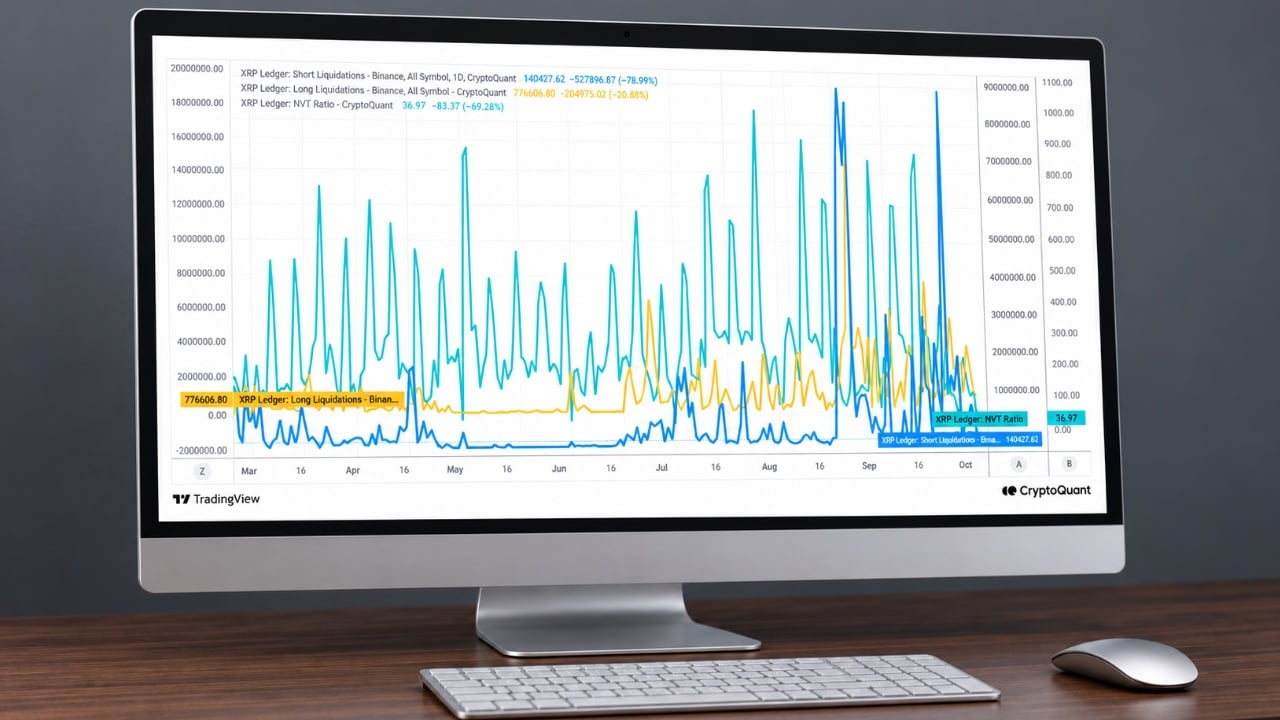
Alongside this significant reduction in forced selling across derivatives platforms, XRP’s network value-to-transactions ratio—commonly referred to as the NVT ratio—experienced a dramatic decline of 69.28 percent, dropping to 36.97 in the recent analysis. The NVT ratio is a widely watched on-chain metric that compares an asset’s total market capitalization with its on-chain transaction volume, which is expressed in dollar terms. These underlying figures represent the total economic value of all circulating tokens and the monetary value of transfers recorded directly on the blockchain, respectively.
Interpreting the NVT ratio requires careful context, as a lower reading can be driven by increased transaction transfers, a reduced overall market valuation, or a combination of both factors. The analyst’s interpretation ultimately depends on these underlying shifts. If greater economic value successfully moved across the blockchain while the NVT ratio decreased, it indicates that actual network usage and utility may have strengthened relative to the asset’s overall market value, a condition that can potentially provide fundamental support for future price appreciation.
Network usage and on-chain activity also drew intense market attention during September’s notable price advance. At that time, prominent blockchain analytics firm Santiment recorded a surge in activity, counting 1,917 large-scale whale transactions alongside 3,647 newly created wallets as the price of XRP pushed past the $1.60 threshold on September 22. However, market observers caution that such metrics illustrate raw on-chain activity rather than verified purchasing behavior. Large whale transfers can signify anything from exchange deposits and OTC sales to internal wallet rebalancing, while the creation of new addresses does not automatically equate to the arrival of fresh retail investors into the ecosystem.
This vital distinction between blockchain transfers and actual purchases also applies directly to exchange activity, where genuine spot buying involves the direct acquisition and ownership of XRP tokens. By comparison, perpetual futures offer price exposure without an expiration date and can be traded with varying degrees of leverage on both centralized exchanges and decentralized platforms that execute trades programmatically through blockchain software.
Fund flows provide yet another crucial gauge of overall market demand, operating alongside the metrics of leveraged trading. U.S. spot XRP exchange-traded funds, which hold the physical asset and offer institutional and retail investors exposure through traditional brokerage shares, recorded a cumulative $121.4 million in net inflows throughout September. However, momentum shifted slightly at the start of October. Figures from Sosovalue reported on October 3 indicated that spot XRP ETFs experienced $3.28 million in net outflows on October 2, with the entirety of those withdrawals stemming from Bitwise’s specific fund. Despite these minor day-to-day fluctuations, these specialized exchange-traded products maintained a combined total of $1.658 billion in net assets.
Summing up the current market environment, the Cryptoquant analyst outlined the precise economic conditions required for XRP to achieve a lasting and stable advance. According to the analysis, if genuine spot market demand accompanies these recent developments in derivatives and on-chain activity, it could provide a much stronger signal to the broader market. While the notable decline in liquidations offers some welcome relief to a previously overextended trading environment, a truly sustained rise will ultimately require spot buying, healthy trading volume, and a strong underlying price structure to support the upward move.
 Bitcoin & Major Altcoins
 Bitcoin & Major Altcoins
 Bitcoin & Major Altcoins







