North America has cemented its status as the most influential region for global cryptocurrency markets over the 12-year reporting period ending July 1, 2026. Backed by the deep investor base and capital of the United States, alongside progressive regulatory updates, stablecoin adoption, and deeper integration with traditional finance, the region continues to export its crypto industry trends to the rest of the world. According to recent data from industry reports, the U.S. and Canada comfortably claimed the top spots on the unweighted "big-money index," which measures the sheer economic power of covered countries. During the 2026 reporting period, their combined crypto economies reached an impressive $3.02 trillion, reflecting only a modest 1.9% contraction from the previous year despite a challenging macroeconomic environment.
This slight regional decline was primarily driven by a localized slowdown within the United States. The U.S. crypto economy dipped 2.2% period-over-period to $2.78 trillion, a predictable outcome amid a brutal broader bear market. Nevertheless, the world’s largest single crypto economy successfully retained the near-doubling of value it achieved during the 2025 period. Fundamental institutional forces—including the burgeoning popularity of spot crypto exchange-traded funds (ETFs), accelerating tokenization of real-world assets, and the ubiquitous spread of stablecoins—helped cushion the blow and preserve those hard-won gains.

Industry leaders point to a broader evolution within the sector. Analysts note that the foundational building blocks established in 2025 have successfully matured into tangible products featuring real users, deep liquidity, and active markets throughout 2026. Observers are closely watching a trio of U.S.-developed crypto products that are capturing immense activity both domestically and internationally: artificial intelligence-driven commerce, stablecoins, and tokenized assets. Meanwhile, the Canadian market has demonstrated remarkable resilience, defying the broader regional downtrend to post 2.3% growth and reaching a $250 billion crypto economy fueled largely by its vibrant immigrant population and robust peer-to-peer activity.
The United States Leads the Emerging AI On-Chain Economy
The United States has seized an early lead in the global artificial intelligence development race, and that dominance is rapidly rippling across financial sectors, including digital assets. Researchers studying advanced payment rails have focused heavily on x402, an innovative protocol that enables autonomous software and AI agents to spend money on-chain without human intervention.

As autonomous software increasingly takes over micropayments, cornerstone American crypto firms have stepped up to support the infrastructure. Circle, the issuer of the leading agent currency USDC, and Coinbase, the primary developer of the x402 system, are actively facilitating this new paradigm. Traditional financial giants are also paying close attention. Major institutions note that AI agents are poised to create significant, round-the-clock demand for frequent, low-value digital transactions.
By the end of the 2026 reporting period, cumulative x402 transactions on Base—the leading blockchain network for agentic commerce—surpassed 138 million. Traditional payment rails like credit card networks cannot economically process transactions worth fractions of a cent due to fixed processing overhead. However, stablecoin settlements that cost less than a cent make machine-to-machine micropayments entirely viable, unlocking new pay-as-you-go services like real-time data API queries.

Industry experts describe a clean division of labor taking shape in the modern payments landscape: standard card rails remain suited for consumer-prompted payments, while stablecoin rails handle machine-to-machine settlements that are simply too small for traditional card economics. Data from the 16 months leading up to September 2026 indicates that the vast majority of x402 activity consists of micropayments. Over 87% of these transactions range between one-hundredth of a cent and ten cents, with the most frequent volume falling neatly into the one-to-ten-cent bracket.
AI Payments Transition from Experimentation to Sustainable Utility
While agentic commerce remains in an exploratory phase, robust indicators confirm that the ecosystem is maturing rapidly. Early iterations of the x402 protocol were characterized by experimental users executing one-off trades and abandoning the ecosystem once their initial funds depleted. That dynamic has fundamentally shifted as repeat usage and wallet stickiness increase.

When grouping wallets by the quarter in which they were first funded, data reveals that the proportion receiving a second funding injection within 30 days climbed dramatically. For wallets funded in the third quarter of 2025, roughly 70.6% saw secondary funding. By the second quarter of 2026, that figure jumped to 89.3%. In the on-chain economy, topping up a depleted wallet functions similarly to renewing a digital subscription, indicating that users are finding sustained utility in agentic tools.
Furthermore, the time gap between initial wallet funding and the first x402 transaction has compressed significantly. In late 2025, wallets were a median of 73 days old before executing their first x402 payment. By the third quarter of 2026, that interval plummeted to just 18 minutes. Roughly two out of three new wallets now initiate spending within their first hour of being funded, reflecting purposeful adoption driven by pre-queued computational tasks rather than idle experimentation.

As AI agents become active economic participants, they are increasingly purchasing machine-readable data, code reviews, financial intelligence, and search APIs. Model inference has emerged as one of the largest transaction categories on the network. Geolocation data indicates that American-funded AI agents dominate this space, accounting for roughly 30% of all geolocated agent-to-services transactions globally. U.S. wallets represent nearly 88% of model inference payments, over 41% of payments directed toward agent frameworks, and more than 23% of data and search API expenditures.
Conversely, Chinese-linked wallets have concentrated heavily on security and code analysis, accounting for roughly 90% of payments into smart contract auditing language models like AgentLISA. Observers attribute this divergence partly to "AI nationalism" and economic reality: China’s domestic open-weight models, such as DeepSeek and Qwen, are largely free to use, whereas U.S.-developed counterparts like ChatGPT and Claude operate on metered, paid models.

The U.S. Imports Digital Gold and Exports Digital Dollars
The legislative passage of the GENIUS Act in mid-2025 formalized what global crypto markets already understood: the United States is the primary global exporter of digital dollars. Stablecoins have effectively converted U.S. sovereign debt into the preferred currency for cross-border businesses and peer-to-peer economies alike. Throughout the 2026 reporting period, stablecoin utility expanded rapidly abroad, generating billions of dollars in economic activity that benefits both U.S. corporations and the federal government.
While the U.S. exports digital dollars, it concurrently imports digital gold. Since the debut of spot bitcoin ETFs in January 2024, the U.S. share of global bitcoin activity has climbed steadily. Conversely, stablecoins represent a progressively smaller fraction of domestic American crypto activity compared to international markets. Users abroad increasingly pivot to dollar-denominated stablecoins to bypass local banking limitations, a need that U.S. residents—who already enjoy deep banking access—do not share. Meanwhile, American investors lean heavily on bitcoin as an inflation-resistant store of value amid rising global public debt.

Cross-border bitcoin flows illustrate a clear bifurcation in market behavior. Retail-sized transfers under $10,000 predominantly run outbound, while institutional-scale transactions flip to net inflows, with transfers exceeding $10 million driving substantial accumulation. Furthermore, nearly all stablecoin trading volume remains pegged to the U.S. dollar, cementing its role as the foundational routing layer between local fiat currencies and global liquidity.
The U.S. Impact on Real-World Asset Tokenization
The United States continues to anchor the rapid expansion of the tokenized real-world asset (RWA) sector. By the end of the second quarter of 2026, the global tokenized RWA market reached $36.07 billion, marking a staggering 135% year-over-year increase. U.S. Treasury debt remains the single largest asset class within this ecosystem, commanding $15.42 billion—or roughly 42.8%—of all tokenized RWA value.

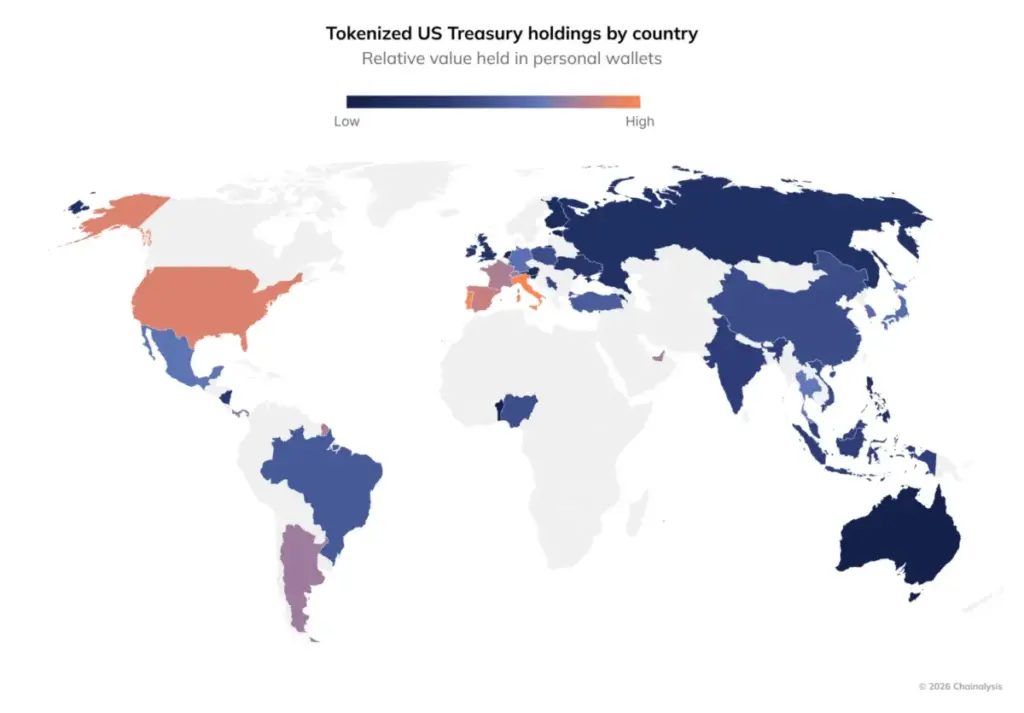
While U.S. investors account for nearly 12% of the global tokenized RWA holder base, tokenized Treasuries reveal a fascinating geographic distribution. Countries like Italy, Portugal, and Singapore represent significant shares of tokenized Treasury value, while nations like Japan boast a wide base of retail holders controlling smaller positions. Tokenization effectively lowers the minimum investment threshold and removes traditional brokerage barriers, allowing retail participants globally to access U.S. government debt directly.
Lending patterns indicate that tokenized Treasuries are largely bought and held as high-yield digital cash equivalents rather than posted as collateral, whereas illiquid asset classes like private credit are actively leveraged across decentralized lending markets. Asset managers emphasize that the long-term trajectory points toward a unified financial system where traditional assets simply leverage the speed, programmability, and global interoperability of blockchain architecture.

Canada Emerges as a Global Peer-to-Peer Leader
Canada, ranking as the second-largest economy in the regional big-money index, saw its crypto economy expand by 2.3% during the 2026 period to reach $247.7 billion. Despite its developed economic status, Canada exhibits remarkably high rates of everyday cryptocurrency utilization, boasting the most robust peer-to-peer crypto economy among G7 nations.
Stablecoins capture a dominant 44% share of Canadian dollar-based order book volume, led primarily by USDC. Executive Director Morva Rohani of the Canadian Web3 Council notes that this preference for U.S. dollar-denominated stablecoins creates policy challenges, as heavy reliance on foreign stablecoins directs potential sovereign debt demand toward the United States rather than Canada. Although Canada recently passed a stablecoin act to encourage domestic Canadian dollar-backed stablecoin issuance, local alternatives currently maintain a fraction of the adoption enjoyed by their U.S. counterparts.

Canada’s remarkable cross-border strength is heavily influenced by its diverse demographic makeup. With approximately 23% of its population born abroad—the highest share in the G7—Canada serves as a major hub for remittances directed toward India, China, and the Philippines. Stablecoin and bitcoin remittances to these three key corridors totaled $2.36 billion during the reporting period, representing a 141% year-over-year surge across millions of individual transactions. By offering settlement costs of a fraction of a cent compared to traditional banking remittance fees exceeding 6%, digital assets provide a vital financial bridge for immigrant communities managing multi-jurisdictional obligations.
 Crypto Wallets & Security
 Crypto Wallets & Security
 Crypto Wallets & Security