North America stood as the most influential region for global cryptocurrency markets during the 12 months leading up to July 1, 2026, according to comprehensive industry data. Anchored by the deep investor base and capital liquidity of the United States, alongside progressive updates to domestic regulations, the region continues to export its financial innovations to the rest of the world. Driven by the widespread adoption of stablecoins, the integration of digital assets into traditional financial institutions, and pioneering technological frameworks, developments within North America’s digital asset sector routinely dictate global market trajectories.
In the 2026 reporting period, the United States and Canada secured the top positions on the industry’s unweighted "big-money index," which measures the sheer crypto-economic power of covered nations. Combined, their respective digital asset economies totaled $3.02 trillion. This figure represents a modest 1.9% contraction compared to the preceding 12-month period, a downward shift driven primarily by a broader slowdown in the U.S. market. The United States economy for digital assets, valued at $2.78 trillion, experienced a 2.2% period-over-period decline. Industry observers noted that this minor contraction was an unsurprising outcome amid a brutal bear market, yet the world’s single-biggest crypto economy largely retained the near-doubling of value it achieved during the 2025 period. Robust institutional forces—such as the proliferation of crypto exchange-traded funds (ETFs), accelerating tokenization initiatives, and the expansive growth of stablecoins—helped cushion the market against steeper losses.

Hoolie Tejwani, Head of Coinbase Ventures, emphasized that current market dynamics reflect industry maturation. The foundational building blocks established in 2025 have successfully transformed into operational products boasting active users, deep liquidity, and established markets throughout 2026. A closer examination of the North American landscape highlights three primary U.S.-developed products driving significant domestic and international activity: artificial intelligence commerce, stablecoins, and tokenized real-world assets. Concurrently, the Canadian market demonstrated remarkable resilience, expanding by 2.3% to reach a $250 billion digital asset economy, heavily supported by unique demographic and remittance trends.
The U.S. Leads the Emerging AI On-Chain Economy
The United States’ commanding lead in the global artificial intelligence development race is rapidly reshaping adjacent sectors, including the blockchain ecosystem. Researchers tracking the adoption of x402—a leading digital payments rail that enables autonomous software agents to execute financial transactions—have gained crucial insights into how an automated, on-chain economy is taking shape. Autonomous software is increasingly utilizing blockchain rails to execute payments, with cornerstone American crypto enterprises playing a central role in supporting this infrastructure. Companies such as Circle, issuer of the leading agent currency USDC, and Coinbase, the developer of the x402 protocol, have provided foundational support for machine-to-machine commerce.

This agentic commerce trend is also capturing the attention of major traditional financial institutions. Will Su, Head of Digital Assets Research at BlackRock, noted that the firm is monitoring agentic commerce closely, anticipating that autonomous AI agents could generate meaningful demand for frequent, low-value payments operating around the clock. By the end of the 2026 reporting period, cumulative transactions utilizing the x402 protocol on Base—the premier blockchain network for agentic commerce—surpassed 138 million.
On-chain settlement layers facilitate economic activity that remains economically unfeasible on legacy payment networks, most notably micro-payments. Traditional credit card networks cannot profitably process transactions worth less than a dollar, and particularly those valued at fractions of a cent. However, stablecoin transactions that settle for a fraction of a cent make it economically viable for software agents to expend microscopic amounts of capital. This capability unlocks an entirely new market for pay-as-you-go digital goods and services, such as purchasing targeted data through automated application programming interface calls.

Executives at Circle describe a clean division of labor emerging within digital payments, where traditional card rails serve consumer-prompted agent expenditures, while stablecoin rails handle high-frequency, machine-to-machine settlements that fall below the economic thresholds of card networks. Empirical data from the 16-month period ending in September 2026 indicates that the vast majority of x402 activity consists of micro-payments. Over 87% of these payments range between one-hundredth of a cent and ten cents, with the most frequent transaction size falling between one and ten cents.
AI Payments Exhibit Growing Stickiness and Purposeful Adoption
While agentic commerce remains in an experimental phase, quantitative metrics reveal clear signs of long-term maturation. Early iterations of x402 were characterized by speculative users testing the protocol with one-off transactions before abandoning their wallets upon depletion of funds. More recent data demonstrates a fundamental shift toward sustained, programmatic utilization.

When grouping wallets by the quarter in which they were first funded, retention rates show consistent improvement. The share of wallets securing a secondary funding injection within 30 days of initial capitalization rose from 70.6% for wallets established in the third quarter of 2025 to 89.3% for those funded in the second quarter of 2026. This behavior—recapitalizing a depleted digital wallet—serves as the on-chain equivalent of renewing a software subscription. Analysts excluded one-time experimenters by evaluating only wallets that initiated transfers across two or more separate days, confirming that users are finding sustained utility in autonomous payment rails.
Furthermore, x402 users are demonstrating increasingly purposeful behavior, highlighted by a sharp reduction in the time elapsed between initial wallet funding and the execution of a first x402 transaction. In late 2025, the median age of a wallet initiating its first x402 spend was 73 days. By the third quarter of 2026, that median time gap plummeted to just 18 minutes. Concurrently, the proportion of wallets executing a payment within their first hour of funding climbed from 4% in the third quarter of 2025 to 67% by the third quarter of 2026. These metrics indicate that newer wallets are being purposefully provisioned to execute pre-planned machine-to-machine economic tasks rather than simply parking capital or testing network mechanics.

An analysis of transaction destinations reveals that AI agents are increasingly purchasing information-centric services, including code review, financial intelligence, and search APIs. This consumption aligns with the operational requirements of large language models, which rely continuously on machine-readable data inputs. Additional capital flows into gaming platforms, token issuance services, agent frameworks, and tooling. Notably, a significant volume of transactions is directed toward model inference, with autonomous agents effectively paying for the computational services of other AI models.
Geopolitical Dynamics in AI-to-AI Commerce
Geolocated data indicates that American-funded AI agents participate more actively in x402 services than counterparts from any other nation, capturing approximately 30% of globally geolocated agent-to-service transactions. U.S.-linked wallets account for 88.1% of geolocated AI model inference transactions, 41.8% of payments directed toward agent frameworks and tool catalogs, and 23.2% of expenditures on data and search APIs.

Conversely, Chinese-attributed wallets display a distinct specialization, concentrating heavily on security and code analysis services. Approximately nine out of ten transactions directed toward smart contract auditing services, such as the language model auditor AgentLISA, originated from Chinese-linked wallets. Chinese operators also captured significant shares in market and financial intelligence markets at 46.7% and payment infrastructure at 35%. However, Chinese-funded agents accounted for a negligible 0.1% of model inference transactions.
Industry analysts attribute this divergence to a combination of economic reality and emerging AI nationalism. China’s domestic market readily utilizes open-weight models developed locally, such as DeepSeek and Qwen, which are often free to deploy, whereas Western markets rely heavily on metered, U.S.-developed models like ChatGPT and Claude. Consequently, visible commercial markets for machine-purchased intelligence concentrate heavily in jurisdictions where commercial acquisition remains the most cost-effective option, positioning American demand at the center of the current ecosystem.

The U.S. Imports Digital Gold While Exporting Digital Dollars
The formalization of regulatory frameworks, such as the passage of the GENIUS Act in mid-2025, codified the United States’ status as the primary global exporter of digital dollars. Stablecoins backed by U.S. sovereign debt have evolved into the currency of choice for cross-border businesses and peer-to-peer economies worldwide. Throughout the 2026 period, stablecoin adoption expanded rapidly abroad, generating billions of dollars in economic activity that reinforces U.S. financial influence.
While the U.S. aggressively exports stablecoins, it simultaneously acts as a net importer of Bitcoin. Since the regulatory approval of spot Bitcoin ETFs in January 2024, the U.S. share of global Bitcoin trading and holding activity has climbed steadily. Conversely, stablecoins represent a smaller proportion of domestic U.S. crypto activity compared to international markets, a structural gap that widened further throughout the reporting period. International users increasingly embrace dollar-denominated stablecoins to satisfy a demand for stable foreign currency that domestic banking systems do not readily fulfill, whereas American investors lean into Bitcoin as an anti-inflationary store of value amid rising global sovereign debt levels.

Cross-border data shows that the U.S. transitioned into a net importer of Bitcoin in 2026 for the first time since 2022. While retail transfers under $10,000 consistently registered as net outbound, high-denomination institutional transfers reversed this trend, with transactions exceeding $10 million accounting for net inflows of over 53,200 coins. Market observers note that this institutional accumulation provides a strong private sector bid, which is further complemented by discussions surrounding potential sovereign reserve strategies. Meanwhile, stablecoin issuers report massive circulating supplies and immense on-chain settlement volumes, solidifying stablecoins as the primary routing layer for moving capital between traditional fiat currencies, local digital assets, and global liquidity pools.
Tokenization and Real-World Assets Expand Rapidly
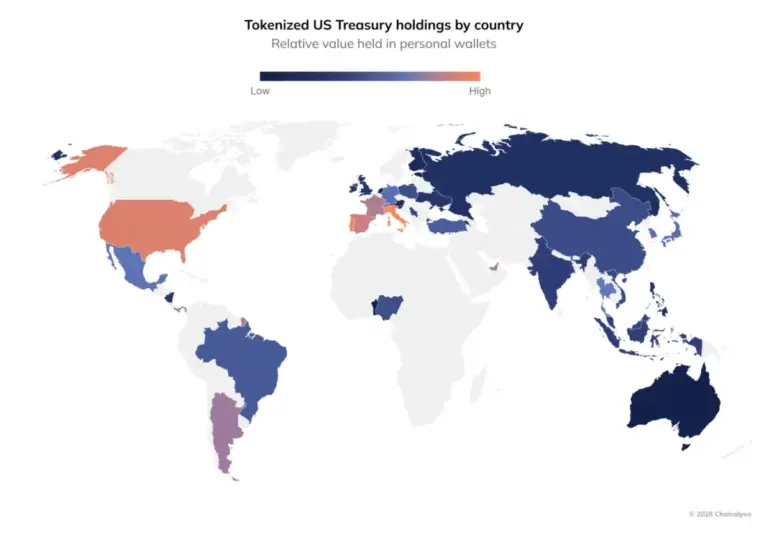
The United States maintained its dominant position within the fast-growing tokenized real-world asset (RWA) sector. Tokenized U.S. Treasury bonds constituted the largest individual RWA category, accounting for $15.42 billion—or 42.8%—of the entire $36.07 billion global tokenized asset market at the close of the second quarter of 2026, representing a 135% year-over-year expansion.

Asset managers, public corporations, and traditional financial institutions continue to launch tokenized funds and debt instruments to capitalize on the speed, programmability, and cross-border interoperability of blockchain infrastructure. While niche categories such as tokenized corporate credit and private equity experienced triple-digit percentage gains from smaller initial baselines, U.S. Treasury tokenization recorded massive dollar-value expansion, outpacing the growth of the next three categories combined.
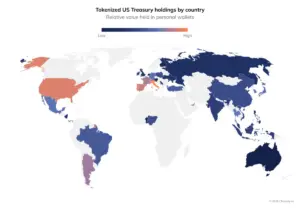
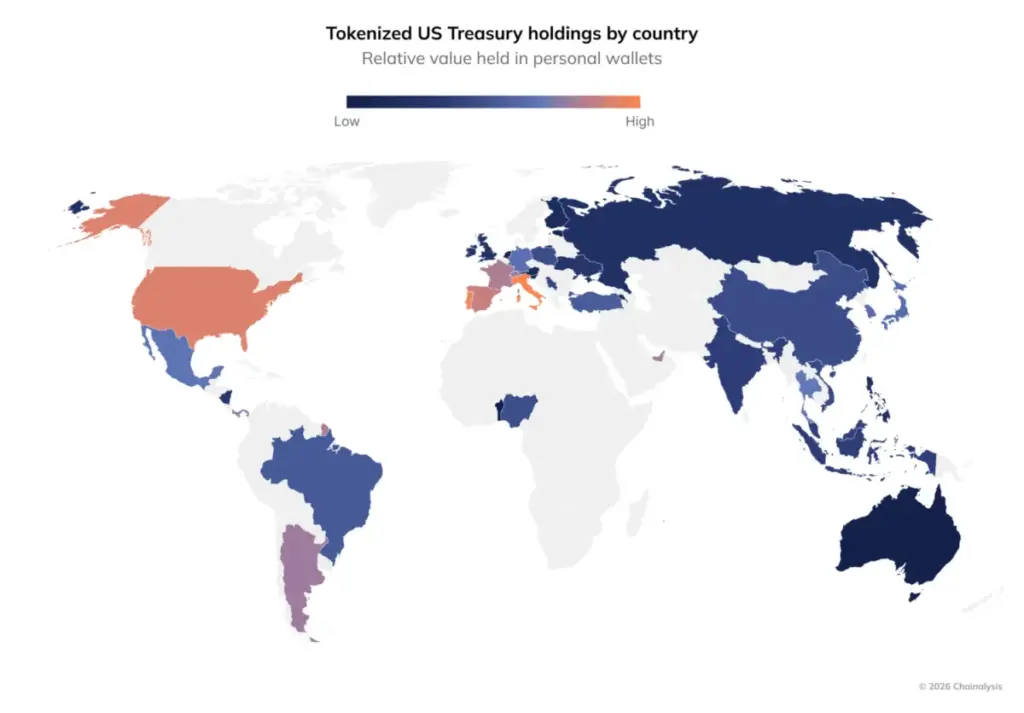
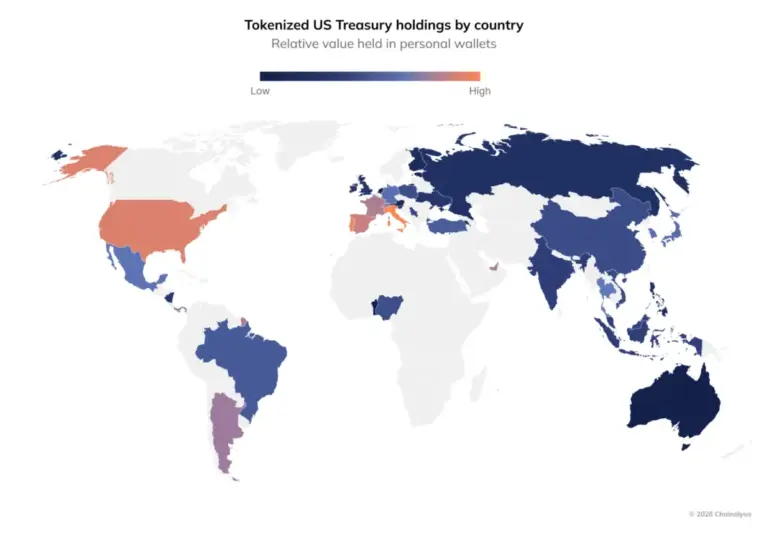
Geolocated data reveals an interesting dynamic regarding the ownership of tokenized U.S. public debt: while U.S.-based investors account for roughly 11.7% of the global tokenized RWA holder base and 11.4% of its value, institutional and retail investors abroad drive the market for tokenized Treasuries. European nations such as Italy and Portugal, alongside Asian financial hubs like Singapore, represent substantial shares of tokenized Treasury holdings by value. Industry executives note that tokenization effectively democratizes access to wholesale sovereign debt instruments, enabling international retail investors to bypass traditional, restrictive brokerage relationships and acquire yield-bearing U.S. government debt directly on-chain.

Canada Emerges as a Global Leader in Peer-to-Peer and Remittance Flows
Canada secured its position as the second-largest crypto economy in North America and ranked tenth globally in grassroots adoption. Between July 2025 and June 2026, the Canadian digital asset market expanded by 2.3% to reach an overall valuation of $247.7 billion. Within this mature market, residents exhibit exceptionally high rates of everyday cryptocurrency usage compared to peers in other developed G7 nations, placing Canada seventh globally in domestic and cross-border peer-to-peer transaction flows.
Stablecoins capture a commanding share of Canadian crypto activity, accounting for 44% of Canadian dollar-based order book volume by June 2026, up from 30% a year prior. USDC dominates this segment, while localized Canadian dollar-backed stablecoins have captured negligible market share. Morva Rohani, Executive Director of the Canadian Web3 Council, noted that heavy reliance on U.S. dollar-denominated stablecoins creates policy challenges for Canadian lawmakers, as capital flows into U.S. Treasury-backed assets rather than supporting domestic sovereign debt issuance.

Despite these monetary policy considerations, Canada’s robust cross-border remittance economy thrives on blockchain rails. Driven by a foreign-born population that constitutes approximately 23% of the country’s total residents—the highest proportion in the G7—Canada maintains active remittance corridors to nations such as India, China, the Philippines, Nigeria, and Pakistan. Stablecoin and Bitcoin transfers originating from Canada to India, China, and the Philippines surged 141% year-over-year to reach $2.36 billion during the reporting period, distributed across 3.56 million transactions with an average transfer size of $663. By offering settlement costs of a fraction of a cent compared to traditional bank wire fees that average over 6%, crypto remittance rails provide an economically advantageous alternative for migrant workers supporting families abroad.
Furthermore, empirical data indicates a strong correlation between the size of Canada’s temporary resident and student permit populations from major remittance countries and domestic peer-to-peer crypto volumes. As temporary visa populations expanded and contracted over recent years, domestic peer-to-peer transaction volumes tracked these demographic shifts in parallel, illustrating that individuals with active cross-border financial lives readily adopt efficient blockchain settlement options for daily commerce.

Ultimately, the North American cryptocurrency landscape in 2026 highlights a clear structural divide: while the foundational infrastructure, stablecoin issuance platforms, and tokenization rails remain firmly anchored in the United States, the consumer and institutional user base extends across the globe. As regulatory bodies in Canada, the United States, and international jurisdictions implement new supervisory frameworks for stablecoins, tokenized assets, and automated AI payments, the industry moves steadily toward full integration with traditional global finance.
 Crypto Wallets & Security
 Crypto Wallets & Security
 Crypto Wallets & Security