North America reinforced its position as the most influential region for global cryptocurrency markets during the 12 months leading up to July 1, 2026. Backed by the deep capital reserves of the United States investor base, evolving regulatory frameworks, expanding stablecoin usage, and an accelerated integration of decentralized networks with traditional finance, the region continues to export its financial innovations to the rest of the world.
According to market data and industry indices covering the 2026 reporting period, the United States and Canada claimed the top spots on the unweighted "big-money index," which measures the sheer crypto-economic power of covered countries. Combined, their respective digital asset economies totaled $3.02 trillion. This figure represents a modest 1.9% contraction compared to the previous period, a shift driven primarily by a broader slowdown in the U.S. market amid a challenging market cycle.

Despite a 2.2% drop in its domestic crypto economy to $2.78 trillion, the United States retained the vast majority of the near-doubling it achieved in the 2025 period. Institutional forces—most notably the maturation of crypto exchange-traded funds (ETFs), accelerated asset tokenization, and the widespread proliferation of stablecoins—helped anchor those structural gains. Industry leaders point to 2026 as a crucial turning point for the sector’s maturation. The foundational building blocks laid down in preceding years are successfully translating into operational products characterized by real users, sustainable liquidity, and functioning global markets.
The U.S. Leads the AI On-Chain Economy
The United States’ leading role in global artificial intelligence development is expanding into the digital asset ecosystem, giving rise to an entirely new paradigm of machine-to-machine financial activity. Researchers examining the x402 payment protocol—one of the most prominent digital rails enabling autonomous AI agents to conduct transactions—have found that the U.S. has quickly emerged as the dominant builder of this nascent sector.

Cornerstone American cryptocurrency firms, including USDC issuer Circle and x402 developer Coinbase, are actively supporting the rapid expansion of agentic commerce. Traditional financial institutions are also taking notice. Major asset management firms, including BlackRock, are monitoring the space closely as AI agents generate continuous demand for frequent, low-value payments that execute around the clock. By the close of the 2026 reporting period, more than 138 million x402 transactions had been processed on Base, making it the leading blockchain network for agentic commerce.
On-chain infrastructure enables economic activity that remains impractical on legacy payment rails, particularly micropayments. Traditional credit card networks cannot profitably process transactions valued at a fraction of a cent or a single dollar. However, stablecoin transactions that settle for less than a cent make it economically viable for software agents to expend tiny amounts of value. This capability unlocks new markets for pay-as-you-go digital goods and services, such as real-time API data retrieval.

Industry participants describe a clean division of labor emerging between traditional and blockchain rails: standard card networks handle consumer-prompted agent payments, while stablecoins facilitate machine-to-machine settlements that fall below the economic thresholds of credit cards.
AI Payments Are Becoming Stickier
Data tracking the operational habits of x402 wallets reveals that agentic commerce is rapidly moving past its initial experimental phase. Successive cohorts of newly funded wallets demonstrate a rising level of commitment. The share of wallets securing a second funding round within 30 days of initial capitalization climbed from 70.6% for those funded in the third quarter of 2025 to 89.3% for wallets originating in the second quarter of 2026. This behavior mirrors software subscription renewals, indicating that users find sustained utility in the protocol.

Furthermore, AI payments are becoming more purposeful and immediate. The median time gap between a wallet receiving its initial seed funding and executing its first x402 transaction dropped dramatically, falling from 73 days in late 2025 to just 18 minutes by the third quarter of 2026. While only 4% of newly funded wallets executed a payment within their first hour during the earlier period, that figure surged to 67% by late 2026. Rather than parking value or casually testing the protocol, users are provisioning wallets specifically because active computational jobs are already queued.
Early adoption was heavily characterized by fleeting fads, such as viral memecoins that drew massive influxes of temporary wallets before fading. As the ecosystem matured, however, agentic commerce shifted toward information-driven services. Autonomous agents routinely purchase machine-readable data, including code review services, financial intelligence, search APIs, and model inference capacity.

Geographically, American-funded AI agents dominate this activity, accounting for roughly 30% of all geolocated agent-to-service transactions globally. U.S. wallets represent 88.1% of all model inference payments, 41.8% of payments directed toward agent frameworks and tool catalogs, and 23.2% of expenditures on data and search APIs. In contrast, Chinese-linked wallets concentrate heavily on security and code analysis—accounting for nine out of ten transactions directed toward smart contract auditing services like AgentLISA—while maintaining a negligible share of model inference payments, likely influenced by the widespread availability of domestic, open-weight models in China.
The U.S. Imports Digital Gold and Exports Digital Dollars
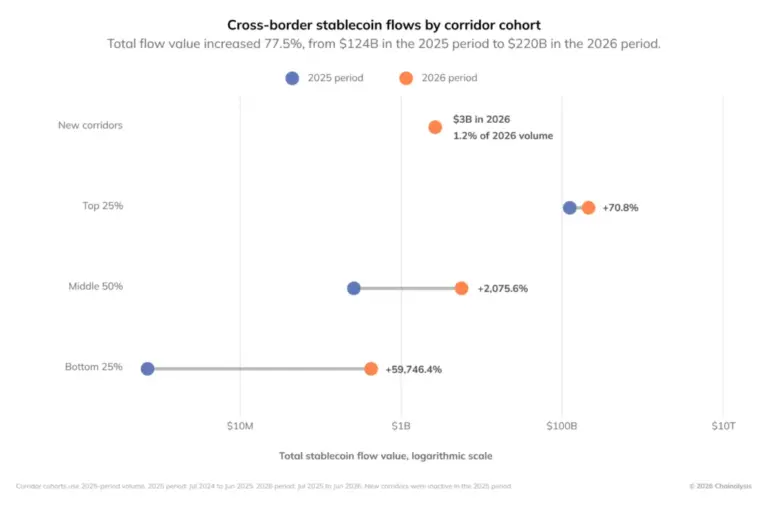
The legislative passage of the GENIUS Act in mid-2025 formalized what global crypto economies already recognized: the United States is the primary global exporter of digital dollars. Stablecoins backed by U.S. debt have increasingly served as the currency of choice for cross-border businesses and peer-to-peer economies alike. This widespread foreign adoption generates billions of dollars in economic activity that benefits both U.S. issuers and the broader American financial system.

While the U.S. acts as a net exporter of stablecoins, it simultaneously functions as a net importer of bitcoin. Following the regulatory approval and launch of spot bitcoin exchange-traded funds in early 2024, the American share of global bitcoin activity has risen steadily. Conversely, stablecoins comprise a smaller relative share of domestic U.S. crypto activity compared to international markets, where users adopt digital dollars to fulfill economic needs that local banking systems do not address.
Cross-border bitcoin flows into and out of the U.S. crossed a notable threshold in 2026, marking the country’s transition to a net importer for the first time since 2022. While retail-scale transfers under $10,000 generally registered as net outbound, high-value institutional transactions reversed the trend, with transfers exceeding $10 million bringing more than 53,000 coins into domestic custody. This strong institutional accumulation has been further bolstered by discussions surrounding federal strategic reserve initiatives, even in the absence of direct sovereign purchasing programs.

The global dominance of U.S. dollar-pegged stablecoins remains largely unchallenged by foreign regulatory efforts. Despite the European Union implementing comprehensive frameworks like MiCA to foster favorable conditions for euro-denominated stablecoins, euro-backed tokens account for a fraction of a percent of order book trading volume. Emerging regulatory frameworks in financial hubs like Singapore and Hong Kong face a similar dynamic, where regulatory readiness has outpaced organic market demand.
The U.S. Impact on Tokenization
The United States continued to anchor the rapid expansion of the tokenized real-world asset (RWA) market during the 2026 period. Driven largely by the tokenization of short-dated U.S. Treasury bonds, the global RWA market expanded by 135% year-over-year, finishing the second quarter of 2026 with $36.07 billion in total value. Tokenized U.S. debt stood as the single largest asset class, accounting for $15.42 billion—or roughly 42.8%—of all tokenized RWA value globally.

Asset managers, public corporations, and institutional financial players are increasingly looking to blockchain infrastructure to enhance the speed, programmability, and interoperability of financial assets. While alternative asset categories like private credit and corporate credit experienced rapid percentage growth from smaller baselines, U.S. Treasury tokenization captured the largest absolute capital inflows.
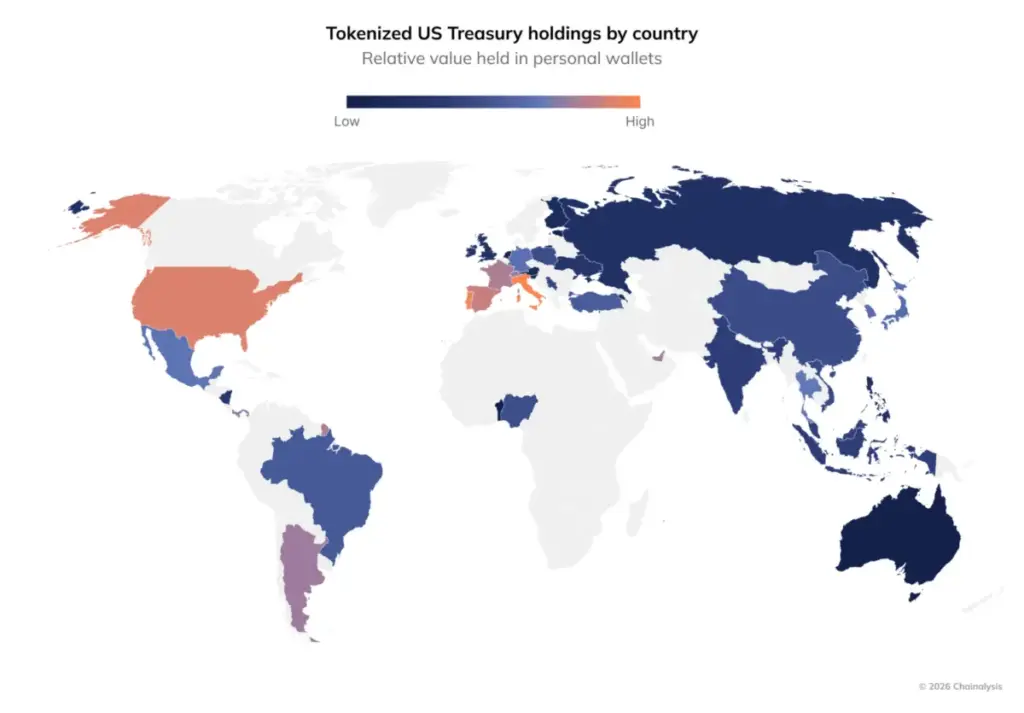
Geographic distribution data reveals a distinct pattern within the tokenized Treasury market. While U.S. investors account for roughly 11% of the overall RWA holder base and total value, international investors drive a disproportionate share of tokenized Treasury holdings. European and Asian jurisdictions, including Italy, Portugal, Singapore, and Japan, represent significant portions of tokenized U.S. sovereign debt holders. By lowering minimum investment thresholds and removing traditional brokerage barriers, tokenization transforms wholesale institutional instruments into accessible assets for retail investors worldwide, effectively expanding foreign demand for U.S. government debt.

Canada Ranks as a Global Leader in Peer-to-Peer Crypto
Canada maintained its standing as the second-largest crypto economy in North America and a top global participant in grassroots adoption. Between July 2025 and June 2026, the Canadian crypto economy expanded by 2.3% to reach an estimated $247.7 billion. Within this steady economic growth, Canadian residents engaged in everyday peer-to-peer cryptocurrency transactions at rates significantly higher than those typically observed in other advanced economies. Among G7 nations, Canada maintained the most robust peer-to-peer crypto economy, ranking strongly in both domestic and cross-border payment flows.
Stablecoins captured a growing share of Canadian cryptocurrency activity, rising to account for 44% of Canadian dollar-based order book volume by June 2026, up from 30% the previous year. USDC served as the dominant stablecoin within this sector, while local Canadian dollar-backed stablecoin initiatives remained minuscule in market capitalization and adoption.

Industry advocates note that the heavy reliance on U.S. dollar-denominated stablecoins creates a policy challenge for Canadian authorities, as foreign asset adoption can inadvertently direct local capital toward U.S. sovereign debt rather than domestic alternatives. Although Canada recently adopted stablecoin legislation aimed at clearing the path for locally denominated digital currencies, regulatory frameworks are still catching up to established market preferences.
Canada’s Cross-Border Remittance and Immigrant Populations
Canada’s prominent position in cross-border crypto flows is closely tied to its diverse demographic profile. With roughly 23% of its population born abroad—the highest proportion within the G7—Canada serves as a major hub for international remittances. Remittance corridors connecting Canadian residents to family members, debt obligations, and asset management accounts in countries such as India, China, and the Philippines have experienced rapid expansion.

During the 2026 reporting period, stablecoin and bitcoin remittance transfers from Canada to India, China, and the Philippines totaled $2.36 billion, marking a 141% year-over-year increase. This volume was distributed across approximately 3.56 million individual transactions, with an average transfer size of $663 and an estimated 75,100 unique monthly senders. The primary driver behind this migration to blockchain rails is economic efficiency: while traditional bank remittance providers charge average fees approaching 7% of the transfer amount, stablecoin transactions settle instantly for a fraction of a cent.
Furthermore, domestic peer-to-peer transaction volumes in Canada have historically tracked closely with fluctuations in the country’s temporary visa and immigrant populations. As temporary permit numbers shifted over recent years, domestic crypto activity moved in parallel, reflecting the natural financial behaviors of individuals maintaining active cross-border financial lives.

Ultimately, the broader North American crypto landscape in 2026 highlights a distinct division between infrastructure providers and end users. American financial institutions, developers, and regulatory frameworks form the foundational rails supporting tokenized assets, digital dollars, and agentic AI commerce. Meanwhile, a global user base—ranging from institutional investors in Europe and Asia to everyday remitters in Canada—provides the primary demand that keeps these decentralized markets scaling worldwide.
 Crypto Wallets & Security
 Crypto Wallets & Security
 Crypto Wallets & Security