North America reinforced its position as the most influential region for global cryptocurrency markets during the 12 months leading up to July 1, 2026. Backed by the deep investor base of the United States, evolving regulatory frameworks, the widespread integration of stablecoins, and traditional financial institutions bridging the gap with blockchain infrastructure, the region continues to export its crypto-economic trends to the rest of the world.
According to the latest reporting period data, the United States and Canada claimed the top spots on the unweighted "big-money index," which measures the sheer economic power of covered countries. Combined, their respective crypto economies totaled $3.02 trillion. While this figure represents a modest 1.9% contraction from the previous year, the dip was primarily driven by a localized slowdown in the United States amidst a broader, brutal bear market.
The U.S. crypto economy stood at $2.78 trillion, slipping 2.2% period-over-period. However, the world’s single-biggest crypto market managed to retain the near-doubling of value it achieved during the 2025 reporting period. Institutional catalysts—such as the expansion of crypto exchange-traded funds (ETFs), accelerating tokenization initiatives, and the proliferation of stablecoins—proved crucial in preserving those gains.

"A lot of what we’re seeing vs. 2025 comes down to maturation of the industry," noted Hoolie Tejwani, Head of Coinbase Ventures. "The building blocks set in 2025 are turning into products with real users, liquidity, and markets in 2026."
Beyond macroeconomic trends, three distinct U.S.-developed products stood out for driving international and domestic activity: AI-driven commerce, stablecoins, and tokenized assets. Meanwhile, Canada’s market demonstrated unexpected resilience, growing 2.3% to reach a $250 billion crypto economy, buoyed significantly by vibrant immigrant-led peer-to-peer and remittance flows.
The U.S. Leads the AI On-Chain Economy
The United States’ commanding lead in artificial intelligence development is rapidly reshaping adjacent sectors, including digital assets. A prime example is the adoption of x402, a popular digital payments rail enabling autonomous software and AI agents to execute financial transactions on-chain.

Autonomous software is increasingly handling payments independently, with foundational American crypto firms playing a pivotal role. Circle, the issuer of USDC—a leading currency for AI agents—and Coinbase, the developer of the x402 system, are heavily supporting this nascent ecosystem. Financial heavyweights are also taking notice. Will Su, Head of Digital Assets Research at BlackRock, noted that the firm is closely monitoring agentic commerce because AI agents have the potential to generate meaningful demand for frequent, low-value payments around the clock.
By the close of the reporting period, more than 138 million x402 transactions had been recorded on Base, the leading blockchain for agentic commerce. Traditional credit card networks cannot economically process transactions worth less than a dollar, and certainly not sub-penny transactions. However, stablecoins settle for a fraction of a cent, making micro-payments entirely viable and unlocking pay-as-you-go services like API data calls.
Circle highlights a clear division of labor emerging in the payments landscape: card rails are reserved for consumer-prompted agent payments, while stablecoin rails handle machine-to-machine settlements that are too small for traditional card economics. Data from the reporting period underscores this shift, showing that over 87% of x402 payments fall between a hundredth of a cent and a dime, with the most common transactions ranging from one to ten cents.

AI Payments Are Becoming Stickier
While agentic commerce began as an experimental novelty characterized by one-off users who abandoned protocols once their initial funds depleted, behavior patterns shifted markedly through 2026. Users of x402 have demonstrated increasing commitment, with wallets showing greater longevity and recurring engagement.
When grouping wallets by the quarter they were first funded, the share securing a second funding round within 30 days rose dramatically. For wallets funded in the third quarter of 2025, 70.6% received subsequent funding; that figure climbed to 89.3% for wallets funded in the second quarter of 2026. This behavior mirrors the on-chain equivalent of renewing a subscription. Furthermore, the time gap between initial wallet funding and the first x402 transaction compressed significantly, dropping from a median of 73 days in late 2025 down to just 18 minutes by the third quarter of 2026.
This immediacy indicates that new wallets are increasingly purpose-built for agentic commerce. Rather than parking value or testing protocols, users are funding wallets because tasks are already queued and funds need to move immediately.

What AI Agents Are Buying with x402
As agentic commerce matured beyond early-stage fads like speculative memecoins, AI agents began purchasing enduring digital goods, heavily skewed toward the information sector. Millions of transactions have flowed from AI wallets into code review services, financial intelligence tools, and data search APIs.
Because machine learning models require a continuous supply of machine-readable data, on-chain micro-payments provide an ideal settlement layer. Beyond data, AI agents utilize x402 rails to pay for gaming, token issuance, gambling services, and agent frameworks. Notably, a significant share of transactions goes toward paying other AI models for inference processing.
Geographic distribution data reveals that American-funded AI agents dominate this space, accounting for roughly 30% of geolocated agent-to-services transactions globally. U.S. wallets represent 88.1% of geolocated AI model inference transactions, 41.8% of payments to agent frameworks and tool catalogs, and 23.2% of payments to data and search APIs.

In contrast, Chinese-attributed wallets concentrated heavily on the security sector, accounting for 90% of transactions directed toward security and smart contract code analysis, largely through the LLM-powered auditing service AgentLISA. Chinese operators also captured substantial market shares in financial intelligence and settlement rails but accounted for just 0.1% of model inference payments. This divergence reflects a combination of AI nationalism and economic reality, as Chinese markets lean toward domestic open-weight models like DeepSeek and Qwen, which are free to use, while U.S. markets utilize metered models like ChatGPT and Claude.
The U.S. Imports Digital Gold and Exports Digital Dollars
Following the congressional passage of the GENIUS Act, the United States solidified its role as the world’s leading exporter of digital dollars. Stablecoins have effectively converted U.S. sovereign debt into the preferred currency for cross-border businesses and peer-to-peer economies alike.
Conversely, the U.S. has increasingly imported Bitcoin. Since the debut of spot Bitcoin ETFs in January 2024, the American share of global Bitcoin activity has consistently expanded. While stablecoins represent a smaller fraction of U.S. domestic crypto activity compared to foreign markets—where users adopt digital dollars to bypass local banking limitations—institutional accumulation of Bitcoin within the U.S. has surged.

Net cross-border flows highlight a distinct structural split: retail transfers under $10,000 ran net outbound, while institutional transfers above $10 million resulted in heavy net inflows. Meanwhile, stablecoin circulation climbed significantly, with issuers reporting tens of billions of dollars in active tokens backed predominantly by short-dated U.S. government debt. This dynamic creates a dual benefit for the American economy: imported Bitcoin acts as an institutional store of value, while exported stablecoins broaden the global footprint of the U.S. dollar.
The U.S. Impact on Tokenization
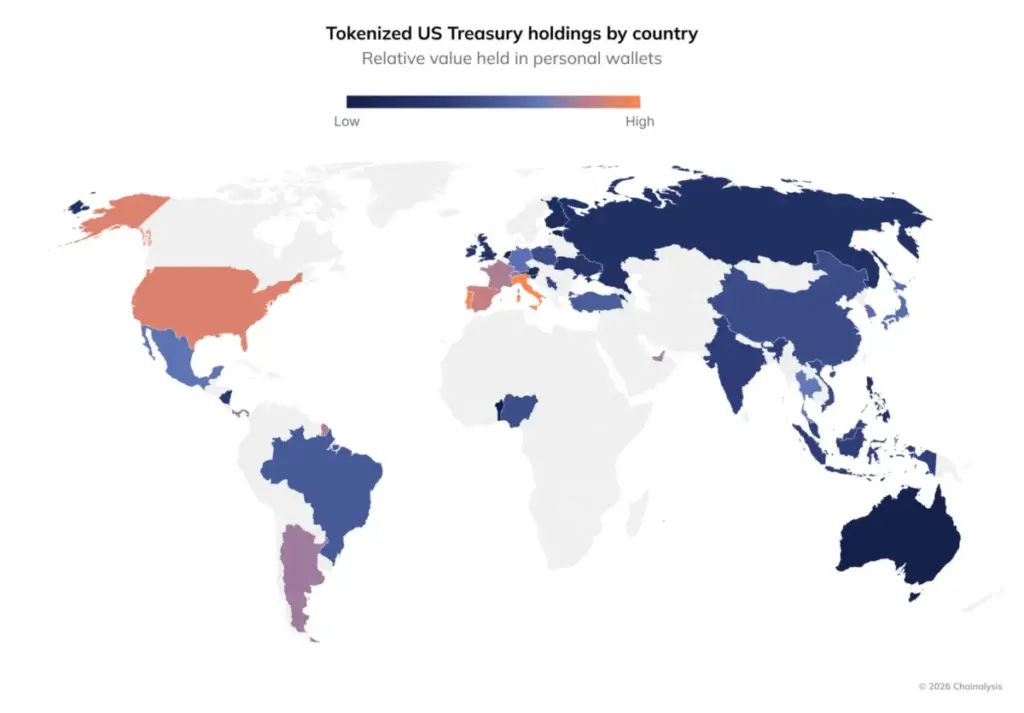
The United States also anchored the explosive growth of the tokenized real-world asset (RWA) sector. The global tokenized RWA market expanded 135% year-over-year, finishing the second quarter of 2026 at $36.07 billion. Tokenized U.S. Treasury bonds formed the largest single asset class, accounting for $15.42 billion, or 42.8% of total RWA value.
"We are seeing asset managers launch tokenized funds, public companies explore putting their equity on-chain, financial institutions build stablecoin infrastructure and tokenized assets become usable within lending, collateral and trading markets," said Tom Murphy, head of communications for Securitize.

While U.S. investors accounted for roughly 11.7% of the global tokenized RWA holder base, the geographic distribution of tokenized Treasuries skewed heavily international. European and Asian nations, including Italy, Portugal, and Singapore, represented major shares of tokenized Treasury value, driven by foreign retail and institutional investors utilizing blockchain rails to access U.S. sovereign debt without needing traditional brokerage accounts.
Canada Excels in Peer-to-Peer and Remittance Economies
Canada maintained its status as the second-largest crypto economy in North America, growing 2.3% to reach $247.7 billion. Notably, Canada recorded the most robust peer-to-peer crypto economy among G7 nations, placing seventh globally in both domestic and cross-border flows.
Stablecoins comprised 44% of Canadian dollar-based order book volume, with USDC dominating the market. Because Canadian users heavily favor U.S. dollar-denominated stablecoins, local policymakers have monitored how foreign assets influence domestic financial demand, prompting the recent adoption of a Canadian Stablecoin Act designed to encourage local currency-backed alternatives.

Canada’s cross-border remittance market proved particularly vibrant. With the highest foreign-born population share in the G7 at roughly 23%, Canada serves as a major hub for remittances directed toward India, China, and the Philippines. Stablecoin and Bitcoin transfers across these key corridors totaled $2.36 billion during the reporting period, representing a 141% year-over-year increase across millions of individual transactions. By utilizing blockchain rails that settle for pennies, senders successfully bypassed traditional remittance fees that often average upwards of 6%.
Data further revealed a strong correlation between Canada’s domestic peer-to-peer crypto volumes and fluctuations in its temporary visa and immigrant permit populations. As temporary resident populations expanded or contracted alongside immigration policy adjustments, domestic P2P activity mirrored those trends, reflecting how individuals with active cross-border financial lives naturally gravitate toward efficient digital settlement tools.
As North America looks ahead, the core infrastructure of the digital asset economy—from tokenized debt and stablecoin issuance to AI payment rails—remains anchored in the United States, while global user demand continues to scale rapidly across borders.
 Crypto Wallets & Security
 Crypto Wallets & Security
 Crypto Wallets & Security