Eastern Asia remains one of the most economically dynamic and structurally diverse cryptocurrency markets in the world. From country to country, entirely distinct regulatory frameworks, localized risk appetites, and unique business objectives push users toward vastly different operational use cases. Although the region’s overall crypto economy experienced a modest contraction between July 2025 and June 2026, aligning with a broader global bear market, this downturn was far from uniform. Growth hotspots emerged across major jurisdictions, highlighting a landscape defined by rapid institutional maturation in some areas and deep grassroots resilience in others.
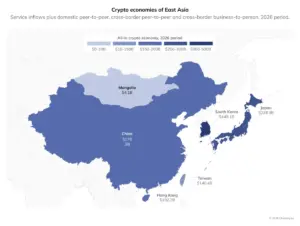
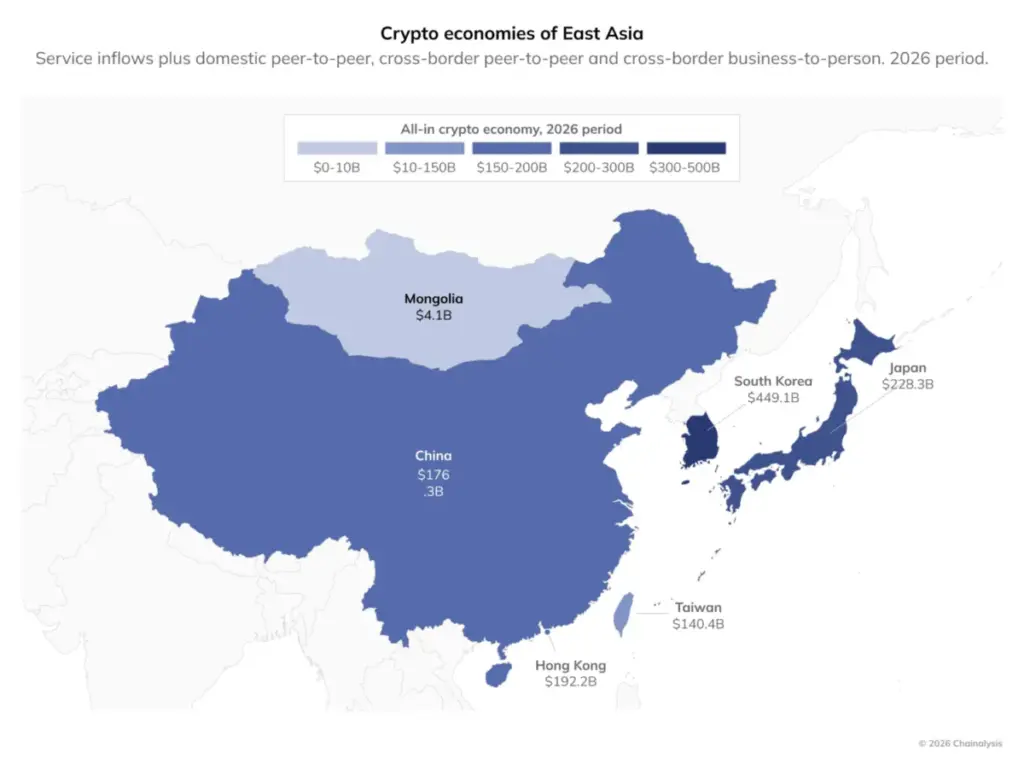
Institutional platforms in Hong Kong, for example, saw inflows surge by 87% compared to the previous year, marking the fastest institutional growth across East Asia. Meanwhile, Japanese users increasingly turned to decentralized exchanges, driving a 36% increase in inflows on those platforms. Regional leader South Korea maintained its dominance as the largest standalone crypto hub in the region, registering a $449 billion crypto economy that expanded 12.3% period-over-period.

These striking regional variations reflect a marketplace where different locations fulfill specialized roles. As Daniel Kim, CEO of Tiger Research, observed, Asia stands out as a rare region possessing both deep grassroots retail participation and substantial institutional firepower.
South Korea Leads as the Region’s Largest Crypto Economy
South Korea’s massive $449 billion all-in crypto economy grew by 12.3% during the 2026 period, bolstered by an additional $51.1 billion in exchange-related flows. This expansion is heavily tied to the country’s famously retail-driven market, according to Francis Kang, executive director of Korea Blockchain Week. Much of this dynamic retail activity has developed in parallel with broader macroeconomic trends, particularly the explosive global interest in artificial intelligence investments.

A major catalyst for South Korea’s retail dominance has been the absence of capital gains taxes on digital assets throughout the period. Although a long-delayed 22% tax on crypto profits is officially scheduled to take effect at the start of 2027, the National Assembly has repeatedly postponed the measure, leaving market participants uncertain about its ultimate timing. This legislative timeline coincides with a gradual shift toward institutional participation. In February 2025, the Financial Services Commission announced a roadmap to open the market to nonprofits, exchanges, listed companies, and registered professional investment corporations, though direct investment-driven corporate participation has been slow to scale in practice.
While traditional financial institutions have been cautious due to past legislative roadblocks, they are actively preparing for a larger footprint. Major banks and securities firms across South Korea have established dedicated digital asset teams and are running pilots involving stablecoins, tokenization, and custody. Jinhyeong Jo, a senior examiner at Korea’s Financial Intelligence Unit, noted that the outcome of upcoming legislative discussions could significantly influence retail demand and overall market participation. If the 2027 tax takes effect as planned while corporate access broadens, South Korea could witness a major structural shift, with institutional capital acting as a meaningful counterweight to retail activity for the first time.

The AI Cryptocurrency Trade Dominates South Korea
South Korean retail traders have consistently favored high-risk, high-reward opportunities, a tendency most visible in the country’s enthusiastic adoption of AI-themed cryptocurrencies. The nation’s traditional equities market is heavily anchored by SK Hynix, a semiconductor giant producing the specialized memory chips that power global data center expansion.
Reflecting this national economic focus, AI-crypto trading in South Korea surged alongside the rise of tech equities. By June 2026, digital assets tied to AI infrastructure and decentralized projects became the single most popular thematically defined investment category by won-denominated trading volume, eclipsing traditional payment tokens like XRP. This makes South Korea a global outlier. Won-denominated trading activity in AI tokens outpaced the Japanese yen rate by a factor of 19.5, while also vastly exceeding equivalent trading shares in major fiat currencies like the Brazilian real, the British pound, and the euro.

Traders directed capital into a diverse assortment of AI-linked tokens. Worldcoin (WLD) led the category with $7.41 billion in trading volume over the period, followed by newcomer token SAHARA with $3.2 billion, VIRTUAL with $2.7 billion, BIO with $2 billion, and NEAR with $1.7 billion. The rapid turnover within this sector—with 2025 leaders giving way to newer projects—demonstrates that South Korean retail investors engage with thematic digital asset categories at a velocity unmatched by any other measured market.
Japan’s Consumer-Crypto Economy and Institutional Shifts
Japan’s $228 billion crypto economy frequently captures headlines for its institutional activity, driven primarily by banks and financial firms rather than retail consumers. Experts examining the world’s fourth-largest economy by GDP emphasize that the most consequential digital asset developments are unfolding within regulated corporate entities. However, beneath this institutional veneer lies an active and growing consumer base comprising a population of 122 million.

Data from the 2026 period revealed substantial consumer engagement. Approximately one in four individuals who withdrew funds from domestic Japanese exchanges subsequently deposited capital into decentralized finance (DeFi) protocols. Furthermore, decentralized exchanges captured nearly 35% of the market share of Japan’s services industry, outperforming every other regional neighbor. Japanese engagement with DEXs has expanded by over 200% since 2022, while centralized exchange activity has remained relatively flat over the same timeframe.
According to Taishi Sato, CEO of DeFimans, the heavy visibility of perpetual futures in Japan stems from a sophisticated retail population already well-versed in foreign exchange trading. Traders utilize on-chain platforms like Hyperliquid alongside equity portfolios to manage directional and macroeconomic exposure, treating them as extensions of traditional financial risk management tools rather than isolated crypto-native venues.

Store-of-value tokens like Bitcoin remained the most popular direct asset class, capturing 73.8% of yen trading volume in the 2026 period. However, their market share slipped slightly amid an overall 27% decline in absolute store-of-value volume. Conversely, smart contract tokens such as Ethereum and Solana experienced significant growth, expanding their share from 10% in the previous period to 15.4% by June 2026, making them the only yen-paired asset class to register absolute volume growth.
While high tax rates—which historically peaked at a marginal rate of 55% for crypto gains—have constrained consumer adoption, proposed tax reforms advanced in July 2026 aim to lower eligible gains to a separate taxation rate of around 20%. Local executives, including Binance Japan General Manager Arisa Toyosaki, believe these reforms could fundamentally shift retail sentiment and boost trading volumes through 2027. Simultaneously, financial institutions are treating digital assets, stablecoins, tokenized deposits, and real-world assets as foundational new business lines, supported by the introduction of yen-denominated stablecoins like JPYC and SBI Group’s JPYSC.

Hong Kong Emerges as Eastern Asia’s Institutional Hub
Hong Kong’s $192 billion crypto economy is characterized less by sheer size and more by the institutional profile of its participants. Government initiatives have placed digital assets at the core of the city’s financial strategy, with regulatory clarity serving as the primary catalyst for market participation. SB Seker, Head of APAC at Binance, noted that Hong Kong’s recent trajectory proves that robust financial innovation and regulatory clarity can advance in tandem.
The region’s Five-Year Plan and recent Policy Address prioritize stablecoins, tokenized finance, and central bank digital currencies. Following the issuance of its first stablecoin licenses and institutional market testing, the city has drawn high-end corporate actors. QCP Group noted that this regulatory direction naturally favors well-controlled, licensed operators, raising operational standards across the board.

Institutional platforms—encompassing over-the-counter desks, custody providers, and market makers—captured 16% of Hong Kong’s service inflows during the 2026 period, nearly triple the proportion of any regional neighbor and up from roughly 9% two years prior. Hong Kong attracted nearly $24 billion in inbound business-to-business crypto transfers, dwarfing inflows to Japan and South Korea. Furthermore, cumulative net B2B inflows climbed steadily to reach $17.4 billion by mid-2026, indicating that institutional capital is settling permanently within the city’s regulated perimeter rather than simply passing through.
China’s Stablecoin Use Surges Amid Social Credit Expansion
Tracking China’s crypto economy remains complex due to the government’s longstanding official ban on domestic crypto services. Nevertheless, available data indicates that China’s crypto economy reached at least $176 billion during the 2026 period, with actual figures likely higher.

A defining characteristic of China’s market is its heavy reliance on peer-to-peer (P2P) transactions rather than exchange-based trading. Domestic P2P activity accounted for 59.1% of the country’s all-in crypto economy in the 2026 period, marking a 3.5-fold increase in share compared to the previous year. A major inflection point in this P2P expansion occurred in March 2025, coinciding with the government’s formal expansion of its social credit system into finance and the internet.
This systemic integration of behavioral scoring and financial restrictions created strong incentives for individuals to utilize censorship-resistant alternatives. Users locked out of traditional banking rails, or those seeking to avoid strict state monitoring when conducting everyday commerce, increasingly turned to stablecoins for domestic payments. Month-over-month growth in domestic stablecoin transactions sustained a steady upward trajectory for 13 consecutive months following March 2025, with transaction volumes in smaller monetary ranges experiencing exponential growth.

Furthermore, self-custodied stablecoin holdings in China exhibited an extraordinary velocity of money, turning over 33.2 times per year. This rate is more than three times the global average of 9.3x and significantly higher than regional peers like Japan and Hong Kong. Such high turnover confirms that Chinese users treat stablecoins primarily as functional working capital and domestic payment rails rather than long-term stores of value.
Regulatory Divergence Shapes the Region’s Future
East Asia provides a clear global test case for the impact of diverging regulatory strategies on digital asset markets. While China’s absolute prohibition prompted local users to migrate toward decentralized P2P stablecoin channels, supervised-access regimes established in jurisdictions like Japan, Hong Kong, Singapore, and South Korea have successfully channeled institutional and retail capital into distinct, compliant frameworks. As regulatory frameworks continue to mature across the region, the coming year’s data will determine whether supervised access fully absorbs global market activity or whether offshore alternatives continue to attract specialized volume.
 Crypto Wallets & Security
 Crypto Wallets & Security
 Crypto Wallets & Security