North America solidified its position as the most influential region for global cryptocurrency markets during the 12-year reporting period ending July 1, 2026. Bolstered by the deep capital base of the United States, evolving regulatory frameworks, the widespread integration of stablecoins, and traditional financial institutions bridging the gap with blockchain technology, developments originating in North America continue to ripple across the international digital asset ecosystem.
According to market data measuring the sheer crypto-economic power of covered countries, the United States and Canada topped the regional "big-money index." Together, their respective crypto economies totaled $3.02 trillion during the 2026 period. This represented a modest 1.9% contraction compared to the previous year, a shift largely attributed to a localized slowdown in the United States amid a broader, challenging market cycle.
The U.S. crypto economy dipped 2.2% to $2.78 trillion over the period. However, analysts note that this minor cooling-off phase follows a massive surge during the preceding period, where the nation’s crypto market valuation nearly doubled. Institutional drivers—most notably the maturation and expansion of crypto exchange-traded funds (ETFs), accelerating asset tokenization, and the ongoing proliferation of stablecoins—helped the U.S. retain the vast majority of those previous gains.

"A lot of what we’re seeing versus 2025 comes down to the maturation of the industry," said Hoolie Tejwani, Head of Coinbase Ventures. "The building blocks set in 2025 are turning into products with real users, liquidity, and markets in 2026."
Industry observers are increasingly focusing on a trio of U.S.-developed crypto products that are generating substantial domestic and international activity: artificial intelligence commerce, stablecoin rails, and tokenized real-world assets. Meanwhile, Canada’s digital asset economy moved in the opposite direction of its southern neighbor, growing by 2.3% to reach approximately $250 billion, supported by a surprisingly robust peer-to-peer economy driven heavily by immigrant populations.
The US is Leading the AI On-Chain Economy
The United States’ commanding lead in the global artificial intelligence development race has begun to influence every corner of the digital economy, including blockchain infrastructure. Researchers analyzing the x402 payment rail—one of the most popular digital settlement systems enabling AI agents to autonomously spend money—have gained fresh insights into how this machine-to-machine economy is taking shape.

Autonomous software has begun executing transactions directly on-chain, with cornerstone American crypto enterprises playing a central role in supporting this burgeoning sector. Circle, the issuer of the USDC stablecoin which serves as a primary currency for autonomous agents, and Coinbase, the developer of the x402 protocol, are actively supporting the infrastructure. Financial giants are also taking notice; Will Su, Head of Digital Assets Research at BlackRock, noted that the firm is closely monitoring agentic commerce due to the potential for AI agents to generate significant demand for frequent, low-value payments around the clock.
By the conclusion of the 2026 reporting period, more than 138 million x402 transactions had been processed on Base, the leading blockchain network utilized for agentic commerce.
Traditional payment rails, such as credit card networks, are structurally unequipped to process transactions worth less than a dollar, and particularly fractions of a cent, due to prohibitive processing fees. However, stablecoin settlements that cost less than a cent make micro-transactions economically viable, unlocking an entirely new market for pay-as-you-go goods and services, such as real-time data retrieval via API calls.

Circle describes a clear division of labor emerging between traditional and blockchain rails: card systems are handling consumer-prompted agent payments, while stablecoin rails are managing machine-to-machine settlements that fall below the economic thresholds of traditional cards.
The vast majority of x402 activity registered as micro-payments during the 16 months leading up to September 2026. More than 87% of payments fell between a hundredth of a cent and a dime, with transaction sizes most frequently ranging between one and ten cents.
AI Payments Are Becoming Stickier
While agentic commerce remains largely in its experimental phase, clear indicators point toward long-term maturation. Early iterations of x402 were dominated by one-off users conducting test transactions before abandoning the platform once their initial funds were depleted. That dynamic has changed substantially as subsequent cohorts of wallets demonstrate higher levels of commitment.

When grouping wallets by the quarter in which they were first funded, the share that received a secondary funding deposit within 30 days rose dramatically. For wallets initially funded in the third quarter of 2025, about 70.6% received subsequent funding. By the second quarter of 2026, that figure climbed to 89.3%. This behavior mirrors the renewal of a traditional software subscription, indicating that users are finding tangible utility in x402 systems and maintaining active balances.
Furthermore, users are engaging with the protocol much faster after initial setup. In late 2025, wallets had a median age of 73 days before initiating their first x402 payment. By the third quarter of 2026, that time gap shrank to a mere 18 minutes. The proportion of wallets spending within their first hour of being funded jumped from 4% in Q3 2025 to 67% in Q3 2026, signaling that new wallets are being purpose-built for immediate execution rather than speculative holding.
What AI Agents Are Buying with x402
As autonomous agents establish themselves as active economic participants, market observers have tracked the types of products and services they are purchasing on-chain. While early transaction volume was heavily skewed toward short-lived trends like memecoins, the maturation of x402 has fostered more sustainable commercial activity, particularly within the information and technology sectors.

Millions of transactions are now flowing from AI-controlled wallets into specialized knowledge services, including code review, financial intelligence, data aggregation, and search APIs. Because autonomous software requires continuous streams of machine-readable data, on-chain micro-payments provide a seamless purchasing mechanism.
AI agents are also directing funds toward gaming, token issuance, gambling services, agent development frameworks, and tooling. Notably, a significant proportion of x402 expenditure is dedicated to AI-to-AI commerce, with model inference ranking among the largest transaction categories.
American-funded AI agents currently transact more frequently with x402 services than counterparts from any other nation, capturing roughly 30% of geolocated agent-to-services transactions. U.S. wallets account for 88.1% of geolocated AI model inference transactions, 41.8% of payments for agent frameworks and tooling, and 23.2% of data and search API expenditures.

In contrast, Chinese-attributed wallets demonstrate a different operational focus, heavily concentrating on security and code analysis. Approximately nine out of ten transactions directed toward smart contract auditing services, such as the language-model-driven platform AgentLISA, originated from Chinese-linked wallets. Chinese operators also accounted for substantial shares in market intelligence and payment rails, though they represented a minuscule fraction of model inference expenditures, reflecting local preferences for free, domestic open-weight models over metered Western services.
The US Imports Digital Gold and Exports Digital Dollars
The formalization of the U.S. stablecoin landscape following legislative milestones in 2025 cemented the country’s status as the world’s leading exporter of digital dollars. Stablecoins have transformed U.S. government debt into a preferred currency for cross-border businesses and peer-to-peer economies alike, generating billions of dollars in economic activity that ultimately benefits the U.S. government and domestic issuers.
While the U.S. exports digital dollars, it simultaneously imports bitcoin. Following the introduction of spot bitcoin ETFs, the U.S. share of global bitcoin activity has climbed steadily. Conversely, stablecoins represent a smaller percentage of overall crypto activity within the United States than they do internationally, reflecting the fact that American citizens already enjoy robust access to traditional banking and dollar accounts. International users, however, increasingly rely on digital dollars to fulfill financial needs unserved by local institutions.

Cross-border bitcoin flows into and out of the U.S. shifted noticeably during the 2026 period, turning the nation into a net importer for the first time since 2022. While retail-scale transfers under $10,000 remained net outbound, large-denomination institutional transfers drove massive net inflows, with transactions exceeding $10 million accounting for more than 53,200 incoming coins.
Stablecoins continue to circulate globally at immense scales, with roughly 99.1% of traded order book volume pegged to the U.S. dollar. Circle reported $73.3 billion of USDC in circulation at the close of the quarter, backed largely by short-dated U.S. government debt, highlighting how digital assets are increasingly utilized as routing layers between traditional fiat currencies and global liquidity pools.
The US Impact on Tokenization
The United States continues to exert dominant influence over the rapidly expanding real-world asset tokenization sector. U.S. Treasury bonds remained the single largest tokenized real-world asset class during the reporting period, accounting for $15.42 billion—or 42.8%—of the total tokenized RWA market value. The overall tokenization market concluded the second quarter of 2026 at $36.07 billion, marking a 135% year-over-year expansion.

Asset managers, public corporations, and financial institutions are increasingly placing equities, corporate credit, and private credit on-chain to leverage the speed, programmability, and interoperability of blockchain infrastructure. While alternative tokenized categories experienced dramatic percentage growth from smaller initial bases, Treasury debt expansion drove the lion’s share of absolute dollar growth.
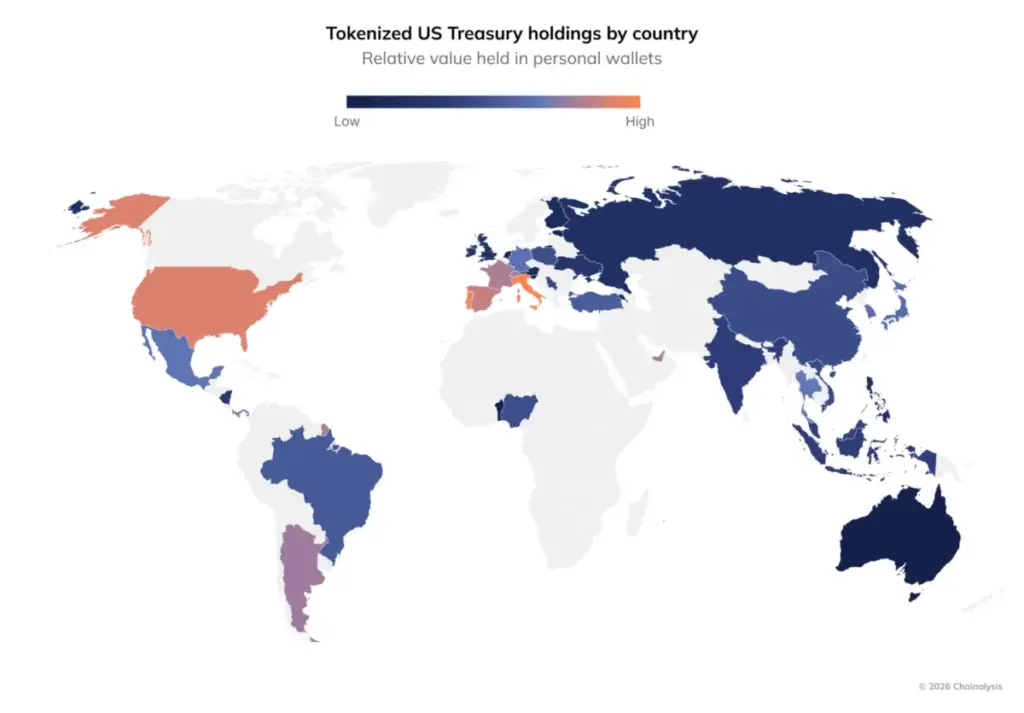
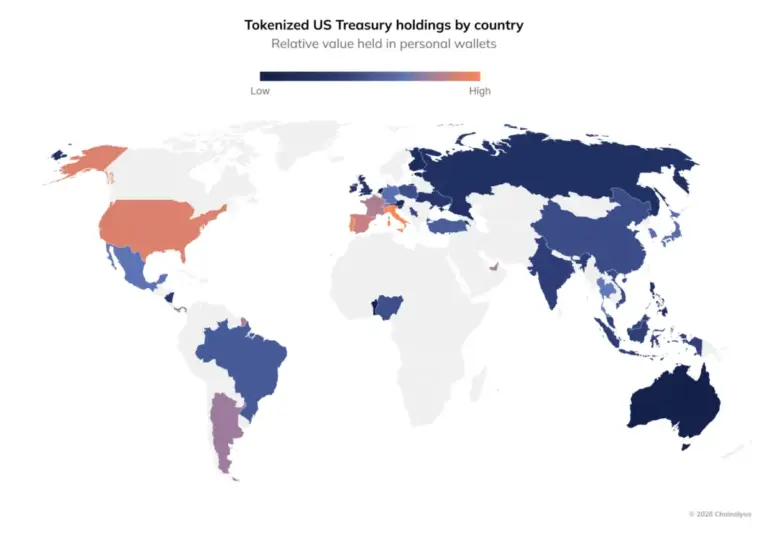
Interestingly, retail holders outside the United States drive a substantial portion of tokenized U.S. Treasury demand. While American investors make up roughly 11.7% of the global tokenized RWA holder base, geolocated data reveals that European and Asian jurisdictions—including Italy, Portugal, Singapore, and Japan—represent significant shares of the underlying capital and holder distribution. By lowering minimum investment thresholds and eliminating the requirement for traditional brokerage relationships, tokenization allows retail investors abroad to directly purchase wholesale U.S. sovereign debt.
Canada Becomes a Global Leader in Peer-to-Peer Crypto
Canada maintained its position as the second-largest crypto economy in North America, with total on-chain value growing 2.3% to reach $247.7 billion between July 2025 and June 2026. Despite its developed banking infrastructure, Canadian residents are adopting cryptocurrency for everyday use at rates far exceeding most peer nations. Among G7 countries, Canada boasts the most robust peer-to-peer crypto economy, ranking seventh globally in both domestic and cross-border flows.

Stablecoins capture a growing share of Canadian cryptocurrency trading volume, accounting for 44% of Canadian dollar-based order book activity by June 2026, up from 30% a year prior. USDC dominates this sector, while Canadian dollar-backed stablecoins represent a negligible fraction of trading volume. This reliance on U.S. dollar-denominated stablecoins has drawn scrutiny from policymakers concerned that domestic capital is indirectly supporting foreign sovereign debt rather than Canadian alternatives.
Canada’s vibrant cross-border crypto economy is heavily influenced by its diverse demographic makeup. With approximately 23% of its population born abroad—the highest proportion within the G7—Canada serves as a major remittance hub. Outbound stablecoin and bitcoin transfers directed toward key international corridors in India, China, and the Philippines reached $2.36 billion during the reporting period, reflecting a 141% year-over-year increase across millions of transactions.
The primary driver behind this shift toward crypto rails is cost efficiency. While traditional remittance channels levy average fees exceeding 6% to 7%, stablecoin transfers settle instantaneously for a fraction of a cent. Furthermore, domestic peer-to-peer transaction volumes in Canada have historically correlated with shifts in temporary visa and immigrant population trends, illustrating how individuals with active cross-border financial commitments naturally gravitate toward cost-effective digital settlement alternatives.

The Infrastructure Layer Is American, the User Base Is Global
The overarching narrative across North America’s digital asset sector in 2026 centers on infrastructure development. American institutions, corporate issuers, and technology developers occupy the foundational layers of three major on-chain markets: tokenized Treasuries, stablecoin liquidity, and autonomous AI payment rails. While the primary builders and issuers remain concentrated in the United States, the end-user base driving transaction volume is increasingly international.
Global regulatory bodies continue to introduce frameworks designed to foster local alternatives, such as the European Union’s MiCA implementation and stablecoin licensing regimes in Singapore and Hong Kong. However, bridging the gap between regulatory readiness and organic market adoption remains a formidable challenge for competing regional currencies. As new legislative measures take effect across North America and abroad, the trajectory of digital asset adoption will depend heavily on the ongoing convergence of traditional finance and blockchain infrastructure.
 Crypto Wallets & Security
 Crypto Wallets & Security
 Crypto Wallets & Security