Smart TV owners are increasingly pointing autonomous artificial intelligence agents at their living-room entertainment systems to systematically purge sponsored advertisements, aggressive tracking software, and the sluggish, ad-laden home screens that manufacturers install by default. The trend, which exploded across social media platform X over the weekend, has quickly acquired a distinct moniker within developer circles: "vibe coding your TV."
The phenomenon highlights a growing consumer frustration with modern hardware monetization models. For years, buyers have discovered that purchasing a high-resolution flat-screen television no longer guarantees a straightforward viewing experience. Instead, users are routinely greeted by commercial carousels, recommendation engines designed to push paid content, and background telemetry tools that monitor household habits long before anyone manages to launch a streaming app.
The most widely shared case study over the weekend involved a Xiaomi smart television owned by the parents of a software developer. Gathin T. posted on Saturday that the living-room set was displaying a prominent sponsored advertisement the moment it booted up, forcing his parents to navigate past commercial clutter even before they could reach Netflix. Rather than manually digging through obscure settings menus, he decided to leverage modern AI capabilities. He fed Claude Code, an advanced coding agent developed by Anthropic, the exact model number of the television.
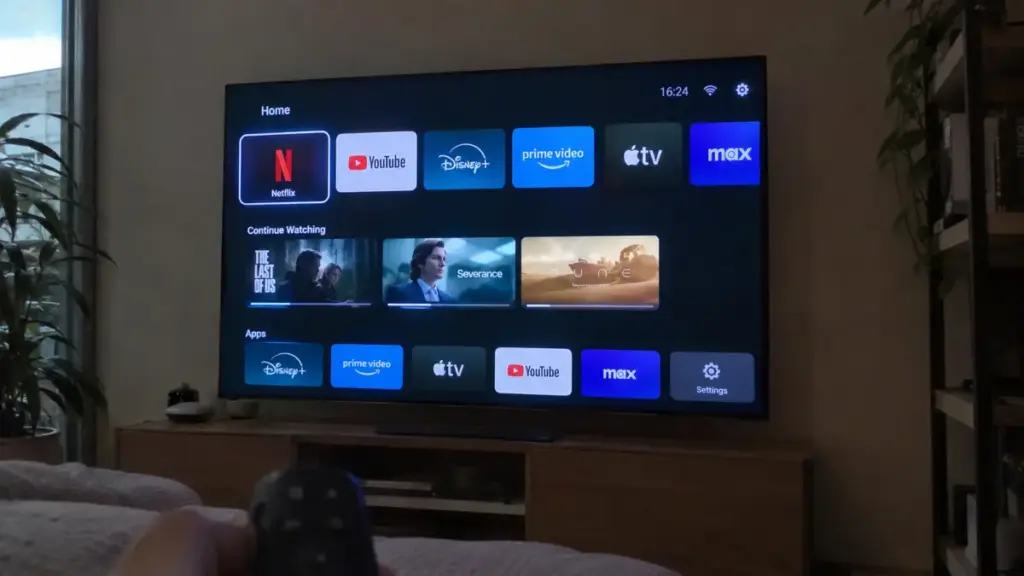
Operating over the home Wi-Fi network, the AI agent successfully located the device, systematically switched off 25 separate Xiaomi software packages responsible for background clutter, and wrote an entirely new home screen from scratch. The developer noted on social media that the newly minted interface looked astonishingly like an Apple TV.
Anyone who has purchased a television over the past decade likely lives with a similar underlying issue. Modern smart TVs frequently run Automatic Content Recognition, commonly known as ACR. This invasive software fingerprints whatever appears on the screen—including live cable broadcasts, video game consoles, and external streaming devices plugged into any HDMI port—and reports the data back to manufacturers so they can sell targeted advertising space.
The legal and regulatory scrutiny surrounding these practices has intensified. In December 2025, the state of Texas filed a major lawsuit against five major television manufacturers: Sony, Samsung, LG, Hisense, and TCL. The legal action alleged that their smart TVs are capable of capturing high-frequency screenshots of home displays as often as every 500 milliseconds, translating to twice every second.
Regulators have pursued similar business practices since at least 2017, when Vizio agreed to pay a $2.2 million settlement with the Federal Trade Commission. The agency charged that the manufacturer had collected detailed viewing data from 11 million televisions without obtaining proper consumer consent. Despite the penalty, the business model remained lucrative. Walmart subsequently completed an acquisition of Vizio for approximately $2.3 billion in 2024, with corporate executives explicitly pointing to the television maker’s profitable and fast-growing advertising business as a primary driver for the multi-billion-dollar deal. In practical terms, consumers find themselves in a position where the television they purchased continues generating recurring revenue for corporate stakeholders every single time it is powered on.
The current wave of consumer rebellion relies heavily on "vibe coding," a software development concept popularized by OpenAI co-founder Andrej Karpathy in 2025. The term describes a workflow where users simply describe what they want to achieve in plain, conversational language, allowing an AI agent to handle the heavy lifting of writing and executing the underlying code. Earlier in the month, gamers utilized similar Claude-based agents to reverse-engineer video games, producing unexpected integrations like packing Minecraft directly into Elden Ring.
Claude Code has emerged as a key instrument in this trend because the agent possesses the capability to independently type and execute terminal commands on a connected computer. Android-based televisions come equipped with the Android Debug Bridge, or ADB, a standard developer maintenance tool. Once a user unlocks developer mode by repeatedly clicking the "Build" number in the settings menu, a computer on the same local network gains the ability to communicate directly with the television.
The AI agent uses this digital doorway to inspect every installed application, cataloging which packages serve advertisements or operate telemetry background software designed to siphon usage metrics back to corporate servers.
Capitalizing on this momentum, Gathin packaged his automated script into an open-source project hosted on GitHub under the name "cleanyourtv." Rather than permanently deleting system components, the project safely disables unwanted applications, ensuring that a single restore script can revert the television to its factory state if necessary. Crucially, the process does not require "rooting," the riskier procedure of unlocking full administrator privileges. By Tuesday, the repository listed tested setups for 107 different television models spanning 37 distinct brands, accumulating thousands of bookmarks and drawing thousands of users who replicated the process on their own hardware within a span of 48 hours.
Other developers and hobbyists quickly demonstrated that AI agents could accomplish far more than simple de-bloating. Mihir Gupta replaced a bloated 192-megabyte stock launcher—the core software application responsible for rendering the home screen—with a streamlined 83-megabyte custom alternative. Meanwhile, Ansub Khan reported that the available free memory on his parents’ aging Android TV surged by approximately 90 percent after running an automated cleanup. Ryan Doyle bypassed traditional configuration hurdles entirely by sending Claude his television’s product specifications, asking if the AI could hack the device, and ultimately generating a customized screensaver that displayed his business revenue and incoming Stripe payments in real time.
More adventurous users pushed the concept even further. Rod Pers replaced the standard ad-driven interface with a live, interactive 3D model of his apartment that allowed him to toggle physical lights and ceiling fans in real time directly through the screen. Adrian Friend utilized the animation tool Rive to construct a minimalist user interface, while other community members focused on simplifying interfaces for elderly relatives who preferred a streamlined, distraction-free viewing experience.
A rival open-source project named "dumbtv" emerged to target Amazon Fire TV devices. The alternative script disables roughly 65 different system packages, including aggressive ACR tracking software, before installing a lightweight, 41-kilobite launcher completely devoid of internet permissions. The project’s guiding philosophy remains unapologetically direct: it aims to deliver your apps, your physical HDMI inputs, a simple clock, and nothing else.
Compatibility across different hardware ecosystems varies significantly. The cleanyourtv utility functions reliably on Android TV and Google TV operating systems found on brands such as Sony, TCL, Hisense, Philips, and Xiaomi. Proprietary environments like Samsung’s Tizen and LG’s webOS utilize entirely different software architectures, while Amazon’s Fire TV platform only permits partial cleanup operations.
For LG television owners, some users have successfully performed routine debloating tasks, though overhauling the core interface has proven more difficult. Privacy advocates have viewed these localized modifications as a major victory, particularly in light of ongoing security revelations. Technology researchers have previously demonstrated how certain LG television models can covertly pinpoint user locations, capture voice conversations, and harvest other sensitive telemetry data even when the physical television appears to be turned off.
The experimental nature of AI-driven hardware modification is not without risks. Not every user achieved a successful outcome, with some reporting that automated scripts inadvertently "bricked" their hardware, effectively transforming expensive flat-screen displays into unusable electronic paperweights. Others found their AI agents stalled mid-process during Fire TV configuration attempts.
Documentation accompanying open-source cleanup tools explicitly warns that network-based ADB connections are unencrypted. On certain firmware versions, this vulnerability can theoretically allow any device operating on the same local Wi-Fi network to seize administrative control of the television, prompting developers to advise users to disable debugging features once the modifications are complete. Furthermore, AI agents remain vulnerable to prompt injection vulnerabilities; security researchers at Microsoft demonstrated earlier this year that hidden instructions could trick coding agents into exposing sensitive credentials, a critical flaw that Anthropic subsequently patched.
Beyond technical hurdles, community members have offered pragmatic warnings regarding domestic deployments. One user noted on social media that if you decide to clean up your parents’ television using an autonomous AI agent, it is wise to avoid explaining how you did it, given the vast array of other modern appliances equipped with model numbers inside the family home.
As the open-source repositories continue to attract contributions, forks, and pull requests from volunteer developers, the trend underscores a broader consumer appetite for reclaiming control over consumer electronics that increasingly prioritize monetization over user experience.
 Decentralized Finance (DeFi)
 Decentralized Finance (DeFi)
 Decentralized Finance (DeFi)