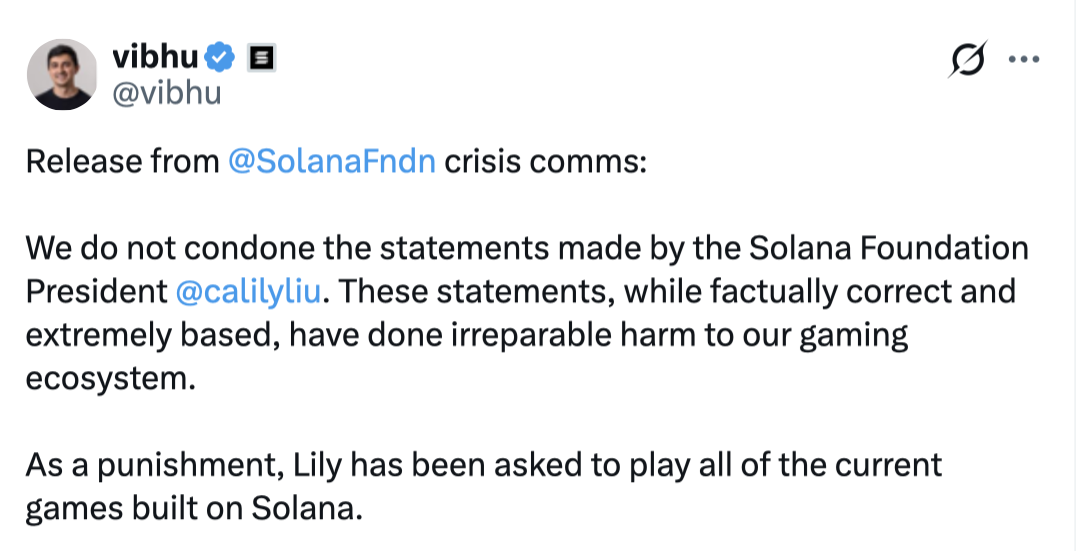
Crypto gaming hopefuls waiting for a sector comeback could be out of luck, according to a provocative social media declaration by Solana Foundation President Lily Liu. Her stark assessment has reignited a broader conversation about the state of Web3 gaming, even as developers push forward with new tools and high-profile metaverse projects attempt to weather a prolonged market downturn.
“Gaming on a blockchain is not coming back,” Liu said in a post on X, sparking an immediate and intense industry-wide debate.
The provocative post quickly gained traction, racking up nearly 900,000 views across the platform as developers, investors, and players weighed in. While the remark struck many as the crypto equivalent of low-hanging fruit given the sector’s recent headwinds, the online reaction highlighted just how sensitive the Web3 gaming community remains regarding its long-term viability.
Tone can be difficult to interpret online, but several indicators suggested Liu may have been playfully poking fun at the sensitivity of the crypto gaming faithful. Liu subsequently updated her X profile picture to an image of herself holding a gaming controller, humorously appending “head of gaming” to her existing title of Solana Foundation president.
Despite the tongue-in-cheek nature of the commentary, many staunch believers in the crypto industry quickly rejected the premise. Popular gaming streamer Yellow Panther pushed back against the sentiment, stating on X, “Gaming on blockchains is here to stay.”
Another gamer, FeranRepom, echoed that resilience, adding, “Gaming on blockchains will always be a breakthrough.”
Gamers Debate Over What Works and Doesn’t in Web3 Gaming
In Liu’s defense, the overarching sentiment surrounding the crypto gaming sector has undeniably been grim for quite some time. The challenges facing decentralized titles are multi-layered, ranging from unsustainable token economies to a fundamental disconnect between traditional gamers and blockchain mechanics.
Addressing these ongoing struggles in January, Axie Infinity founder Jeff “JiHoz” Zirlin told industry reporters that more crypto gaming studios are likely to face the chopping block throughout 2026. The attrition reflects a harsh market correction after years of overhyped promises and underdelivered gameplay experiences.
Justin Waldron, the founder of Zynga, weighed in on the discussion by arguing that Web3 gaming has faltered largely due to a foundation of false promises. According to Waldron, many early projects attempted to construct overly complex ecosystems, extended development roadmaps, and massive token economies long before taking the time to prove that everyday players actually cared about the core gameplay.
Echoing similar retrospective criticisms, VeryAI CEO Zach Melter noted that Web3 gaming “could’ve all worked out if we had just gotten existing games to use blockchains.” Rather than building entirely new, speculative economies from scratch, integrating decentralized elements into proven entertainment models might have averted many of the pitfalls that plagued the sector.
At the same time, some industry leaders are looking toward regulatory clarity as a potential turning point for the market. Immutable founder Robbie Ferguson pointed to the proposed United States crypto market structure bill, known as the CLARITY Act, as a prospective catalyst that could ignite a massive crypto gaming bull run. In a post on X, Ferguson asserted that the upcoming legislation “will make the last decade of growth in gaming look like a joke.”
Pixel Launches All-in-One Application to Tackle Play-to-Earn Problem
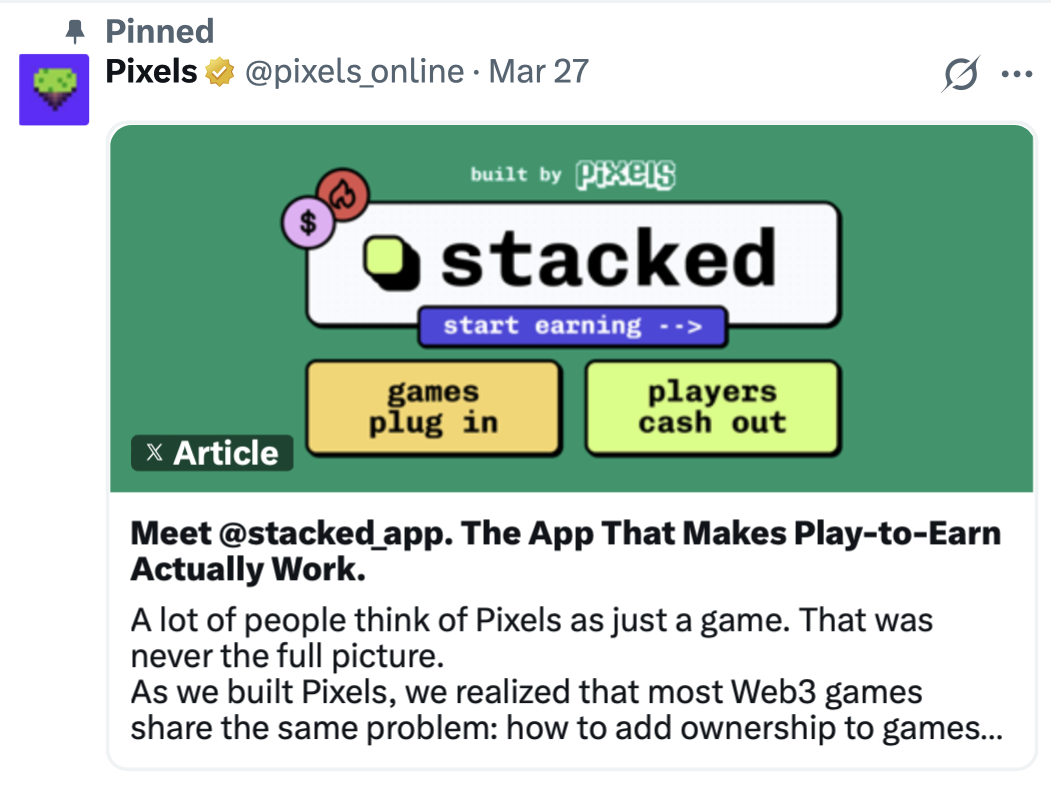
Amid the broader philosophical debate over blockchain gaming’s future, developers are actively attempting to fix the structural flaws that derailed the first wave of play-to-earn projects. Popular Web3 game Pixels has taken a major step in that direction by launching an all-in-one application dubbed “Stacked,” designed specifically to alleviate the administrative headaches that have plagued player monetization.
“For players, it is one place to: play games, complete missions, build streaks, earn rewards, and cash out across a growing ecosystem,” Pixels explained in a detailed thread on X.
The team behind Pixels acknowledged that the core difficulty of decentralized gaming was never merely a matter of placing digital assets on-chain. Instead, the real challenge has always centered on managing proper incentive alignment—a hurdle they identify as the primary reason so many Web3 titles have previously struggled to retain active audiences.
Historically, numerous play-to-earn games failed to deliver on lofty promises of sustainable real-money rewards. Instead, they bogged players down with complicated mechanics, confusing tokenomics, and messy cash-out procedures that frequently left earned tokens virtually worthless by the time users attempted to collect them.
Pixels noted that the broader market has “been chasing” sustainable play-to-earn mechanics for “a long time.” By consolidating everything into a single application, Stacked aims to allow players to claim their earnings smoothly without forcing them to juggle multiple disparate wallets or browser platforms.
Pixels founder Luke Barwikowski emphasized that the overarching design goal of the application is to redistribute “rewards to people instead of platforms.”
During its initial rollout, the application will focus primarily on games within the broader $PIXEL ecosystem, including Pixels, Pixels Dungeons, Sleepagotchi, and Chubkins. However, the roadmap leaves room for expansion as the infrastructure matures. As confidence in the system builds, Pixels intends to accelerate user acquisition, scale Stacked more aggressively, and eventually open the doors to additional business-to-business partners.
New Season of Bruce Lee Avatars Launches on The Sandbox
While developers grapple with gameplay mechanics and token structures, the metaverse and NFT sectors continue to forge ahead with high-profile brand integrations. The latest example comes from The Sandbox, which has launched the seventh season of Bruce Lee avatars as non-fungible tokens, extending an ongoing partnership with Bruce Lee Enterprises.
“Each design reflects a different side of his legacy through discipline, focus, precision, and strength in The Sandbox,” the metaverse platform stated on its official website.
The digital collectibles are aimed at a wide range of fans and collectors, with pricing structured to accommodate different budgets. Entry-level avatars start at just 19 SAND, roughly equivalent to $1.90 USD, while the rarest, legendary NFTs are priced up to 399 SAND, or approximately $30 USD.
The latest avatar drop arrives at a challenging time for the broader NFT market, which has continued to face downward pressure and recently hit five-year lows. According to data from CoinGecko, the total market capitalization of the NFT sector has tumbled 55% from its yearly high of $3.2 billion down to $1.45 billion.
The severe contraction is underscored by dramatic valuation drops across prominent collections. In February, media reports highlighted that the Bored Ape Yacht Club NFT purchased by pop star Justin Bieber for approximately $1.3 million worth of ETH in January 2022 had plummeted in estimated value to roughly $12,000, illustrating the stark realities facing digital asset collectors as the market continues to evolve.
 Non-Fungible Tokens (NFTs)
 Non-Fungible Tokens (NFTs)
 Non-Fungible Tokens (NFTs)