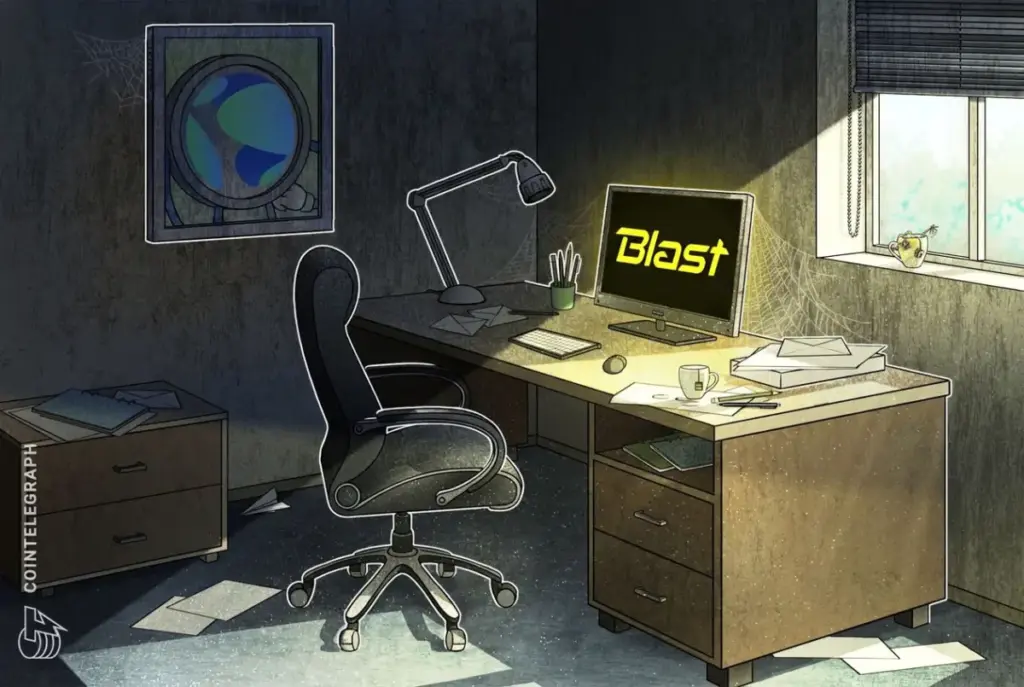
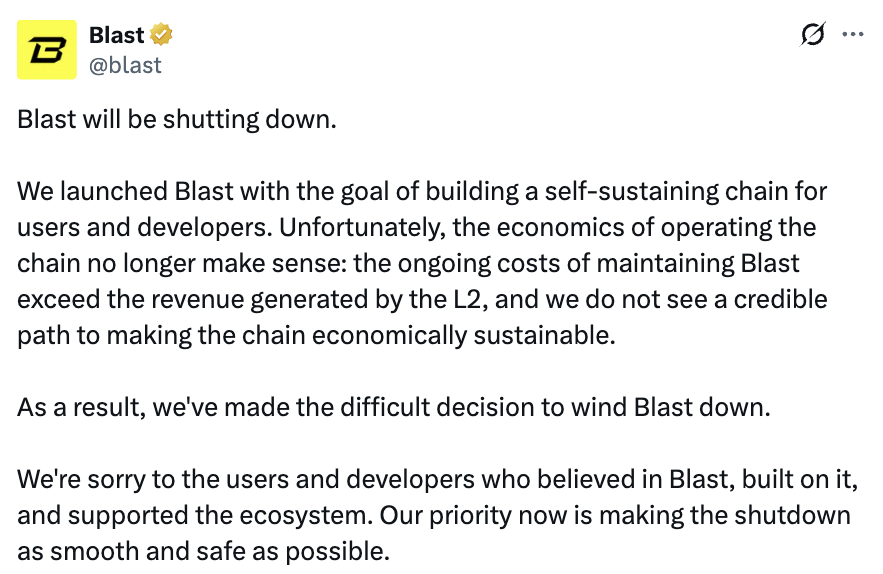
Ethereum layer-2 scaling network Blast is officially shutting down its operations after the costs associated with running the chain exceeded the revenue it generated. The sudden closure marks a significant downturn for a platform that initially captured massive attention and billions of dollars in capital during the height of its early adoption phase.
In an official post published on Friday through its social media channel on X, the Blast team stated that they see no "credible path" toward making the network economically sustainable over the long term. Consequently, the project has strongly urged all network users to begin withdrawing their digital assets back to the Ethereum mainnet as soon as possible.
"We launched Blast with the goal of building a self-sustaining chain for users and developers," the project team said in their public statement. "Unfortunately, the economics of operating the chain no longer make sense."
To facilitate a smoother exit for depositors, the network announced that it will reduce its standard withdrawal delay window down to 24 hours. However, withdrawals will be temporarily unavailable while Blast actively unwinds its underlying Lido assets, a complex administrative and technical process that is expected to take approximately one week to complete.
Following this initial wind-down phase, users will have a strict deadline until October 26 to withdraw their funds conveniently through Blast’s native web interface. After that specific date passes, user assets will technically remain accessible on-chain, but the automated interface will no longer be supported. Consequently, any subsequent withdrawals will require users to interact directly and manually with the underlying Blast bridge contracts deployed on the Ethereum mainnet.
The development team confirmed that they plan to publish clear instructions detailing how to withdraw funds directly through the bridge contracts well ahead of the October 26 cutoff. In the meantime, network administrators are strongly encouraging all community members and liquidity providers to move their assets entirely over to the Ethereum mainnet prior to the deadline to avoid unnecessary complications.
Blast Emerged From Blur’s NFT Boom
The history of Blast is deeply intertwined with the broader ecosystem built by Tieshun "Pacman" Roquerre, the prominent developer and entrepreneur who also founded the pioneering non-fungible token (NFT) marketplace Blur. Blur itself launched back in October 2022 with a clear strategy to challenge the longstanding market dominance of OpenSea. By explicitly targeting professional, high-volume traders and offering lucrative token incentives and reward systems, Blur quickly disrupted the competitive landscape.
By the end of 2022, Blur had successfully surpassed OpenSea in total trading volume. It continued to extend its market lead through early 2023, largely fueled by a highly anticipated token airdrop and aggressive trader reward mechanics that incentivized constant market participation. Building upon the massive momentum and community attention generated by Blur, Roquerre unveiled the concept for Blast in November 2023.
Blast was introduced to the market with a unique value proposition: it offered native yield generation capabilities on Ether (ETH) and various stablecoins, combined with a gamified points program tied to an anticipated future token airdrop. This aggressive growth strategy proved remarkably effective at capturing liquidity in a competitive layer-2 ecosystem. The marketing and incentive structure helped attract more than $2 billion in total deposits even before the network’s mainnet officially launched to the public in February 2024.
Despite its explosive initial growth and high-profile backing, Blast’s trajectory proved difficult to sustain over the long term, particularly amid a broader and prolonged downturn in the global NFT market and shifting macroeconomic conditions across decentralized finance. Data from blockchain analytics platform DefiLlama highlights the severity of the network’s decline. Blast’s decentralized finance total value locked has experienced a severe contraction, falling by more than 98% since it reached its all-time high of roughly $2.2 billion in June 2024.
This dramatic loss of capital and user engagement mirrored similar challenges faced by its sister platform. Blur has undergone a parallel decline in user activity and locked capital. While Blur’s total value locked rose above $200 million at the height of its early-2024 peak, the platform now stands at roughly $27 million, underscoring the broader cooling trend affecting the projects originating from the ecosystem.
 Non-Fungible Tokens (NFTs)
 Non-Fungible Tokens (NFTs)
 Non-Fungible Tokens (NFTs)