The Ethereum layer-2 scaling network Blast is officially shutting down its operations after finding that its ongoing operating costs have significantly exceeded the revenue generated by the blockchain.
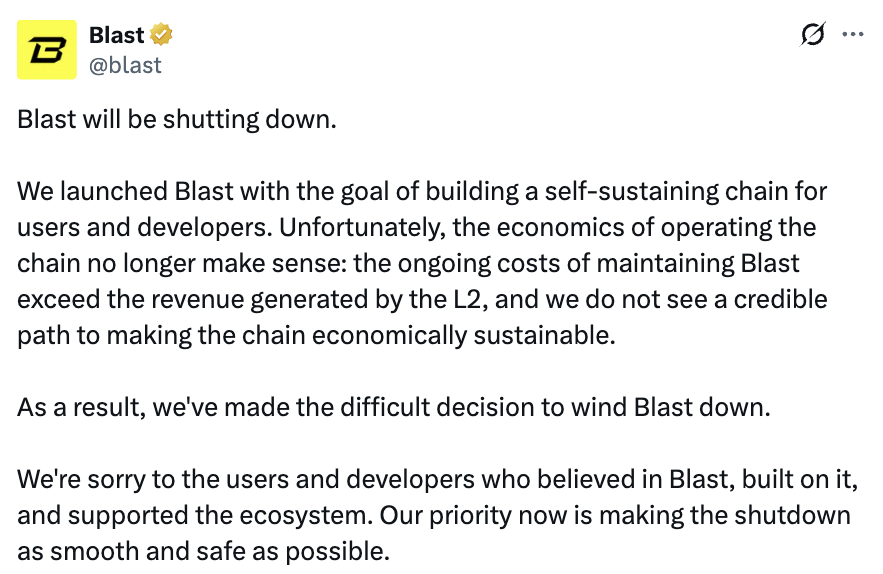
In an official announcement published on Friday through a post on the social media platform X, the Blast team revealed that they currently see no credible path forward to achieving long-term economic sustainability for the network. Consequently, the project leadership has strongly advised all users and community members to promptly withdraw their deposited assets back to the Ethereum mainnet.
"We launched Blast with the goal of building a self-sustaining chain for users and developers," the project team stated in their official communication on X. "Unfortunately, the economics of operating the chain no longer make sense."
As part of the wind-down process, the network has announced that it will reduce its standard withdrawal delay period down to 24 hours. However, the team noted that withdrawals will be temporarily unavailable while Blast completes the technical process of unwinding its underlying Lido assets, a procedure that is currently anticipated to take approximately one week to finalize.
Users have been given a specific deadline of October 26 to execute their withdrawals smoothly through the official Blast user interface. After this critical date passes, user assets will technically remain accessible, but retrieving them will no longer be as straightforward. Instead, users will be required to interact directly with the underlying Blast bridge contracts deployed on the Ethereum mainnet to reclaim their funds.

To assist the community during this transition, Blast stated that it will publish comprehensive instructions detailing how to withdraw funds directly through the bridge contracts ahead of the October 26 cutoff date. The network continues to urge all participants to move their digital assets back to the Ethereum mainnet well before the deadline to avoid any potential friction or administrative hurdles.
Blast Emerged From Blur’s NFT Boom
The origins of the Blast network trace back to the height of the non-fungible token market boom, closely tied to the ecosystem of the NFT marketplace Blur. Blast was originally founded by Tieshun "Pacman" Roquerre, the visionary creator behind Blur.
Blur itself launched in October 2022, aggressively challenging established market leaders like OpenSea by targeting professional NFT traders with lucrative token incentives and specialized trading tools. By the end of 2022, Blur had successfully surpassed OpenSea in overall trading volume, extending its dominant market lead into early 2023. This explosive market entry was heavily fueled by a strategic token airdrop and ongoing trader rewards programs that captured the attention of the broader cryptocurrency community.
Capitalizing on the momentum and user base built by Blur, Roquerre unveiled the concept for Blast in November 2023. The layer-2 network was introduced with unique value propositions, including native yield generation on Ether and popular stablecoins, alongside an ambitious points program tied to an anticipated future token airdrop.
This aggressive marketing and yield-focused strategy proved remarkably successful in attracting capital. Blast managed to draw in more than $2 billion in total deposits before its mainnet officially launched to the public in February 2024.
However, despite its explosive initial growth and high-profile backing, Blast’s upward trajectory proved difficult to maintain over the long term, particularly amid a broader and prolonged downturn in the global NFT market and shifting decentralized finance sentiment.
According to data compiled by DefiLlama, Blast’s decentralized finance total value locked has experienced a severe contraction. The network’s TVL has fallen by more than 98% since reaching its peak of roughly $2.2 billion in June 2024.
The decline has mirrored similar struggles within the broader ecosystem of its sister platform. Blur has undergone a comparable downturn in recent years. The marketplace’s total value locked, which surged above $200 million during its early-2024 peak, has since plummeted and now stands at approximately $27 million, underscoring the deep structural shifts that have impacted both protocols since their initial market debuts.
 Non-Fungible Tokens (NFTs)
 Non-Fungible Tokens (NFTs)
 Non-Fungible Tokens (NFTs)