
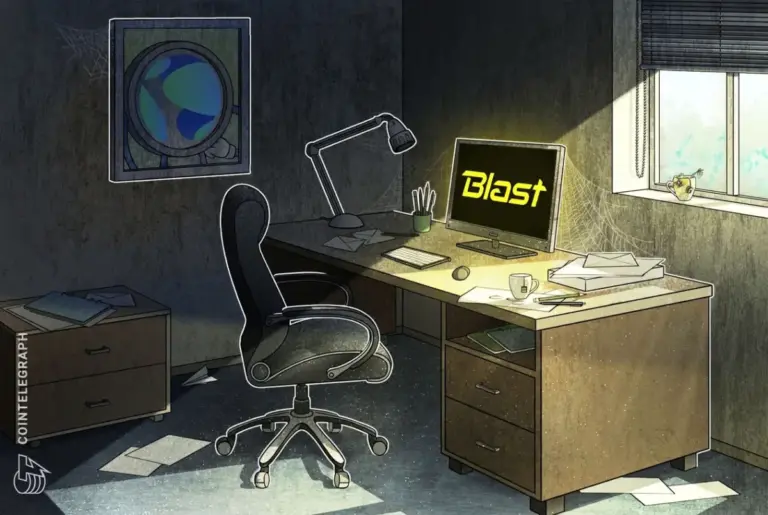
Ethereum layer-2 network Blast is officially shutting down its operations after operating costs exceeded the revenue generated by the blockchain. The sudden closure marks a dramatic fall for a network that once commanded billions of dollars in total value locked during its peak adoption phase.
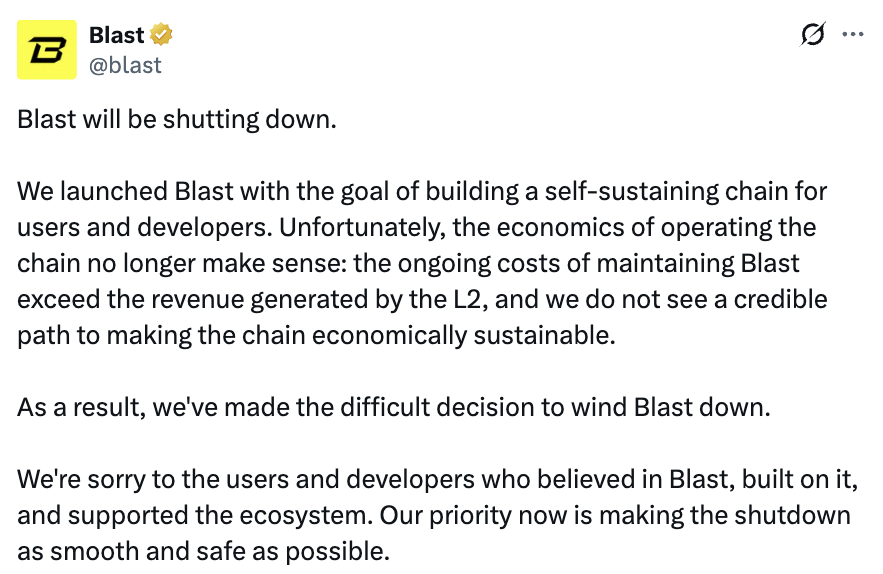
In a formal announcement posted on X on Friday, the Blast team stated that they see no credible path forward to making the network economically sustainable. Consequently, the project has strongly urged all users to withdraw their assets back to the Ethereum mainnet as the infrastructure winds down.
"We launched Blast with the goal of building a self-sustaining chain for users and developers," the team said in their public statement. "Unfortunately, the economics of operating the chain no longer make sense."
To facilitate the wind-down process, the network is immediately reducing its standard withdrawal delay to 24 hours. However, the team noted that withdrawals will be temporarily unavailable while Blast begins the complex process of unwinding its underlying Lido assets. This unstacking and liquidation process is expected to take approximately one week to complete.
Users have been given a strict deadline of Oct. 26 to withdraw their funds easily through Blast’s native user interface. After this date, assets will technically remain accessible on the chain, but retrieving them will become significantly more difficult, requiring users to interact directly with the underlying Blast bridge contracts deployed on the Ethereum mainnet.
To prepare for this transition, Blast announced that it will publish comprehensive instructions for interacting directly with the bridge contracts ahead of the Oct. 26 cutoff. The development team continues to strongly urge all participants to move their funds back to the Ethereum mainnet well before the deadline to avoid complications.
Blast Emerged From Blur’s NFT Boom
The closure of Blast brings a sobering conclusion to a project that originated at the height of the non-fungible token boom driven by its sister platform, Blur. Blast was originally founded by Tieshun "Pacman" Roquerre, the prominent developer behind the NFT marketplace Blur. Launched in October 2022, Blur quickly shook up the digital asset ecosystem by aggressively challenging the market leader, OpenSea. By targeting professional traders with lucrative token incentives and optimized trading speeds, Blur rapidly captured significant market share.
By the end of 2022, Blur had successfully surpassed OpenSea in total trading volume, extending its lead further into early 2023. This explosive momentum was fueled largely by a highly anticipated token airdrop and structured trader reward programs that drew liquidity and attention away from established competitors.
Capitalizing on this early success, Roquerre unveiled the concept for Blast in November 2023. The layer-2 network pitched a unique value proposition: native yield on deposited Ether and stablecoins, paired with a gamified points program tied to an anticipated governance token airdrop. This clever marketing and economic strategy proved extraordinarily effective at capturing crypto capital, helping the protocol attract more than $2 billion in total deposits even before its mainnet officially launched to the public in February 2024.
However, Blast’s meteoric growth proved exceptionally difficult to sustain over the long term, particularly amid a broader, prolonged market downturn within the wider NFT sector and changing macroeconomic conditions across decentralized finance. According to historical data from DefiLlama, Blast’s decentralized finance total value locked has experienced a catastrophic decline, falling by more than 98% from its all-time high of roughly $2.2 billion recorded in June 2024.
The network’s struggles mirror the trajectory of its parent ecosystem. Blur has undergone a similarly severe contraction over the past couple of years. The NFT marketplace’s total value locked, which surged above $200 million during its early-2024 peak alongside the broader market enthusiasm, has since dwindled significantly and now stands at approximately $27 million, according to on-chain tracking data from DefiLlama.
The compounding downturns across both Blur and Blast ultimately undermined the financial viability of maintaining the layer-2 infrastructure, leaving the team with little choice but to wind down operations and direct users to safety on the Ethereum mainnet.
 Non-Fungible Tokens (NFTs)
 Non-Fungible Tokens (NFTs)
 Non-Fungible Tokens (NFTs)







