The Central and Southeast Asia and Oceania (CSAO) region continues to demonstrate remarkable diversity in its digital asset adoption, even as its overall crypto economy experienced a modest contraction of 6.8% between July 1, 2025, and June 30, 2026. While overall economic activity slowed down during the global bear market, the region recorded notable upticks across a wide variety of use cases, ranging from tokenization and corporate treasury management to cross-border settlements and retail peer-to-peer (P2P) transfers.
Market dynamics varied significantly from country to country. In established financial centers like Singapore and Australia, institutional participation gained substantial ground. Meanwhile, countries such as the Philippines, Thailand, and Vietnam saw peer-to-peer activity comfortably outperform global trends. In India, crypto as a speculative and investable asset remained strong despite a sharp contraction in overall market volume. Across much of the broader region, stablecoins rapidly evolved into a preferred mechanism for moving value efficiently across borders.
The Region’s Largest Crypto Economies
Singapore recorded the largest measured crypto economy in the CSAO region, generating $284 billion in digital asset activity during the 2026 reporting period, representing a robust 55.4% increase year-over-year. A significant portion of Singapore’s expansion was fueled by institutional-platform activity, which surged 94% to reach $60 billion. This high-volume activity was largely concentrated among a select group of market makers, over-the-counter (OTC) trading firms, and institutional brokerages. Furthermore, the city-state’s growth remained well-balanced, highlighted by a 30% increase in capital flows into centralized exchanges (CEX) and a 69% increase in flows into decentralized exchanges (DEX).

Australia followed closely as the region’s second-largest digital asset market, recording $173.1 billion in economic activity. Although total activity dipped by 5.6%—largely driven by a significant decline in DEX value flows—both centralized exchange volumes and institutional platform activity expanded, pointing to underlying market resilience. In Australia, institutional flows were predominantly concentrated within custodian and OTC desks, reflecting a maturing market structure.
India experienced one of the region’s steepest corrections, with its crypto economy contracting by 14.7% amid broader macroeconomic and market headwinds. Despite this downturn, India remains an economic powerhouse in absolute terms, registering $135 billion in crypto activity during the 2026 period. Centralized exchange activity remained particularly strong within the country, cementing India’s position as the CSAO region’s largest market by centralized exchange inflows.
Beneath Regional Decline, Pockets of Growth
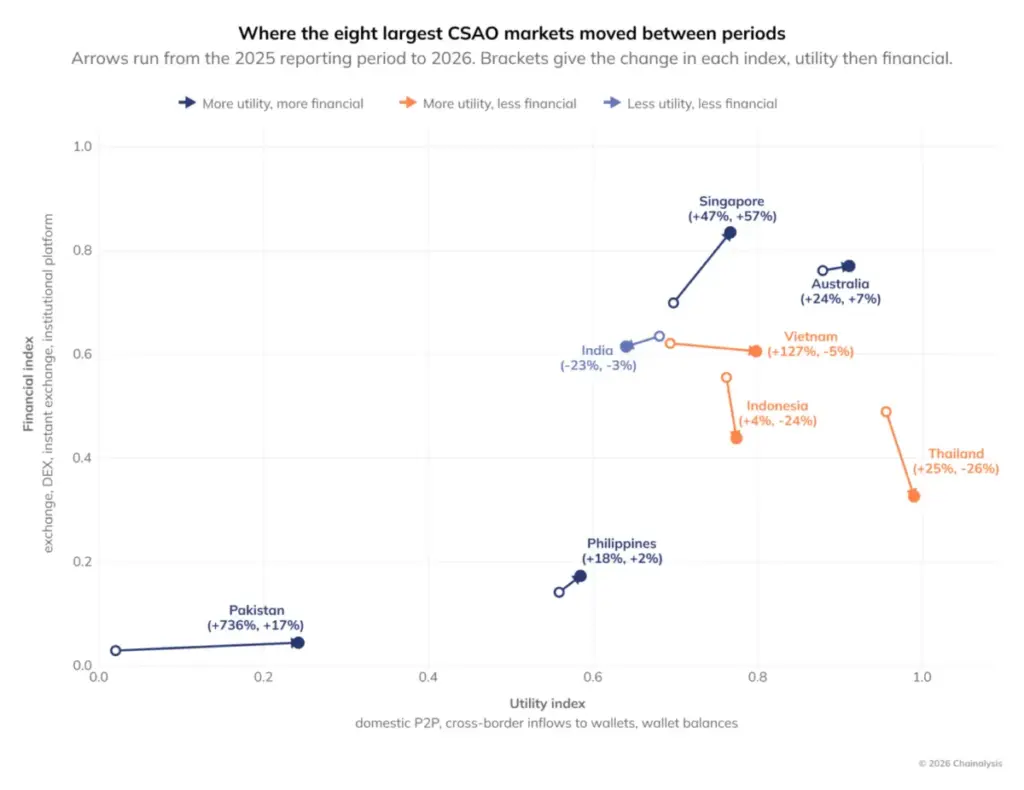
Crypto adoption is traditionally evaluated through financial activity, such as trading, staking, and lending. Analysts track these movements by monitoring where digital assets flow; capital moving into an exchange is classified as financial activity, contributing to a higher ranking on financial indexes. However, adoption is equally measured by utility—how frequently and in what ways digital assets support daily life and commerce. Activities such as P2P payments and cross-border remittances serve as primary indicators of real-world utility.

While Singapore and Australia expanded across both financial and utility indexes, other countries experienced unique growth trajectories driven by local economic conditions. Pakistan, for instance, witnessed a remarkable 736% surge in utility metrics, though this dramatic percentage increase occurred off a very shallow base. During the 2025 reporting period, Pakistan recorded just $69 million in domestic P2P and cross-border utility activity—a negligible figure globally. By the 2026 period, that figure grew to $351 million. This rebound coincided with a major regulatory pivot: in April 2026, Pakistan officially lifted a seven-year ban that had previously prohibited domestic banks from partnering with cryptocurrency companies.
Similarly, the Philippines, Thailand, and Vietnam all saw notable growth in utility functions, driven heavily by expanding P2P transfer volumes. Together, these three nations accounted for 14.4% of the global total for small-value P2P transfers during the 2026 reporting period.
Stablecoins Drive Cross-Border Settlements
A closer examination of practical crypto usage across the region reveals a striking trend: stablecoins are most prominent when deployed for cross-border transactions. In every market analyzed within the CSAO region, cross-border stablecoin activity substantially exceeded domestic stablecoin activity.

Malaysia demonstrated the widest gap, with cross-border stablecoin transactions running 29.5 times larger than domestic transfers. Across the entire CSAO region, the comparable ratio averaged 3.2 times. Experts attribute this disparity to the existence of highly efficient domestic digital payment rails in many regional economies, which minimizes the need for stablecoins in everyday local commerce. David Low, CEO of Malaysian exchange Hata, noted that stablecoins offer a relatively weak value proposition for everyday domestic payments where local banking infrastructure is already fast and reliable. Instead, the real opportunity lies in cross-border settlement.
Remittances are also driving this expansion in key markets. Nichel Gaba, Founder and CEO of the Philippine Digital Asset Exchange (PDAX), pointed out that the Philippines hosts the world’s fourth-largest remittance market. He estimated that roughly 5% to 10% of inbound remittances to the country are now settled using stablecoins, with all major remittance firms actively rolling out stablecoin settlement initiatives.
Furthermore, business-to-business cross-border stablecoin payments have become an established reality within the region’s multi-billion-dollar crypto economies. Srivatsan Tirumalai, former executive director of architecture and engineering at Singapore-based financial services group UOB, explained that corporate treasuries and regional merchants are increasingly bypassing traditional banking delays, reducing high fees, and sidestepping inefficiencies by utilizing regulated stablecoins for instant settlement.

The Philippines, Thailand, and Vietnam Beat Global P2P Growth
While stablecoins dominate cross-border settlements, certain markets are experiencing surging demand for smaller-value transfers between individuals. During the 2026 period, the Philippines, Thailand, and Vietnam collectively processed 5.4 million small-value P2P transfers under $10,000. This volume accounted for 14.4% of the global total, even though the combined population and market size of the three nations represent just 2.5% of the worldwide crypto economy.
The vast majority of these domestic transfers—more than four out of five—were valued at under $1,000, with an average transfer size of $618, compared to a global average of $1,210. In Vietnam, this growth is largely driven by economic necessity. Nicole Nguyen, co-founder of APAC DAO, explained that stablecoins are increasingly utilized as an informal dollar-savings vehicle by retail users seeking protection against the continuous depreciation of the local currency, the dong. Additionally, thriving local freelance and digital nomad populations are fueling sustained peer-to-peer adoption.
Institutional Activity Gains Ground and Opens New Use Cases
Institutional participation has become an increasingly vital pillar of the region’s digital asset landscape. Institutional platforms across the CSAO region—including market makers, prime brokers, OTC desks, custodians, and institutional-only exchanges—processed a combined $152.3 billion during the reporting period, marking a 40% increase year-over-year. By the end of the second quarter of 2026, the share of institutional-platform activity across all regional transactions rose to 18.9%.

Traditional financial institutions, including commercial banks and asset managers, are actively exploring how blockchain infrastructure and digital assets can be integrated into their existing product offerings. Singapore and Australia are leading this institutional evolution. Nicolas Gilardi, head of risk and compliance at Australian exchange BTC Markets, noted that the defining shift of 2026 was the transition of crypto from a primarily retail-driven phenomenon to an asset utilized for collateral, settlement, and tokenized financial instruments.
In Singapore, market conversations have similarly broadened beyond speculative trading returns to encompass payments, corporate treasury management, and market infrastructure development, according to Daniel Yang, head of compliance at QCP Group. In emerging markets like Malaysia, Indonesia, and Thailand, traditional financial institutions are similarly shifting their internal dialogue from whether they should engage with digital assets to determining how they can participate safely and effectively.
Australia’s Crypto Market Broadens
Australia’s institutional-platform growth outpaced both regional and global averages during the 2026 period. Local institutional platforms received $40 billion in inflows, accounting for nearly a quarter of all service inflows nationwide. Market makers represented 35% of these institutional inflows, while prime brokers and OTC desks drove another 19%, and custody and collateral providers accounted for 26%.

Industry leaders attribute this growth to the introduction of investment products tailored to traditional investors, including retirement accounts and regulated investment vehicles like exchange-traded funds (ETFs). Tokenization has also gained significant momentum, bolstered by collaborative public-private initiatives such as Project Acacia, a joint research project by the Reserve Bank of Australia and the Digital Finance Cooperative Research Centre exploring tokenized asset use cases in wholesale financial markets.
Moreover, enhanced regulatory clarity has strengthened confidence among institutional actors. Amy-Rose Goodey, CEO of the Digital Economy Council of Australia, highlighted the implementation of the country’s expanded anti-money laundering and counter-terrorism financing (AML/CTF) regime, alongside upcoming digital asset platform licensing frameworks scheduled to take effect through the Australian Securities and Investments Commission.
Parallel to institutional growth, Australia has experienced a marked shift in outbound cross-border payment corridors. Data shows that stablecoin transfer counts from Australia rose dramatically from approximately 100,000 transactions in the 2021-2022 period to roughly 2 million transactions in 2025-2026, while Bitcoin transfers experienced a relative decline. Furthermore, these assets are flowing toward distinct geographic regions: Australian Bitcoin flows remain heavily concentrated toward North America, reflecting deep ties to North American liquidity markets and institutional products, whereas stablecoin flows are predominantly directed toward East Asian payment and trading corridors.

Singapore Strengthens Its Position as a Regional Crypto-Finance Hub
Singapore continues to solidify its status as a premier regional crypto hub, exhibiting broad-based growth across nearly all major metrics. Industry participants credit the city-state’s success to a deliberate strategy of implementing targeted, incremental regulatory measures that provide clarity for institutional players. Key milestones include the introduction of the Digital Payment Token licensing regime and a comprehensive stablecoin regulatory framework established by the Monetary Authority of Singapore.
This regulatory clarity has directly contributed to a 94% year-over-year surge in Singapore’s institutional-platform activity, far outpacing regional and global averages. Furthermore, the local market has experienced a structural evolution away from speculative retail trading and toward institutional tokenization and wholesale liquidity management. Reflecting this shift toward institutionalization, the share of Singapore-held crypto residing in self-custody personal wallets dropped from 90% in 2020 to 48% by mid-2026, aligning with the country’s function as an advanced hub for professional trading, custody, and financial intermediation.
At the same time, Singapore has maintained its position as a consistent net recipient of cross-border crypto flows, accumulating cumulative net inflows of approximately $5 billion by mid-2026.

India’s Centralized Exchange Activity Remains Robust
India stands as the CSAO region’s third-largest crypto economy overall and its leading market by centralized exchange activity. Between July 2025 and June 2026, India-based users received $88.4 billion in centralized exchange inflows, narrowly outpacing Singapore at $82.3 billion, Australia at $79.3 billion, and Vietnam at $69.8 billion.
While India’s centralized exchange inflows have experienced volatility, their cumulative growth has closely mirrored broader regional trends. Industry leaders report that the Indian market remains predominantly investment-driven. Ashish Singhal, co-founder of CoinSwitch, observed that crypto is primarily utilized as an investable asset for buying, holding, and selling, though the investor base is steadily broadening to include older demographics and larger portfolios. Edul Patel, CEO of Mudrex, noted a similar maturation in investor mindset, with users increasingly viewing digital assets as a long-term diversification vehicle alongside equities, gold, and mutual funds.
A notable structural outlier in India remains the location of exchange usage. The share of exchange volume captured by domestic platforms dropped sharply following the introduction of a 1% tax deducted at source (TDS) on virtual digital asset transactions in 2022, shifting local volume toward offshore platforms that may not uniformly enforce identical tax compliance measures.

Outlook for Central & Southeast Asia and Oceania
The future trajectory of the CSAO region’s digital asset economy will depend heavily on the successful translation of institutional interest and everyday utility into sustainable long-term applications. Industry experts emphasize that continued growth relies on robust regulatory clarity, strong investor protection, and supportive underlying infrastructure.
As the digital asset ecosystem matures, financial institutions and market participants across Singapore, Australia, Malaysia, and beyond are increasingly viewing blockchain technology not merely as an alternative asset class, but as foundational infrastructure capable of transforming how the region executes payments, structures financial markets, and manages modern commerce.
 Crypto Wallets & Security
 Crypto Wallets & Security
 Crypto Wallets & Security